
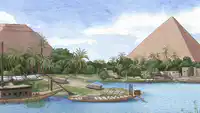
7.3.1 Egypt Under the Pharaohs

Presentation
•
Social Studies
•
6th - 8th Grade
•
Practice Problem
•
Medium

Robert Alexander
Used 1+ times
FREE Resource
18 Slides • 17 Questions
1
Topic 3 - Lesson 1
2
Introduction
Egypt developed along the Nile River and became one of the world’s earliest civilizations.
Like Mesopotamia, it formed in a fertile river valley.
Egypt’s geography and culture were very different from regions in the Fertile Crescent.
The Nile shaped farming, trade, religion, and government.
Understanding Egypt’s environment explains how the civilization grew strong and lasted thousands of years.
3
Multiple Choice
Why was the Nile River so important to Egyptian civilization?
It separated Egypt from other civilizations
It provided fertile soil, water, and a place for farming
It created mountains for protection
It produced metals needed for tools
4
The Nile River Valley
The Egyptians depended entirely on the Nile for survival.
Without it, Egypt would be dry desert.
The Nile is about 3,500 miles long, the longest river in the world.
The river has two main sources:
White Nile from Lake Victoria
Blue Nile from the Ethiopian highlands
The two rivers meet in Sudan, known in ancient times as Nubia/Kush.
5
Multiple Choice
What are the two main sources of the Nile River?
The Amazon River and the Congo River
The Red Sea and the Persian Gulf
The White Nile and the Blue Nile
The Mediterranean Sea and the Dead Sea
6
Upper & Lower Egypt
The Nile flows through six cataracts (rocky rapids) in Nubia.
These cataracts blocked travel and protected Egypt from invasions.
Below the cataracts, the river flows through a narrow valley.
This region is Upper Egypt (upstream).
Farther north, the river slows and forms a wide delta.
This region is Lower Egypt (downstream).
The delta’s rich silt created excellent farmland.
7
Multiple Choice
Why were the Nile’s cataracts important in ancient Egypt?
They made travel faster and easier
They blocked invasions and prevented upstream travel
They provided drinking water for cities
They created extra farmland for crops
8
Floods & the Black Land
The Nile flooded every summer due to heavy rains in East Africa.
Floodwaters left behind dark, fertile soil called Kemet (“the Black Land”).
The Black Land made farming possible in Egypt.
Floods could be unpredictable:
Too much water could destroy crops.
Too little water led to drought and hunger.
Outside the fertile area was the Red Land—hot, deadly desert.
9
Multiple Choice
What created the “Black Land” that Egyptians depended on for farming?
Earthquakes along the Nile
Heavy snow from nearby mountains
Floodwaters that left behind dark, fertile soil
Winds blowing sand from the desert
10
How Did Egyptian Civilization Develop
People began farming along the Nile over 7,000 years ago.
Farming created stability and food supply.
Surplus crops allowed the population to grow.
Extra food supported new jobs, communities, and religious practices.
These developments led to organized civilization.
11
Multiple Choice
How did farming help early Egyptian civilization grow?
It forced people to move away from the Nile
It encouraged people to become nomads
It created a surplus of food that supported a larger population
It made trade with other regions impossible
12
Agricultural Techniques Create a Surplus
Farmers built earthen walls to trap floodwater.
Water soaked slowly into the soil, helping grains grow.
Irrigation became important as rainfall decreased over time.
Local rulers collected surplus crops as taxes.
Surplus increased the power of leaders and supported workers.
13
Multiple Choice
What method did Egyptian farmers use to trap floodwater for their crops?
Building stone pyramids
Constructing earthen walls around fields
Digging underground tunnels
Draining all water from the soil
14
How Did Cities Develop?
Rulers used tax surplus to trade for luxury goods.
Merchants and artisans provided these goods.
Artisans began working full-time in special crafts.
People settled near rulers’ homes, forming early cities.
Cities became centers of wealth, religion, and government.
15
Multiple Choice
Why did early Egyptian cities begin to form?
Farmers settled in the desert to avoid flooding
Merchants and artisans moved near rulers who bought their goods
Pharaohs forced everyone to live in one place
Soldiers needed camps along the northern border
16
The Kingdoms of Egypt
By the 3000s BCE, Egypt had two kingdoms:
Upper Egypt (white crown)
Lower Egypt (red crown)
Around 3000 BCE, Narmer united both kingdoms.
Became the first pharaoh.
Wore the double crown to show unity.
Started Egypt’s first dynasty.
17
Multiple Choice
What was Narmer’s major accomplishment around 3000 BCE?
He built the first pyramid in Egypt
He defeated the Hittites in battle
He united Upper and Lower Egypt
He invented the first writing system
18
The Old & Middle Kingdoms
Old Kingdom (2686–2125 BCE)
Strong central government and cultural achievements.
Civil wars ended the Old Kingdom and led to the next period.
Middle Kingdom (2055–1650 BCE)
Pharaohs managed the Nile’s challenges.
Built canals to control floods and irrigate farmland.
19
Multiple Choice
What major improvement did Middle Kingdom pharaohs make?
They created a navy to sail the Mediterranean
They built canals to control flooding and irrigate farmland
They made a new language for writing
They conquered all of Mesopotamia
20
High Point & Decline
New Kingdom (1550–1070 BCE)
Height of Egypt’s wealth, military power, and empire.
Expanded into Africa and the Middle East.
After the New Kingdom, Egypt weakened due to invasions and civil wars.
Conquered by Assyrians, Persians, and then Alexander the Great (332 BCE).
21
Multiple Choice
Why did Egypt weaken after the New Kingdom?
The Nile River dried up completely
The Egyptians chose to abandon farming
Civil wars and invasions reduced Egypt’s power
All pharaohs refused to collect taxes
22
How Was Egyptian Society Organized?
Society was shaped like a pyramid with the Pharaoh at the top
Most Egyptians were farmers.
Worked on large building projects when not farming.
Slaves were often prisoners of war or people paying off debt.

23
Multiple Choice
Which group made up the largest part of Egyptian society?
Priests
Scribes
Farmers
Nobles
24
Egyptians were polytheistic and worshiped many gods.
Gods controlled nature, weather, life, and death.
Many gods had animal features.
Major gods included:
Amon-Re — sun god
Osiris — god of the underworld
Isis — mother goddess, protector
Horus — sky god; pharaohs were believed to be his human form
Religion gave the pharaoh great authority.
Egyptian Religion
25
Multiple Choice
Why did religion give the pharaoh so much authority?
Egyptians believed the pharaoh was the richest person alive
Egyptians believed the pharaoh was a god on Earth
The pharaoh forced everyone to worship him
The pharaoh controlled the weather and the Nile
26
Preparing for the Afterlife
Egyptians believed in a life after death.
Osiris judged whether a person deserved eternal life.
To reach the afterlife, Egyptians believed a person needed a preserved body.
The poor were buried in the desert.
Hot sand naturally preserved bodies.
Wealthy people were made into mummies through a special process.
27
Multiple Choice
Why did Egyptians believe a body needed to be preserved after death?
To prevent animals from eating the body
To allow the spirit to recognize and return to it in the afterlife
To keep the body warm in the cold desert nights
To store food inside the tomb
28
Hatshepsut
Hatshepsut was one of the few female pharaohs.
Became ruler when Thutmose III was too young.
Gained support by performing traditional king rituals.
Even wore a false beard as a symbol of power.
Focused on trade instead of war.
Sent a major expedition to Punt, returning with valuable goods.
Built a grand temple and brought wealth and stability to Egypt.
29
Multiple Choice
How did Hatshepsut gain support as a female pharaoh?
She removed all priests from government
She dressed and acted like a traditional male king
She banned trade with other civilizations
She ruled without building any temples or monuments
30
Thutmose III
Thutmose III became pharaoh after Hatshepsut’s death.
Known as a strong military leader.
Expanded Egypt through successful conquests.
Conquered lands in Syria, Nubia, and the Fertile Crescent.
Egypt grew richer and more powerful under his rule.
31
Multiple Choice
How did Thutmose III strengthen Egypt?
By avoiding all conflicts and staying isolated
By destroying all Egyptian cities
By leading successful military campaigns and expanding Egypt’s empire
By refusing to collect taxes from conquered lands
32
Ramses II
Ramses II ruled about 150 years after Thutmose III.
One of Egypt’s most powerful pharaohs.
Fought many battles, including the Battle of Kadesh against the Hittites.
Later made peace with the Hittites through a treaty.
Known as Egypt’s greatest builder.
Constructed many temples and monuments.
33
Multiple Choice
What is one reason Ramses II is remembered as a powerful pharaoh?
He wrote the first Egyptian law code
He built many impressive temples and monuments
He ended farming along the Nile
He forced Egyptians to move to Nubia
34
Lesson Summary
The Nile River provided fertile soil, transportation, and life for Egyptian civilization.
Surplus farming led to the growth of cities and powerful rulers.
Egypt reached its height during the New Kingdom.
Religion shaped daily life, government, and beliefs about the afterlife.
Famous pharaohs like Hatshepsut, Thutmose III, and Ramses II expanded Egypt’s wealth, power, and culture.
35
Multiple Choice
Which factor most helped Egypt become a long-lasting and powerful civilization?
Its location in the mountains
The rich resources of the Nile River
Its ability to avoid all contact with neighbors
The cold climate and heavy rainfall
Topic 3 - Lesson 1
Show answer
Auto Play
Slide 1 / 35
SLIDE
Similar Resources on Wayground

28 questions
Light and Color
Presentation
•
6th - 8th Grade
28 questions
Soil Formation and Layers
Presentation
•
6th - 8th Grade
28 questions
Organisms in the Environment Notes
Presentation
•
6th - 8th Grade
27 questions
Run-On Sentences
Presentation
•
6th - 8th Grade
27 questions
Kinetic Energy
Presentation
•
6th - 8th Grade
30 questions
End of the Civil War
Presentation
•
6th - 8th Grade
30 questions
"Over the Top" Realities of WWI
Presentation
•
6th - 8th Grade
27 questions
Primary and Secondary Sources
Presentation
•
7th Grade
Popular Resources on Wayground
10 questions
Safety Day 2026 – Student Review

Quiz
•
9th Grade
21 questions
Continents and Oceans
Quiz
•
6th Grade
20 questions
Parts of Speech
Quiz
•
5th Grade
16 questions
Subject & Predicate
Quiz
•
5th Grade
25 questions
Multiplication Facts
Quiz
•
5th Grade
12 questions
Map Skills
Quiz
•
3rd Grade
22 questions
Continents and Oceans
Quiz
•
5th Grade
15 questions
Rounding Decimals
Quiz
•
5th Grade
Discover more resources for Social Studies
19 questions
Foundations of America
Quiz
•
6th - 8th Grade
5 questions
Mesopotamia Video Quiz

Interactive video
•
6th Grade
10 questions
Exploring the Age of Exploration: Key Events and Figures
Interactive video
•
6th - 10th Grade
20 questions
Articles of Confederation
Quiz
•
8th Grade
15 questions
Middle Ages of the Middle East Vocab List (CFA #2)
Quiz
•
6th - 8th Grade
13 questions
Ancient Egypt
Interactive video
•
6th Grade
10 questions
13 Colonies: Comparing Regions
Quiz
•
7th Grade
26 questions
SW Asia History
Quiz
•
7th Grade