Search Header Logo
Mod 2.4 Enzyme Regulation

Mod 2.4 Enzyme Regulation

Assessment

Presentation

Biology

9th - 12th Grade

Practice Problem

Easy

NGSS
HS-LS2-3, HS-PS1-5, HS-LS1-1

+4

Standards-aligned

Created by

J Simmers

Used 4+ times

FREE Resource

19 Slides • 16 Questions

1

media

2

media

3

Match

Question image

Match the following Enzyme Concepts

Enzyme

Active Site

Substrate

Product

Transition state

Protein facilitates chemical reactions

Enzyme location that binds substrate

Starting reactants bind to enzyme

End result of reaction after reaction

Energetic, unstable state in a reaction

4

Multiple Choice

In the lock-and-key model of enzyme action, the ___________ fits into the __________ of the enzyme.

1

product; substrate

2

active site; product

3

substrate; active site

4

activw site; substrate

5

Multiple Choice

Which analogy best fits for enzyme function?

1

A substrate is like a skeleton key that fits into many enzymes / locks.

2

An enzyme is like a teacher that does not help students learn faster or substrates transform.

3

The interaction between enzyme and substrate is like a hug or handshake where the shape changes to make the interaction possible.

4

Enzyme functions as the stage crew for a play of the chemical reaction where the stage crew is changed by the play.

6

Labelling

Label the graph showing which line represents the activation energy with or without an enzyme.

Drag labels to their correct position on the image

activation energy WITHOUT enzyme

Energy stored in reactant

Energy stored in product

Activation energy WITH enzyme

7

media

8

Factors that affect the microenvironment, orientation, direct participation, or strain/stretch of the enzyme-substrate complex change the enzyme activity and chemical reaction

This change might be external interaction with or internal response to the environment.

9

media

10

Open Ended

Brainstorm: Why do so many factors affect enzyme activity and the chemical reactions that they catalyze?

11

media

12

media

13

Multiple Choice

Question image

For the enzyme-catalyzed reaction shown in Figure 6.2, which of these treatments will cause the greatest increase in the rate of the reaction, if the initial reactant concentration is 1.0 micromolar?

1

doubling the activation energy needed

2

cooling the reaction by 10°C

3

doubling the concentration of the reactants to 2.0 micromolar

4

doubling the enzyme concentration

14

media

15

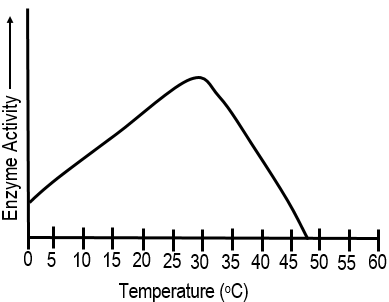
Multiple Choice

Question image
Based on the graph, what is the optimal temperature for this enzyme? 
1
15oC
2
40oC
3
30oC
4
35oC

16

media

17

Multiple Select

What levels of enzyme shape are affected by denaturation? Select all that apply.

1

Primary

2

Secondary

3

Tertiary

4

Quaternary

18

media

19

Fill in the Blanks

20

media

21

Dropdown

Allosteric means the molecule binds ​
either increasing the rate of the reaction and lowering the activation energy as an​
​ or decreasing the rate of reaction and increasing the activation energy as an​

22

media

23

media

24

Hotspot

Identify the location where a competitive inhibitor would bind

25

media

26

Drag and Drop

As part of positive feedback, a cell could overcome competitive reversible inhibition by​
Drag these tiles and drop them in the correct blank above
increasing substrate
decreasing substrate
increasing inhibitor
decreasing enzyme

27

media

28

Fill in the Blanks

29

media

30

media

31

Drag and Drop

Protein folding and protein cleavage affects enzyme​
directly
Drag these tiles and drop them in the correct blank above
shape
location
denaturation

32

media

33

Dropdown

Phosphofructokinase - an enzyme that transforms glucose into energy - is inhibited by phosphorylation​
by​
stopping glucose metabolism as ​
​feedback

34

media

35

Word Cloud

What is the evolutionary advantage of regulating enzymes? (1-2 word answer)

media

Show answer

Auto Play

Slide 1 / 35

SLIDE