Search Header Logo
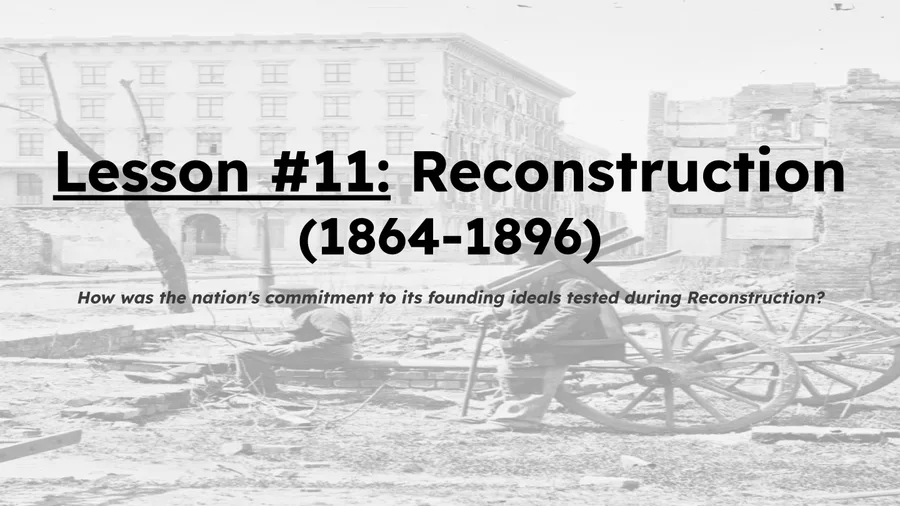
Lesson #11: Reconstruction

Lesson #11: Reconstruction

Assessment

Presentation

Social Studies

10th Grade

Practice Problem

Medium

Created by

Jacob Smith

Used 1+ times

FREE Resource

54 Slides • 22 Questions

1
media

2

media

3

media

4

media

5

Open Ended

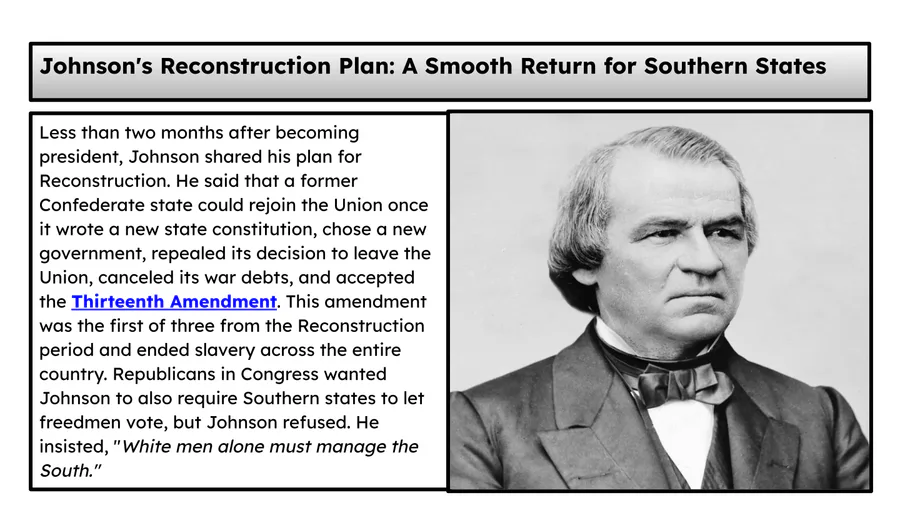
Explain the challenges faced by Vice President Andrew Johnson in bringing the country back together after Lincoln's assassination.

6

media

7

Multiple Select

Which of the following were consequences of the Civil War mentioned in the text?

1

The South was left in ruins

2

More than half a million people died

3

The North was destroyed

4

Rebuilding cities was easy

8

media

9

Open Ended

Question image

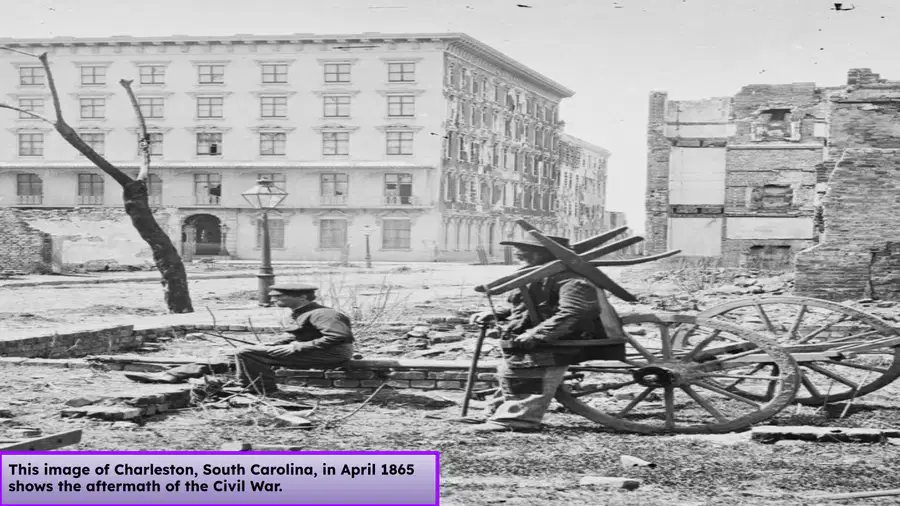
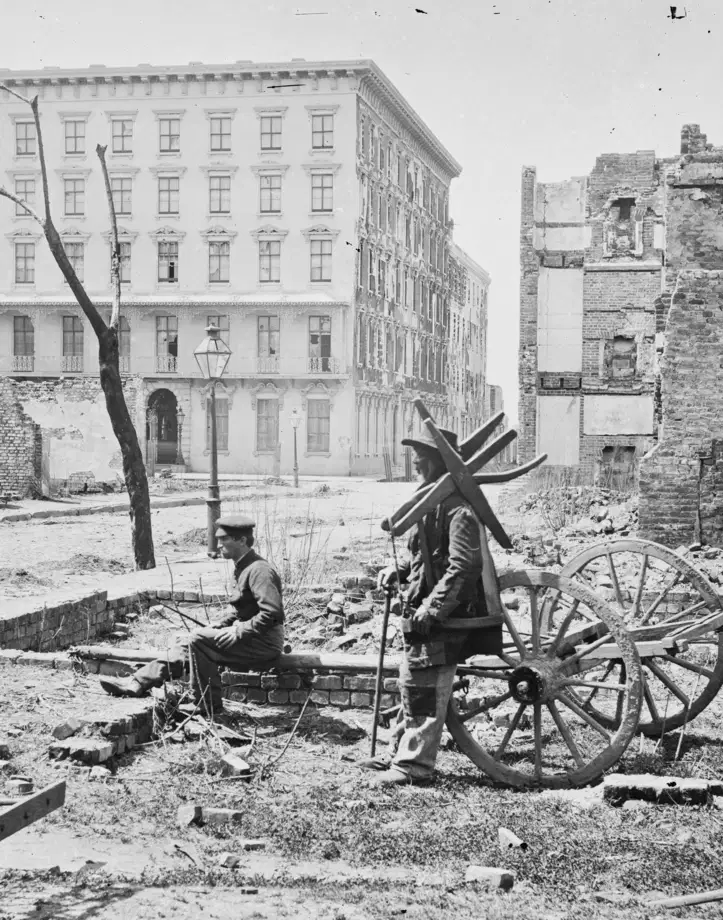
This image of Charleston, South Carolina in April 1865 shows the aftermath of the Civil War. What does the destruction in the image suggest about the difficulties of Reconstruction?

10
media

11

Fill in the Blanks

12

media

13

Multiple Choice

Which of the following Amendments to the Constitution abolished slavery?

1
14th Amendment
2
15th Amendment
3
19th Amendment
4
13th Amendment

14

media

15

Multiple Choice

Which of the following was NOT a way that freedom changed the lives of former slaves during Presidential Reconstruction?

1

They could travel freely to find family members.

2

They could legally get married without fear of separation.

3

They could immediately vote in national elections.

4

They could attend weddings and form families.

16

media

17

Open Ended

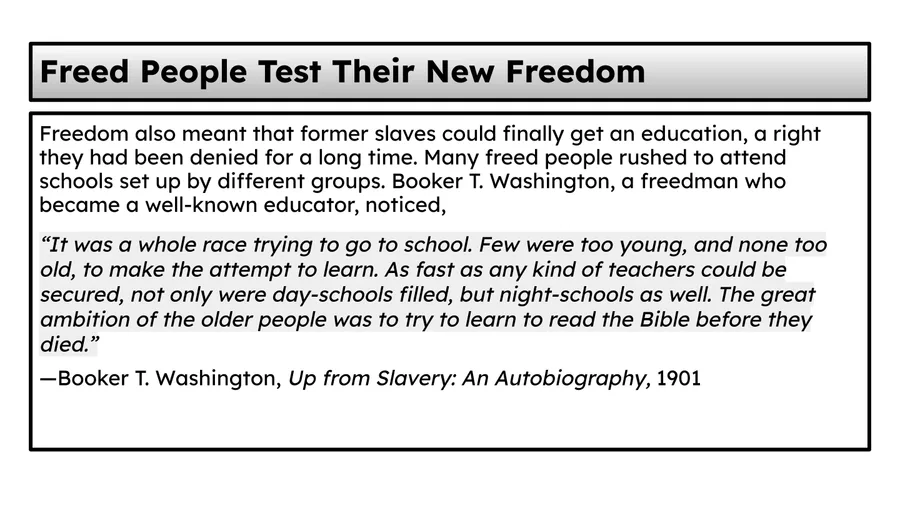
Describe how education became important to freed people after emancipation. What challenges did they face in pursuing education?

18

media

19

Fill in the Blanks

20

media

21

Multiple Select

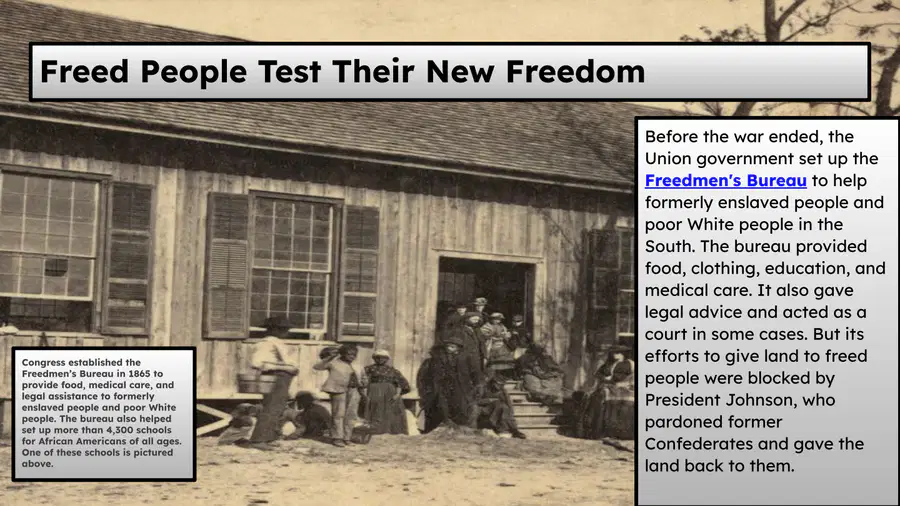
Which of the following were services provided by the Freedmen’s Bureau?

1

Food and medical care

2

Legal advice and court services

3

Setting up schools

4

Providing farmland

22

media

23

media

24

Multiple Select

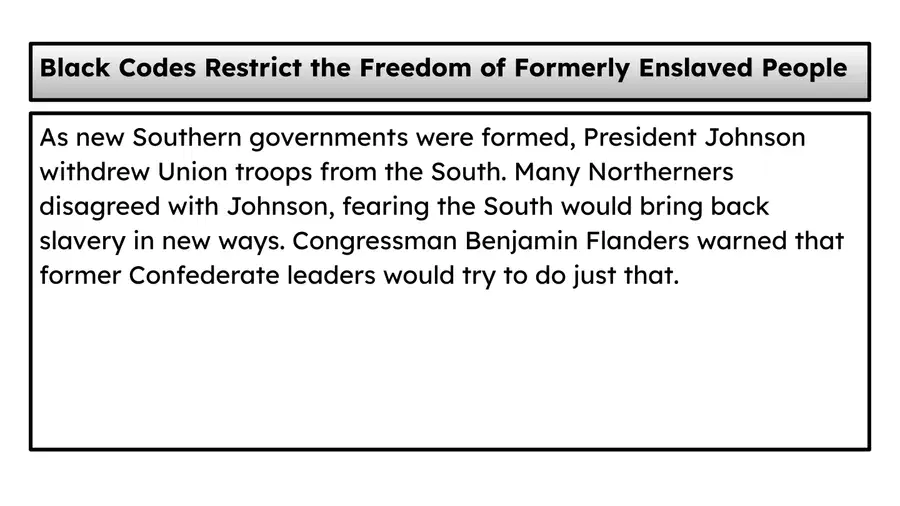
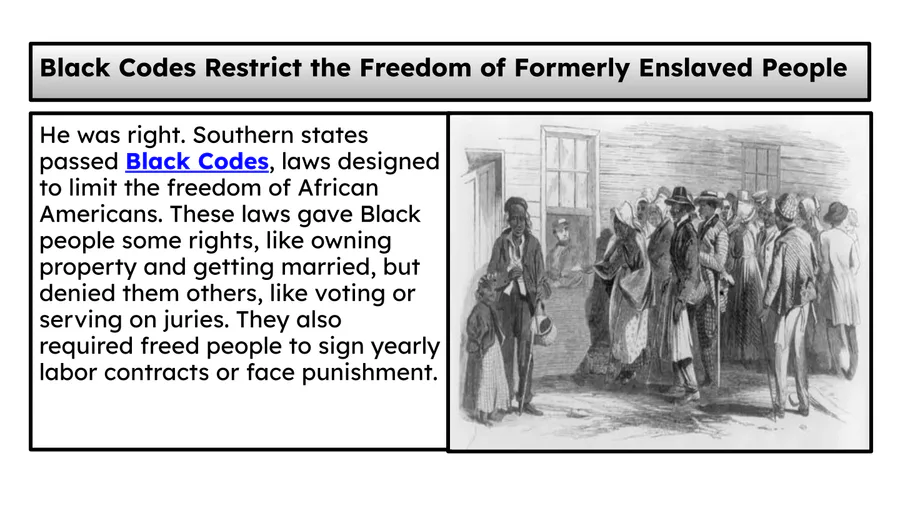
Which rights were denied to African Americans under the Black Codes?

1

Owning property

2

Getting married

3

Voting

4

Serving on juries

25

media

26

Multiple Select

Question image

In what ways did Black Codes limit the freedom of African Americans and help maintain a system that resembled slavery? (Select all that apply)

1

They deprived African Americans of basic civil rights, such as the right to vote.

2

They banned education for African Americans.

3

They required freed people to sign yearly labor contracts.

4

They restricted African Americans to jobs on farms or as unskilled laborers.

5

They required African Americans to work for their former enslavers.

27

media

28

Multiple Choice

What was the main reason many people in the North disagreed with President Andrew Johnson's approach to Reconstruction?

1

They wanted to punish the South more harshly

2

They believed the Black Codes were unfair and restricted freedom

3

They supported the return of slavery

4

They wanted Johnson to remain president

29

media

30

media

31

Multiple Select

Which of the following actions did Radical Republicans and moderates take in 1866 to help formerly enslaved people?

1

Passed the Freedmen's Bureau extension

2

Passed the Civil Rights Act

3

Passed the Fifteenth Amendment

4

Passed the Black Codes

32

media

33

media

34

Open Ended

What was the significance of the Fourteenth Amendment during Reconstruction, and how did it affect the rights of people born in the United States?

35

media

36

media

37

Multiple Select

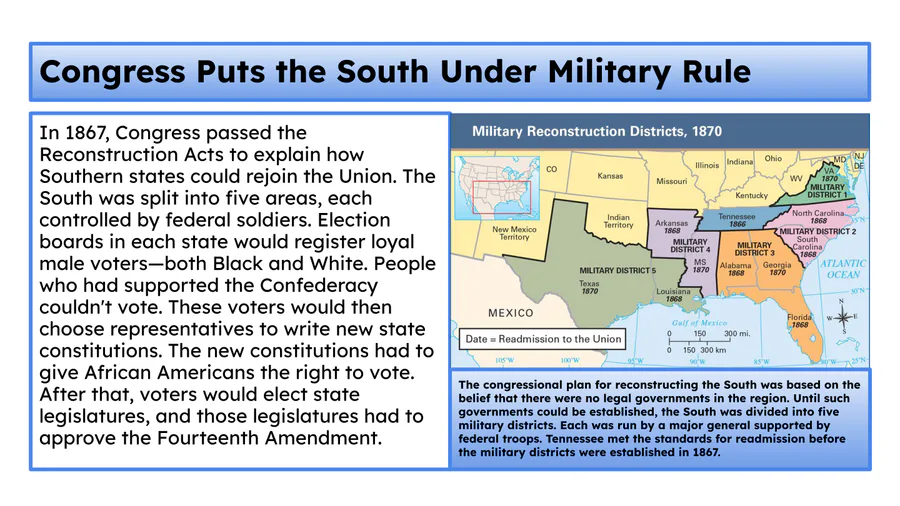
Which of the following were requirements for Southern states to rejoin the Union under the Reconstruction Acts?

1

Elect state legislatures

2

Approve the Fourteenth Amendment

3

Give African Americans the right to vote

4

Allow Confederate supporters to vote

38

media

39

media

40

media

41

Multiple Choice

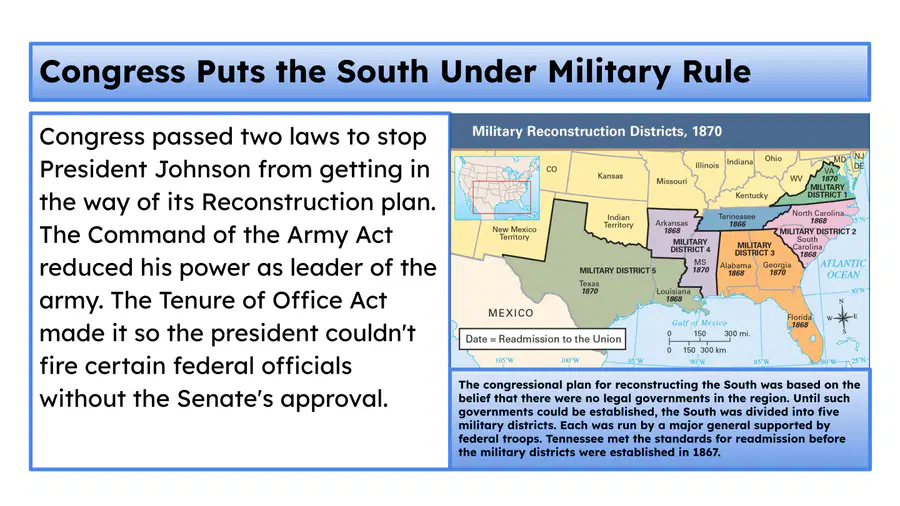
How was Congress able to take control of Reconstruction?

1

Congress passed a series of laws that granted it control over Reconstruction.

2

The Supreme Court found that Congress was better suited to handle Reconstruction than President Johnson.

3

Republicans won a two-thirds majority in both houses, enabling them to override President Johnson's vetoes.

4

President Johnson assigned Congress the responsibility of taking care of Reconstruction.

42

Match

match the following

Gave African Americans the legal rights as white citizens

Ended slavery in the United States

Prohibited discrimination based on race in public places

Fourteenth Amendment

Thirteenth Amendment

Civil Rights Act

43

media

44

media

45

media

46

media

47

media

48

media

49

media

50

media

51

media

52

media

53

media

54

media

55

Multiple Select

Select all of the TRUE statements

1

For the most part Southern states welcomed Reconstruction.

2

The 15th Amendment prevents denying an individual the right to vote based on race.

3

After Reconstruction, the South became reliant on trade & manufacturing.

4

Reconstruction governments established the South's first public school systems.

5

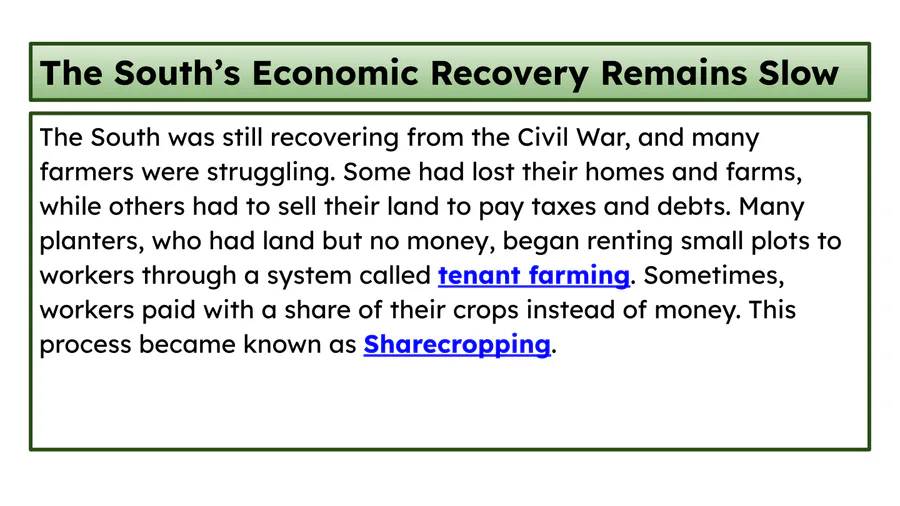
Sharecropping resulted in the sharecroppers living a life of poverty.

56

media

57

media

58

media

59

media

60

media

61

media

62

media

63

media

64

media

65

media

66

media

67

media

68

media

69

media

70

media

71

media

72

media

73

Dropdown

Question image
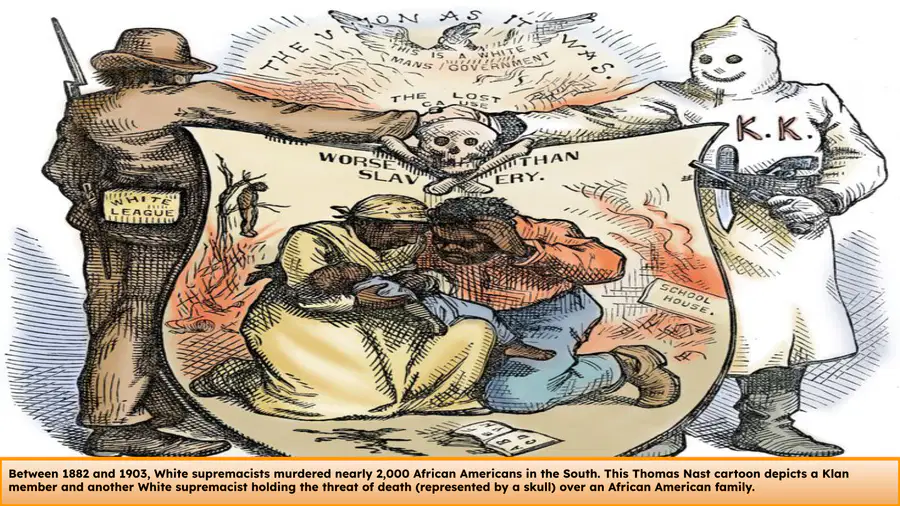
During Reconstruction, many White Southerners rejected the idea of Black people voting and holding office. This led radical White supremacists to form terror groups, such as the ​
. Northerners lost interest in Reconstruction, and after the ​
, Reconstruction ended. New legislation was passed in the South, such as the ​
, making racial segregation the norm. In 1896, the ​
case established the concept of "separate but equal."

74

Match

Match the Key Terms

Segregation was found legal under the doctrine of "separate but equal"

outlawed slavery

made formerly enslaved people citizens

gave African American men the right to vote

Plessy v. Ferguson

13th Amendment

14th Amendment

15th Amendment

75

Match

match the following Key Terms

any of the laws legalizing racial segregation of Black people and White people that were enacted in Southern states beginning in the 1880s and enforced through the 1950s

established in 1866, a secret, White supremacist terrorist group that resisted Reconstruction by harassing, threatening, and using violence against Black people

the 1896 Supreme Court case that established the controversial "separate but equal" doctrine by which segregation became legal as long as the facilities provided to Black people were equivalent to those provided to White people

a constitutional change ratified in 1870 granting Black men the right to vote

Jim Crow Law

Ku Klux Klan

Plessy v. Ferguson

Fifteenth Amendment

76

Match

match the following Key Terms

laws enacted in 1865 and 1866 in the former Confederate states to restrict freedom and opportunities for African Americans

a federal agency established in 1865, at the end of the Civil War, to help and protect the 4 million newly freed African Americans as they transitioned out of enslavement

during and after the Civil War, a member of the Republican Party who believed in and fought for the emancipation of enslaved people and, later, the equal rights of African Americans

a constitutional change ratified in 1865 abolishing slavery in the United States

a constitutional change ratified in 1868 granting citizenship to all formerly enslaved people by declaring that anyone born in the United States is a citizen; extended the rights of due process of law and equal protection under the law to Black people

Black Codes

Freedmen's Bureau

Radical Republican

Thirteenth Amendment

Fourteenth Amendment

media

Show answer

Auto Play

Slide 1 / 76

SLIDE