

L77-78: Separation of Powers and Checks and Balances

Presentation
•
History
•
8th Grade
•
Practice Problem
•
Medium

Justin Terawood
Used 7+ times
FREE Resource
9 Slides • 11 Questions
1

2
Open Ended
What would you do if you were given unlimited power?
3

4
Open Ended
How did the failures of the Articles of Confederation lead to changes in the framework of government?
5
Multiple Choice
Why was the idea of separating government powers into different branches significant for the development of the United States government?
We needed a strong central government but one that didn't threaten our liberties by becoming too powerful.
We decided that we wanted three leaders to have all the power in the United States.
This wasn't all that significant. It was kind of an accident that we just created and then stuck with afterwards.
By breaking the government into 3 branches, the founders insured that the federal and state governments had their own powers.
6
7
Multiple Choice
What does tyranny mean?
It's another word in English for a king
Cruel and oppressive rule by a leader
The biggest and scariest person in a country
A leader people don't like
8
Open Ended
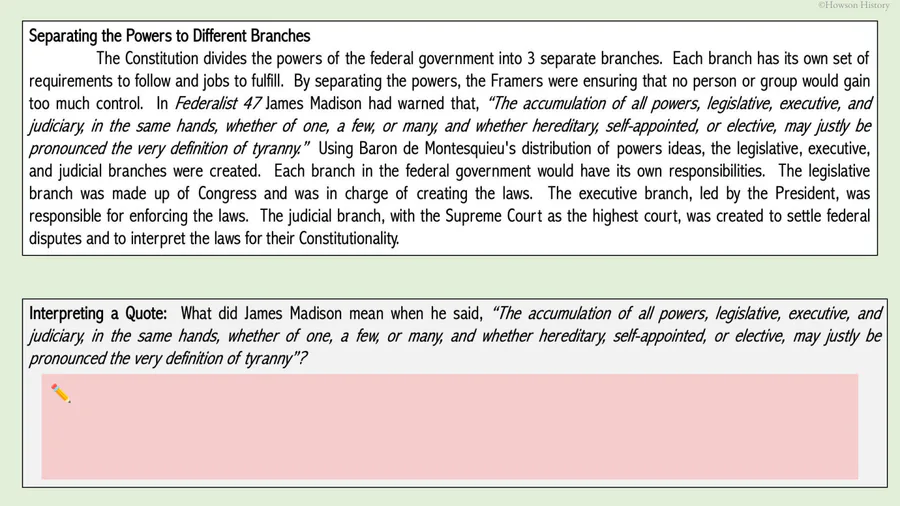
What did James Madison mean when he said, "The accumulation of all powers, legislative, executive, and judiciary, in the same hands, whether of one, a few, or many, and whether hereditary, self-appointed, or elective, may justly be pronounced the very definition of tyranny"?
9
Multiple Choice
Which of the following best describes the main purpose of separating the powers of the federal government into three branches, as explained in Federalist 47?
To make government more efficient
To prevent any one person or group from gaining too much control
To allow the President to have more power
To reduce the number of laws passed
10

11
Multiple Choice
Which responsibilities are correctly matched to their respective branches of government?
Congress - Interprets laws; President - Declares war; Supreme Court - Signs laws
Congress - Makes laws; President - Commander in Chief; Supreme Court - Interprets laws
Congress - Signs laws; President - Coins money; Supreme Court - Declares war
Congress - Pardons people; President - Approves treaties; Supreme Court - Appoints ambassadors
12

13

14
Open Ended
How did the ideas of Enlightenment thinkers, particularly Baron de Montesquieu, influence the development of the principle of checks and balances in the U.S. Constitution?
15
16
Multiple Choice
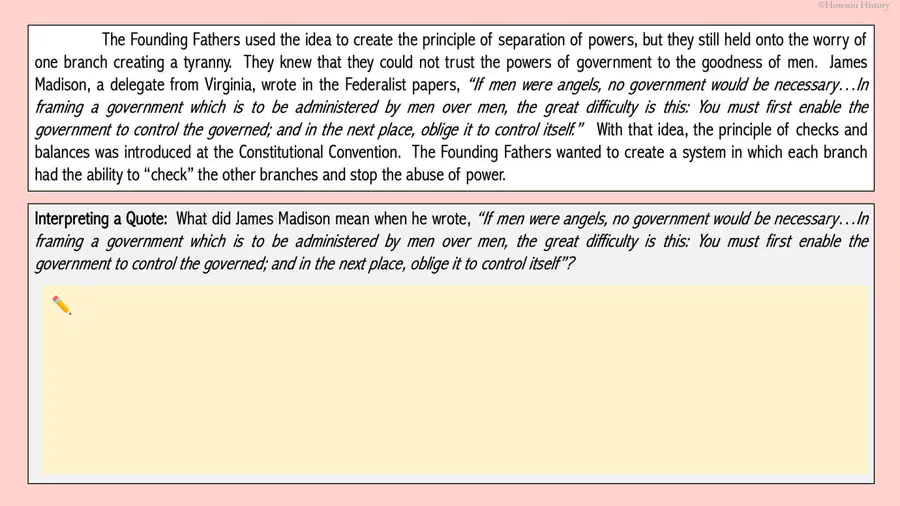
"If men were angels, no government would be necessary" is another way of saying...
if humans can, humans will
people are infinitely good
governments are created because good people exist
humans can become angels
17

18
19
Multiple Choice
How does the separation of powers prevent a tyranny?
It doesn't.
It prevents any one person or group from having all power.
It allows the people to vote for their leader, so they don't choose a tyrant.
It's just like the Articles of Confederation designed it to be.
20
Multiple Choice
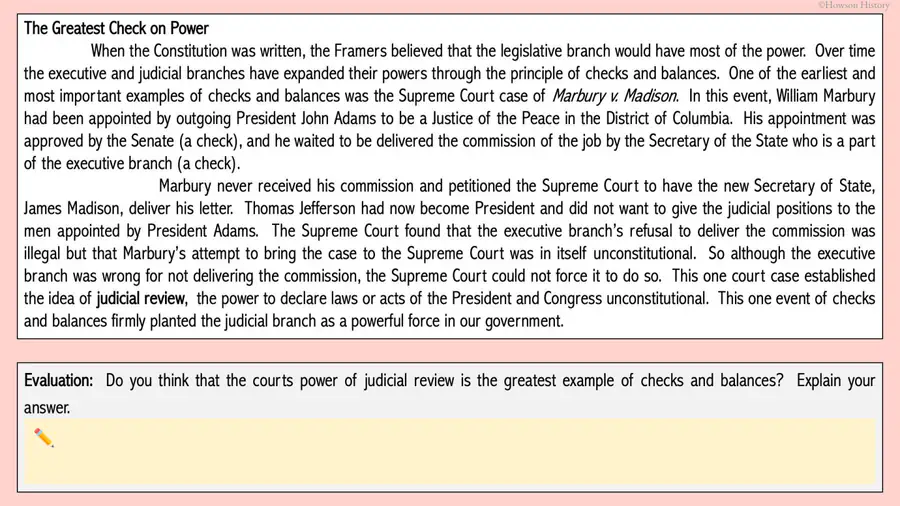
What is the purpose of checks and balances?
It gives each branch a way to make sure the others don't gain too much power.
It's the principle that gives us the right to vote for our leaders.
It's a mystery as to why the Founding Fathers did this.
It gives one branch a tyrannical power.
Show answer
Auto Play
Slide 1 / 20
SLIDE
Similar Resources on Wayground

17 questions
Chapter 16: Lesson 2
Presentation
•
8th Grade
19 questions
Civil War
Presentation
•
8th Grade
19 questions
War of 1812- Causes and Effects
Presentation
•
8th Grade
11 questions
Towards Independence: Causes of the American Revolution
Presentation
•
8th Grade
16 questions
Urbanization
Presentation
•
7th - 9th Grade
16 questions
John Adams' Presidency
Presentation
•
7th Grade
14 questions
Cheif Tecumseh
Presentation
•
8th Grade
16 questions
MAIN Causes of WWI
Presentation
•
7th Grade
Popular Resources on Wayground
10 questions
Safety Day 2026 – Student Review

Quiz
•
9th Grade
21 questions
Continents and Oceans
Quiz
•
6th Grade
20 questions
Parts of Speech
Quiz
•
5th Grade
16 questions
Subject & Predicate
Quiz
•
5th Grade
25 questions
Multiplication Facts
Quiz
•
5th Grade
12 questions
Map Skills
Quiz
•
3rd Grade
22 questions
Continents and Oceans
Quiz
•
5th Grade
15 questions
Rounding Decimals
Quiz
•
5th Grade
Discover more resources for History
15 questions
Unit 3 - Part 1 Road to Revolution
Quiz
•
8th Grade
25 questions
WWII Assessment
Quiz
•
8th Grade
25 questions
The American Revolution
Quiz
•
7th - 10th Grade
15 questions
The Bill of Rights
Quiz
•
8th - 12th Grade
18 questions
American Revolution Review
Quiz
•
8th Grade
14 questions
Weekly Wrap Up #3: CE.1a/e -Fundamental Principles
Quiz
•
8th Grade
15 questions
Ancient Rome
Quiz
•
7th - 10th Grade
16 questions
Students of Civics Unit 2: The Constitution
Quiz
•
7th - 11th Grade