Search Header Logo
termodynamics

termodynamics

Assessment

Presentation

Physics

University

Practice Problem

Easy

Created by

Faizal Jannu

Used 2+ times

FREE Resource

37 Slides • 28 Questions

1

media

2

Open Ended

NIM / ID

3

media

4

media

5

media

6

media

7

Multiple Choice

What is the definition of 'System' in the context of the universe?

1

A part of the universe being studied

2

Everything outside the system

3

The focus of the study

4

A portion of the environment

8

media

9

media

10

Multiple Select

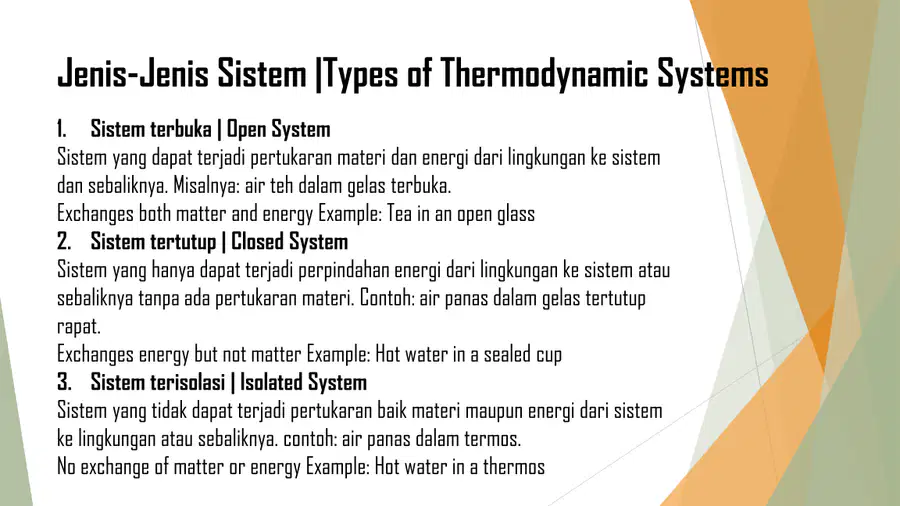
What are the three types of thermodynamic systems?

1

Open System

2

Closed System

3

Isolated System

4

Dynamic System

11

media

12

Multiple Choice

What are the differences between extensive and intensive properties?

1

Extensive properties depend on the amount of matter, while intensive properties do not.

2

Intensive properties depend on the amount of matter, while extensive properties do not.

3

Both extensive and intensive properties depend on the amount of matter.

4

Extensive properties are always larger than intensive properties.

13

media

14

media

15

media

16

media

17

Fill in the Blanks

media image

Type answer...

18

media

19

media

20

Multiple Choice

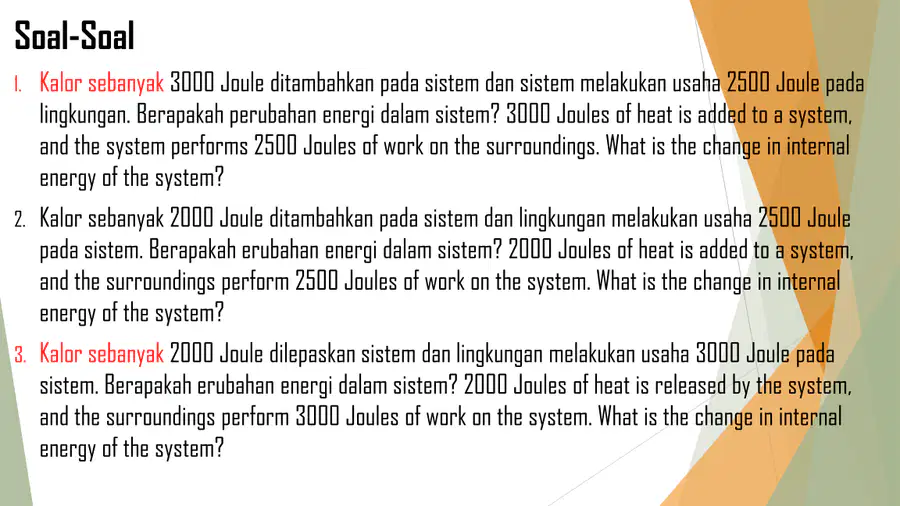
What does the equation ΔU = Q - W represent in thermodynamics?

1

Change in internal energy

2

Heat absorbed by the system

3

Work done by the system

4

Heat released by the system

21

Multiple Choice

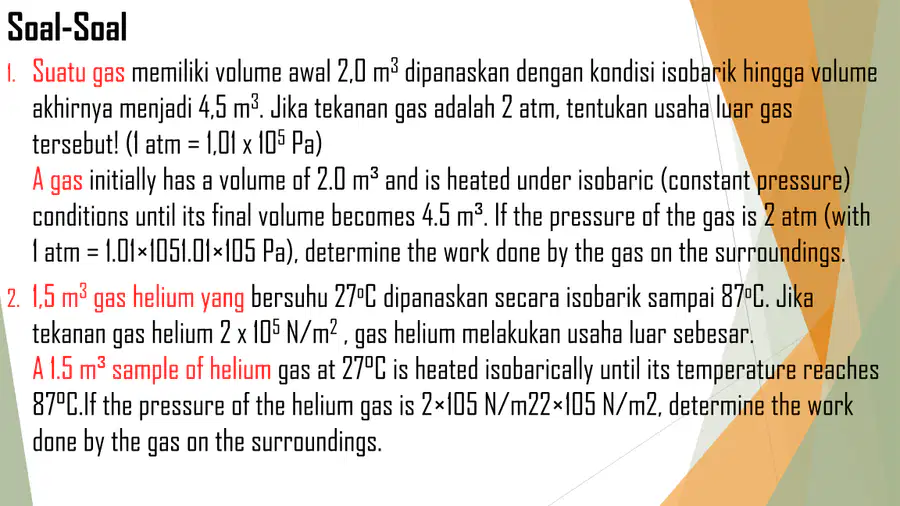
110 Joule of heat is added to a gaseous system, whose internal energy is 40 J.

Then the amount of external work done is

1

150 J

2

70 J

3

110 J

4

40 J

22

Multiple Choice

Calculate the change in internal energy (ΔU) given that W = -100 J and Q = 150 J. What is ΔU?

1

50 J

2

150 J

3

250 J

4

-250 J

23

media

24

Multiple Choice

Given the values Q = 3000 J and W = 2500 J, calculate ΔU. What is the value of ΔU?

1

100 J

2

500 J

3

2000 J

4

3000 J

25

Fill in the Blanks

26

Fill in the Blanks

27

media

28

media

29

Multiple Choice

A system undergoes an isobaric process. The system has 100 J of work done on it, and it absorbs 150 J of heat. What is the value of ΔU (the change in internal energy)?

1

250 J

2

100 J

3

150 J

4

-50 J

30

media

31

media

32

Multiple Choice

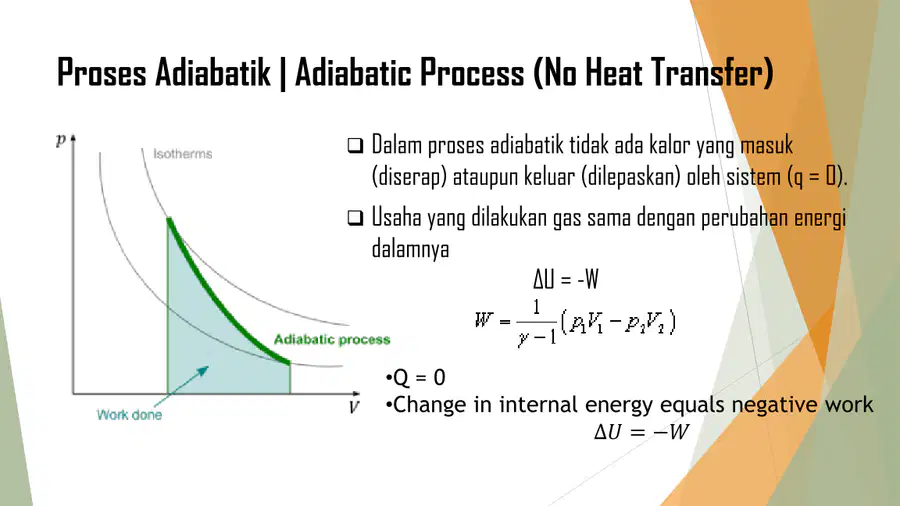
What are the four types of thermodynamic processes?

1

Adiabatic

2

Isothermal

3

Isobaric

4

Isochoric

33

media

34

Multiple Choice

What is the relationship between heat and change in internal energy in an isochoric process?

1

Heat is equal to work done

2

Heat equals change in internal energy

3

Heat is independent of internal energy

4

Heat is always negative

35

media

36

Multiple Choice

What is the formula for work done in an isobaric process?

1

W = pΔV

2

W = ΔU + qp

3

W = qp - pΔV

4

W = p + ΔV

37

media

38

Multiple Choice

What is the relationship between heat (Q) and work (W) in an isothermal process?

1

Q = W

2

Q > W

3

Q < W

4

Q = 0

39

media

40

media

41

Multiple Choice

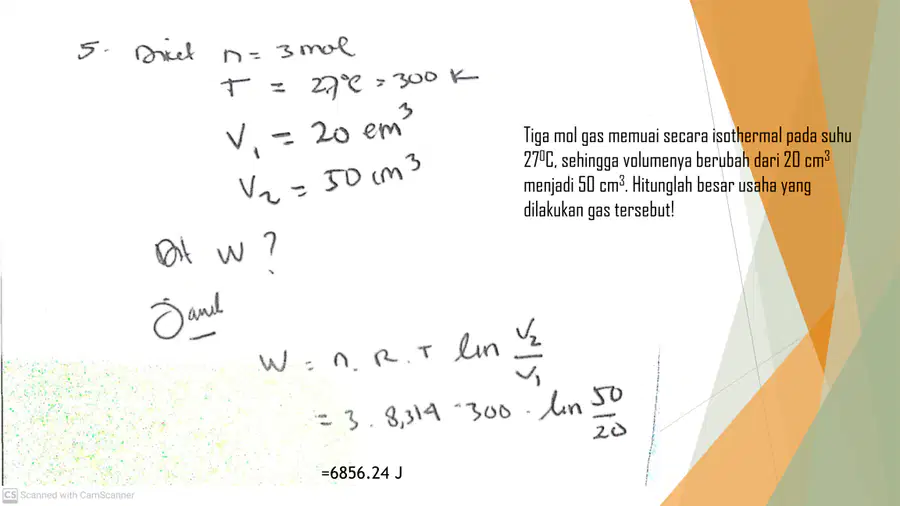
What is the work done in an isothermal process for an ideal gas?

1

W = P(Vf - Vi)

2

W = 0 J

3

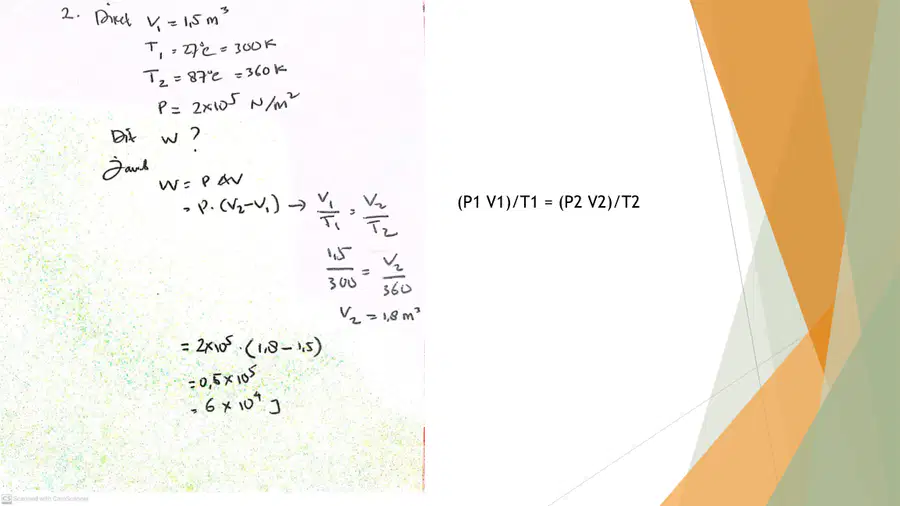
W = nRT ln(Vf / Vi)

4

W = (3/2)nR(Ti - Tf)

42

media

43

Fill in the Blanks

44

media

45

Multiple Choice

What is the work done (W) calculated using the formula W = P.ΔV?

1

2.01 x 10^5 Pa

2

5.025 x 10^5 J

3

4.5 m^3

4

2 m^3

46

Fill in the Blanks

47

media

48

media

49

Fill in the Blanks

media image

50

media

51

media

52

Fill in the Blanks

53

media

54

Fill in the Blanks

55

media

56

media

57

Fill in the Blanks

58

media

59

Multiple Choice

Question image

One mole of an ideal gas is taken through a closed cycle represented by this PV diagram. If going from point 1 to 2 is isothermal, what is true about the change in internal energy and heat going from point 2 to 3?

1

ΔU = 0, Q > 0

2

ΔU > 0, Q > 0

3

ΔU < 0, Q < 0

4

ΔU < 0, Q > 0

60

media

61

Multiple Choice

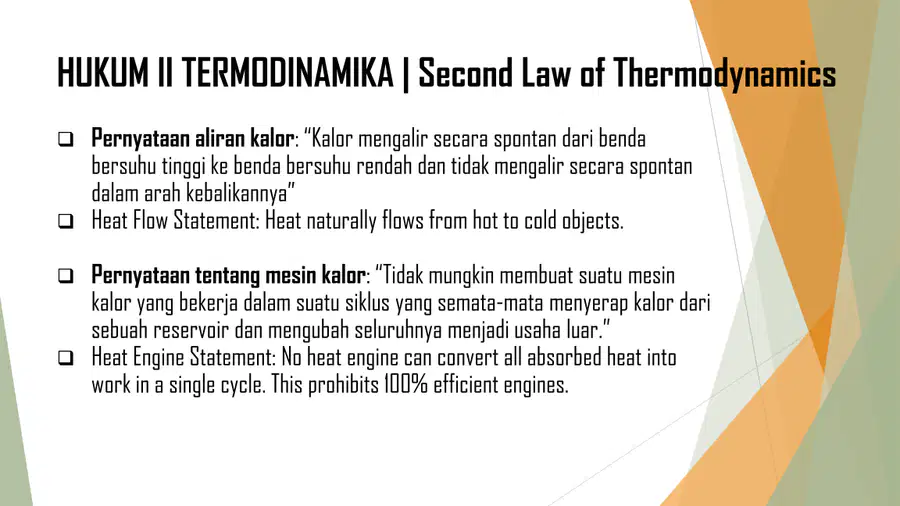
Two identical blocks of iron, one at 10 degrees C and the other at 20 degrees C, are put in contact. Suppose the cooler block cools to 5 degrees C and the warmer block warms to 25 degrees C. This would violate the
1
first law of thermodynamics.
2
second law of thermodynamics.
3
both of the above
4
none of the above

62

media

63

Multiple Select

Question image

A sample of an ideal gas can be taken from state A to state B through one of two processes AYB or AXBA\rightarrow Y\rightarrow B\ or\ A\rightarrow X\rightarrow B , as shown in the pV diagram. Which of the following will be the same for both processes?

1

The average kinetic energy of the gas

2

The temperature of the gas at the end of the process

3

The thermal energy transferred to the gas by heating

4

The work done on the gas

64

media

65

Poll

How confident do you feel about this topic now?

Very confident
Somewhat confident
Not confident
media

Show answer

Auto Play

Slide 1 / 65

SLIDE