
Search Header Logo
Lesson - Waves

Lesson - Waves

Assessment

Presentation

•

Science

•

7th Grade

•

Medium

•
NGSS
HS-PS4-1, MS-PS4-1, MS-PS4-2

+6

Standards-aligned

Created by

A. Bleecher

Used 2+ times

FREE Resource

15 Slides • 49 Questions

1

media

2

Drag and Drop

Question image
Waves move ​
without moving ​
.
Drag these tiles and drop them in the correct blank above
energy
matter
electromagnetism
mechanical
light
sound

3

Multiple Choice

Energy is measured in........

1

Wavelength

2

Meters

3

Joules

4

Frequency

4

media

5

Multiple Choice

How do electromagnetic and mechanical waves compare?

1

Mechanical waves can only travel through a vacuum, but electromagnetic waves can travel through a solid, liquid, or gas.

2

Mechanical waves can travel through a solid, liquid, or gas, but electromagnetic waves can only travel through a gas.

3

Mechanical waves can only travel through a solid, liquid, or gas, but electromagnetic waves can travel through a vacuum.

4

Mechanical waves can travel through a solid, liquid, or gas, but electromagnetic waves can only travel through a solid.

6

Dropdown

Question image
What type of wave is this?

7

Multiple Choice

Which of the following is true for sound waves?

1

They require a medium.

2

They are unrelated to vibrations.

3

They cannot travel through liquids

4

They can travel in a vacuum

8

Multiple Choice

A student asks a series of questions about a wave. The answer to which question will allow the student to determine whether the wave is electromagnetic or mechanical?

1

Does it require a medium in order to travel?

2

Can it pass through air and water?

3

Does it have a measurable speed?

4

Does it have a measurable frequency?

9

media

10

Drag and Drop

Vibrations in a ​
wave are perpendicular to the direction of wave motion AND Vibrations in a ​
wave are always parallel to the direction of wave motion.​
Drag these tiles and drop them in the correct blank above
TRANSVERSE
LONGITUDINAL

11

Match

Match the following

wave needs a medium

wave does not need a medium

particles in wave move perpendicular (right angles) to wave

particles in wave move parallel to wave

Mechanical Wave

Electromagnetic Wave

Transverse Wave

Longitudinal Wave

12

Multiple Choice

Question image

Examples of ________ waves include visible light, xrays, ultraviolet, and radio waves.

1

transverse

2

longitudinal

13

media

14

media

15

media

16

Match

Question image

Match each number with the correct part of the longitudinal wave.

1

2

3

4

Wavelength

Compression

Rarefaction

Amplitude

17

Labelling

Label the transverse wave

Drag labels to their correct position on the image

equilibrium position

amplitude

crest

wavelength

trough

18

Match

Question image

Match the following

crest

amplitude

wavelength

Trough

wavelength

A

C

B

D

E

19

Labelling

Label the following Transverse Wave with the vocabulary provided.

Drag labels to their correct position on the image

Amplitude

Rest position

Wavelength

20

Match

Question image

Match the following terms with their definitions related to longitudinal waves.

compression

rarefaction

crest 

amplitude

Where particles are packed closely together

Where particles are spread apart

Highest point of a wave

Maximum displacement from rest position

21

media

22

Drag and Drop

Question image


​
cause the medium to move perpendicular to the direction of the wave. ​
cause the medium to move parallel to the direction of the wave.
Drag these tiles and drop them in the correct blank above
Transverse waves
Longitudinal waves
Light waves

23

media

24

media

25

media

26

media

27

media
media

28

media

29

Multiple Choice

When a bat searches for prey at night, it makes sounds as it flies, and it uses the sounds echoes to find its prey. When the bat flies and listens to echoes to locate prey, it is using....

1

thermal energy and light energy

2

sound energy and thermal energy

3

mechanical energy and sound energy

4

light energy and mechanical energy

30

media
media
media

31

media

32

Multiple Choice

What does energy have to do with wavelength and frequency?

1

The higher the frequency the less energy the wave has.

2

The lower the frequency the more energy the wave has.

3

The shorter the wavelength the more energy the wave has.

4

The longer the wavelength the more energy the wave has.

33

Hotspot

The temperature outside is 20C. At what point on the graph should we look to find the speed of sound?

34

Multiple Choice

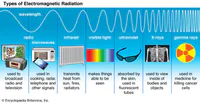
True or false: as you move along the spectrum, left to right, the wavelengths decrease in size (get smaller)
1
true
2
false

35

Multiple Choice

A wave with a large wavelength will have a ______ frequency and _____ energy
1
high, low
2
high, high
3
low, high
4
low, low

36

Multiple Choice

Select the correct order of waves on the EMS 
1
Radio, Micro, Infra, Visible, Ultra, X-ray, Gamma
2
Gamma, X-ray, Ultra, Vis, Infra, Micro, Radio
3
Vis, Micro, Infra, Ultra, X-ray, Gamma, Radio
4
Micro, Radio, Vis, Infra, Ultra, X-ray, Gamma

37

Multiple Choice

Which has the LONGEST wavelength and, therefore, the lowest frequency/energy
1
Gamma Rays
2
Radio Waves
3
Visible Light
4
Infrared rays

38

Multiple Choice

Which has the SHORTEST wavelength and, therefore, the highest frequency/most energy
1
Radio waves
2
Ultraviolet Rays
3
Gamma Rays
4
X-rays

39

Multiple Choice

Which section of the spectrum is the ONLY one we can see?
1
X-rays
2
Visible Light
3
Gamma Rays
4
Ultraviolet Rays

40

Multiple Choice

Put the visible light colors in order from longest wavelength to shortest wavelength
1
Violet, Indigo, Blue, Green, Orange, Yellow, Red
2
Red, Yellow, Green, Orange, Violet, Blue, Indigo
3
Red, Orange, Yellow, Green, Blue, Indigo, Violet

41

Multiple Choice

Which of the following electromagnetic waves is given off as heat? 
1
Radio Waves
2
Infrared Rays
3
Visible Light
4
Gamma Rays

42

Multiple Choice

The _______________ determines the color of visible light. 
1
wavelength
2
speed
3
amplitude
4
light

43

Multiple Choice

How are electromagnetic waves different from other waves? 
1
They have very short wavelengths 
2
They transmit energy instead of matter 
3
They can travel through a vacuum 
4
They can change direction by reflection 

44

Multiple Choice

Which of the following electromagnetic waves has the lowest energy?
1
gamma ray
2
infrared wave
3
visible light wave
4
microwave

45

Multiple Choice

As the frequency of an electromagnetic wave increases, the amount of energy in that wave...
1
increases.
2
decreases.
3
stays the same.

46

Multiple Choice

Which color has the highest frequency?
1
red
2
orange
3
green
4
blue

47

Multiple Choice

Which color has the least amount of energy?
1
red
2
orange
3
green
4
blue

48

Multiple Choice

Which of the following has the longest wavelength?
1
microwaves
2
visible light
3
x-rays
4
infrared waves

49

Multiple Choice

Question image
High frequency waves have _________ wavelengths.
1
varying
2
long
3
the same
4
short

50

Multiple Choice

The distance between two crests or two troughs of a wave is called:
1
frequency
2
amplitud
3
wavelength
4
hertz

51

Multiple Choice

All electromagnetic waves have the same...
1
frequency
2
speed
3
wavelength
4
energy

52

Multiple Choice

How much of the electromagnetic spectrum is visible?
1
All of it
2
None of it
3
Most of it
4
Only a small part

53

Multiple Choice

The height of the wave is known as the _____________.
1
amplitude
2
crest
3
trough
4
wavelength

54

Multiple Choice

Which is associated with Roy G Biv
1
gamma rays
2
X-rays
3
visible light
4
radio waves

55

Multiple Choice

Light waves are arranged in the electromagnetic spectrum by
1
wavelength and brightness
2
speed and color
3
brightness and color
4
wavelength and frequency

56

Multiple Choice

_______ can be used in Medicine to produce images of tissues deep inside of the body (MRI)
1
Radio Waves 
2
Infrared waves
3
Ultraviolet Rays 
4
Gamma Rays 

57

Multiple Choice

Place the following in the proper order from shortest wave length to longest wave length
1
radio waves, infrared waves, x rays  
2
gamma rays, ultraviolet, Microwaves 
3
x rays, gamma rays , ultraviolet light 
4
microwaves

58

Multiple Choice

RADAR uses this type of waves
1
Microwaves
2
Radio waves 
3
Gamma Rays 
4
Infrared waves 

59

Multiple Choice

Sunblock provides an opaque layer that prevents ______ from reaching your skin
1
Infrared Waves 
2
Microwaves 
3
Ultraviolet Rays
4
X Rays 

60

Multiple Choice

______ are DETECTED by CHARGED PARTICLES (created by their collisions between/with different atoms).These waves are very hard to detect
1
Infrared Waves 
2
Ultraviolet Waves
3
Gamma Rays
4
X-Rays 

61

Multiple Choice

______ is created by natural radioactive decay
1
Gamma Rays
2
Microwaves 
3
X- Rays 
4
Infrared Rays 

62

Multiple Choice

_______ can cause skin damage or different types of cancers if exposed to for long periods of time
1
X - Ray
2
all of the above 
3
Gamma Rays
4
Ultraviolet Rays 

63

Multiple Choice

Different colors are related to different tempertatures 
1
False 
2
True

64

Multiple Choice

In visible light, _____ has the shortest wave length and _____ has the longest
1
red, violet
2
yellow, violet
3
violet, red
4
yellow, red
media

Show answer

Auto Play

Slide 1 / 64

SLIDE
