

U9D3 Chemosynthesis and Biomagnification Mon Dec 1

Presentation
•
Science
•
9th - 12th Grade
•
Practice Problem
•
Hard
+4
Standards-aligned

Carl Alberico
FREE Resource
16 Slides • 17 Questions
1

2
3
Open Ended
How do chemosynthetic bacteria contribute to deep-sea ecosystems, and why is their energy production fundamentally different from photosynthesis?
4
Multiple Choice
Why is chemosynthesis significant in environments where sunlight is absent?
It allows organisms to produce energy using chemical reactions.
It helps plants perform photosynthesis.
It is used by animals to breathe underwater.
It is a process for decomposing organic matter.
5

6
Multiple Choice
Which of the following is NOT a characteristic of hydrothermal vent ecosystems?
Located in deep ocean regions
Characterized by high pressure and temperature
Support only photosynthetic organisms
Support diverse and unique life forms
7
8
Open Ended
Explain how chemosynthesis allows life to exist in hydrothermal vent ecosystems where sunlight does not reach.
9
Multiple Choice
Which of the following best describes the role of chemosynthetic bacteria in hydrothermal vent ecosystems?
They are top predators in the food web.
They serve as primary producers, converting chemical compounds into energy.
They rely on sunlight for energy production.
They eliminate toxins from the ecosystem.
10
11
Multiple Select
Which statements about photosynthesis and chemosynthesis are correct?
Photosynthesis uses sunlight as an energy source.
Chemosynthesis uses chemical compounds as an energy source.
Photosynthesis occurs in dark, extreme environments.
Chemosynthesis occurs in sunlit environments.
12
13
14
Fill in the Blanks
Type answer...
15
16
Open Ended
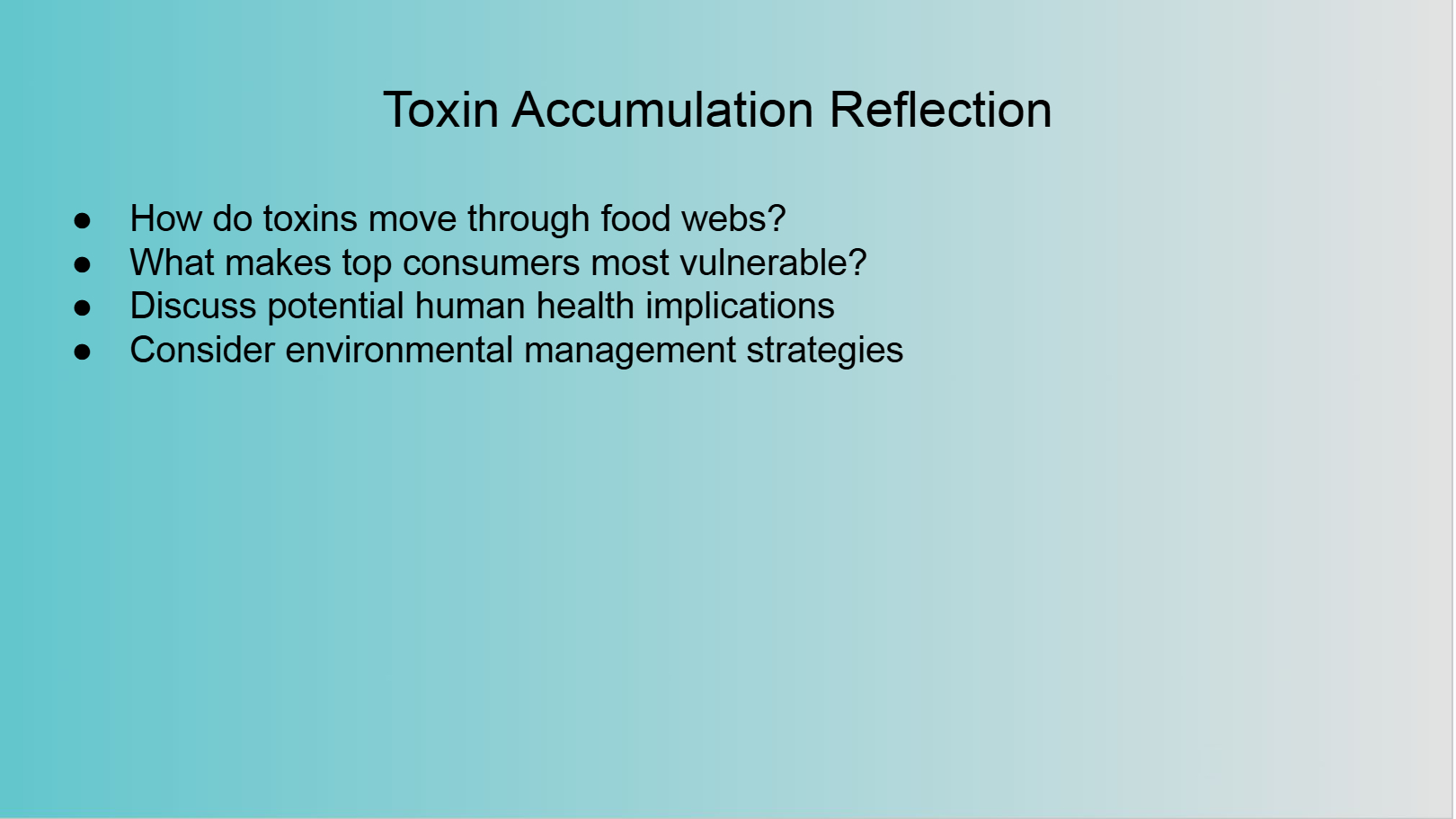
Describe the mechanism by which toxins accumulate and increase in concentration through biomagnification.
17
18
Multiple Choice
Which of the following best describes the process of biomagnification in a food chain?
Toxins decrease as you move up trophic levels
Toxins remain constant across all trophic levels
Toxins increase as you move up trophic levels
Toxins only affect producers
19
20
Fill in the Blanks
Type answer...
21
22
Multiple Select
Which of the following are roles of menhaden in their ecosystem?
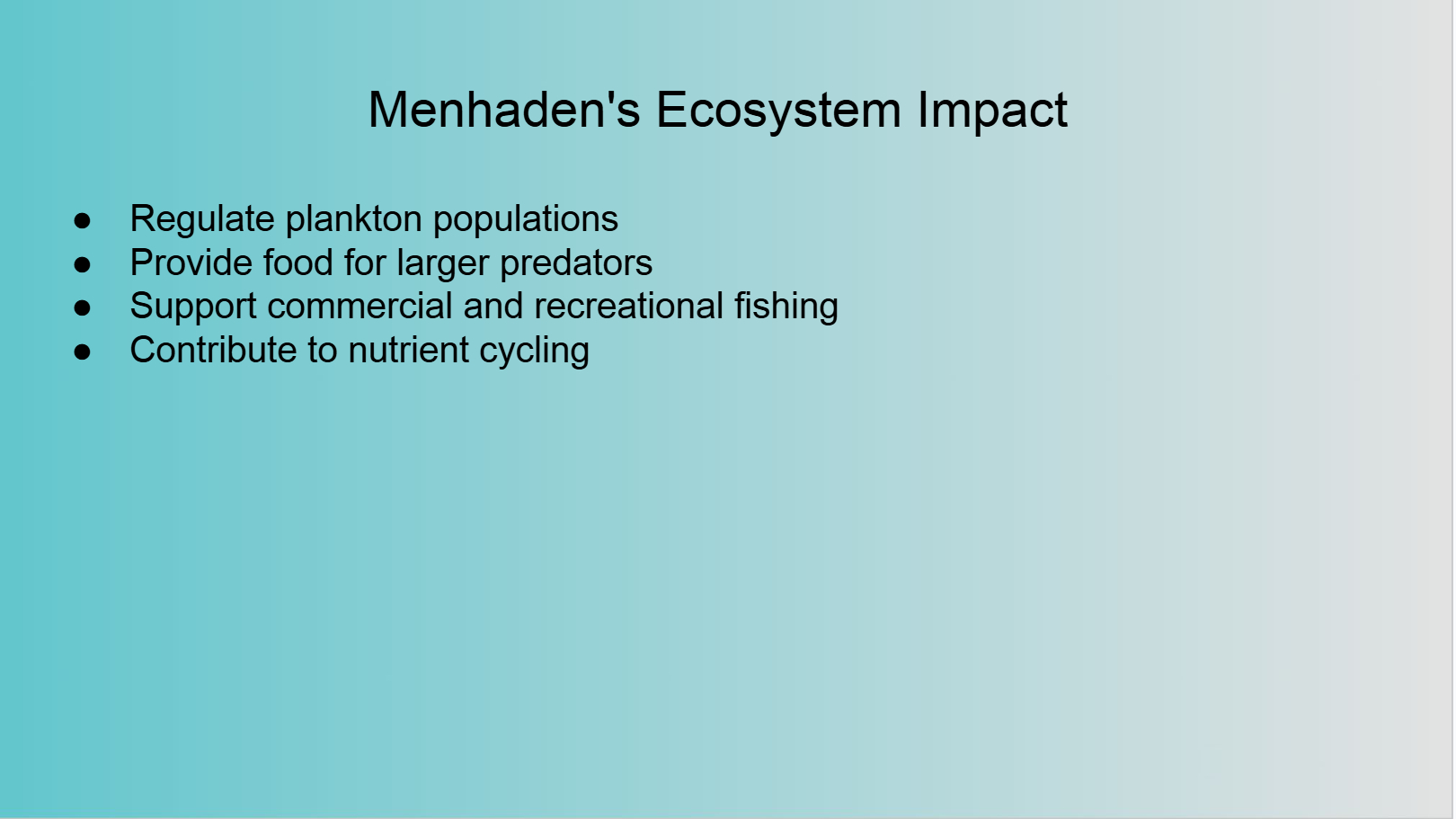
Regulate plankton populations
Serve as prey for larger species
Support commercial fishing
Increase toxin concentration
23
Open Ended
Explain how menhaden contribute to the health and balance of the Chesapeake Bay ecosystem.
24
25
26
27
Multiple Choice
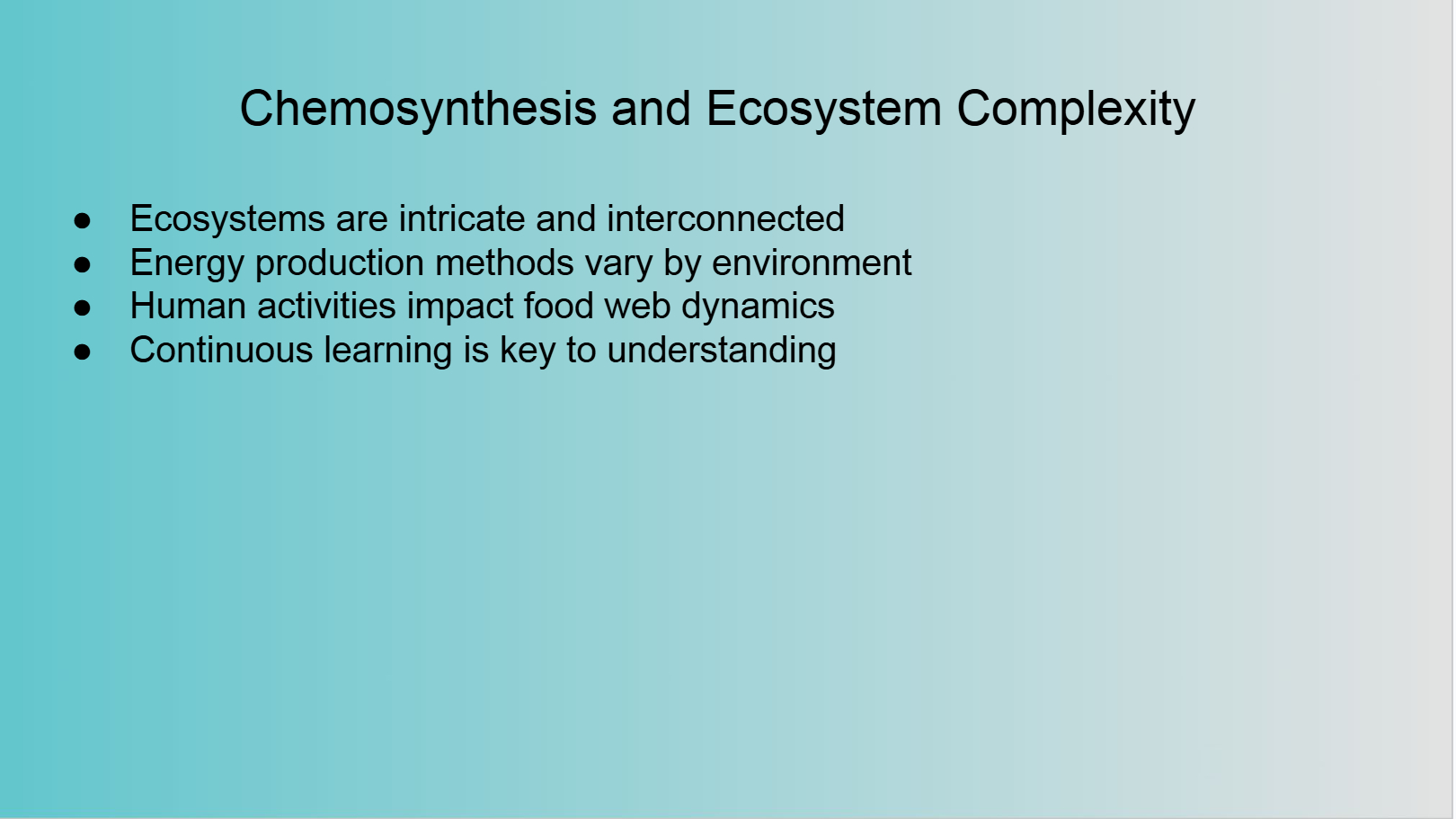
Which human activities can impact food web dynamics in ecosystems?
Fishing
Pollution
Deforestation
All of the above
28
29
Open Ended
Explain the process of biomagnification and discuss how it can impact hydrothermal vent ecosystems.
30

31
Open Ended
Reflecting on what you learned about chemosynthesis, food webs, and biomagnification, what questions do you still have or what would you like to explore further about these topics?
32
Multiple Choice
How is chemosynthesis fundamentally different from photosynthesis in terms of energy source?
Chemosynthesis uses sunlight, photosynthesis uses chemical energy
Chemosynthesis uses chemical energy, photosynthesis uses sunlight
Both use sunlight as their energy source
Both use chemical energy as their energy source
33
Multiple Choice
Which of the following best describes the diversity of energy production methods in ecological systems?
Only photosynthesis is used for energy production.
Chemosynthesis and photosynthesis are both used for energy production.
Energy production is limited to solar energy.
All organisms rely on the same energy source.
Show answer
Auto Play
Slide 1 / 33
SLIDE
Similar Resources on Wayground

26 questions
T4 Exploring Trophic Cascades
Presentation
•
9th - 12th Grade
27 questions
Ch 18.1: Renewable Energy Resources
Presentation
•
10th - 12th Grade
25 questions
Periodic Trends
Presentation
•
10th - 12th Grade
31 questions
Energy Pyramids, Food Webs, and Biodiversity
Presentation
•
9th - 12th Grade
28 questions
Cell Types and Specialization EOC Review
Presentation
•
9th - 12th Grade
26 questions
More About Hurricanes
Presentation
•
9th - 12th Grade
27 questions
Enzymes
Presentation
•
9th - 12th Grade
Popular Resources on Wayground
10 questions
Oak Hills High School Policy and Success Quiz

Passage
•
9th Grade
11 questions
Hallway & Bathroom Expectations

Quiz
•
6th - 8th Grade
15 questions
School Bus Safety Questions
Quiz
•
6th Grade
25 questions
AJHS Scavenger Hunt
Quiz
•
6th Grade
20 questions
Lab Safety Quiz
Quiz
•
6th Grade
22 questions
would you rather
Quiz
•
3rd - 11th Grade
29 questions
Laboratory Safety Rules
Quiz
•
6th Grade
21 questions
Continents and Oceans
Quiz
•
6th Grade
Discover more resources for Science
73 questions
Reading Graphs
Quiz
•
9th - 12th Grade
10 questions
Scientific Method (The scientific method)

Interactive video
•
9th Grade
9 questions
Scientific method
Interactive video
•
9th - 12th Grade
10 questions
Lab Safety Essentials
Interactive video
•
6th - 10th Grade
33 questions
Lab Safety
Quiz
•
9th - 12th Grade
24 questions
Flinn Lab Safety Quiz
Quiz
•
5th - 12th Grade
10 questions
Exploring Common Lab Equipment
Interactive video
•
6th - 10th Grade
12 questions
What is Biology?
Presentation
•
9th - 12th Grade