

Integrating Quotes

Presentation
•
English
•
9th - 12th Grade
•
Practice Problem
•
Easy
+3
Standards-aligned

Cassidy vanVonno
Used 3+ times
FREE Resource
11 Slides • 9 Questions
1
Integrating Quotes
By Cassidy vanVonno & Caelan Tietze
2
Draw
Before we start,
Draw a little picture to show how you're feeling today.
3

OBJECTIVE:
1. Identify the three components of the quote sandwich method (Introduction, Quotation, Analysis)
2. Recognize the difference between integrated and unintegrated quotations
4
Poll
As of right now,
How confident are you at smoothly integrating quotes into your writing?
Very Confident
Somewhat Confident
Not Very Confident
What is a quote?
5
Poll
Which sentence sounds better?
John Proctor struggles with guilt. "I have confessed myself! Is there no good penitence but it be public?"
"I have confessed myself! Is there no good penitence but it be public?" (Miller 42).
When John Proctor desperately asks, "Is there no good penitence but it be public?" he reveals his internal conflict between private redemption and public reputation (Miller 42).
In Act 3, Proctor said "I have confessed myself! Is there no good penitence but it be public?" This shows he feels guilty.
6
NEVER DROP A QUOTE
THE GOLDEN RULE OF INTEGRATING QUOTES
A "dropped quote" appears suddenly without any introduction or context. They confuse your readers and weaken your argument.
Example of a DROPPED quote:
John Proctor is conflicted about his reputation. "I have given you my soul; leave me my name!" He cares what people think.
7
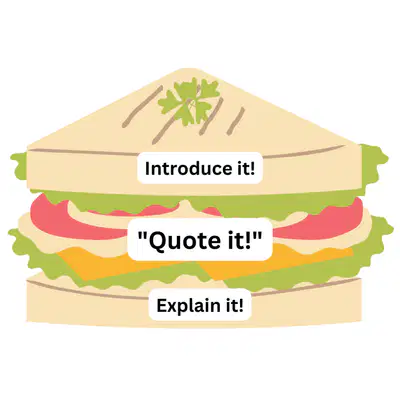
QUOTE SANDWICH METHOD
1. BREAD: Context/Introduction (Signal Phrase)
Set up the quote by telling your reader WHO is
speaking, WHEN, and WHY it matters.
2. MEAT: The Quotation Itself
The actual quote with proper punctuation and a citation.
3. BREAD: Analysis/Explanation
Explain what the quote means and how it supports your argument. Never leave a quote to speak for itself!
8
When confronted by Putnam in Act 1, Rebecca. says,"..
After Abigal lies to protect herself, Parris realizes,"...
After a heated debate with Parris, Proctor desperately questions,"
Examples of Strong Signal Phrases:
Your reader needs to know:
Who is speaking or being quoted
When this happens (what part of the play/scene)
What's happening at this moment?
LEAD THE READER INTO YOUR QUOTE BEFORE YOU DROP A QUOTE
STEP 1: Provide Context & Introduce the Quote (Top Piece of Bread)
Building Your Quote Sandwich
9
Abigail said to Proctor in an attempt to hide the truth about Betty, "Uncle, the rumour of witchcraft is all about, I think you'd best go down and deny it yourself" (Miller 30).
Example
Place the quote in your sentence quotation mark
At the end of the quote, put the in text citation!
Building Your Quote Sandwich
Step 2 : Integrate the Quote
(The Filling)
In Text Citations should include:
-The Author's Last Name
-The Page Number
10
Format: (Author's Last Name Page #).
-No comma between name and page number
-No "p." or "pg." before the page number
-Period goes AFTER the parentheses
Examples:
(Miller 142).
(Miller 98).
In-Text Citations Breakdown
If you mention the author in your sentence:
Miller describes Proctor as a man who "knew his place in society" (19).
Just put the page number as the in-text citation.
11
Explains what the quote means
Connects it back to your argument
Shows WHY this quote matters
Never end a paragraph with a quote!
Always follow up with analysis that:
Building Your Quote Sandwich
Step 3 : Explain & Analyze
(Bottom Piece of Bread)
Weak analysis:
This shows how Abigail feels really well.
Strong analysis:
If the town finds out that Betty is sick from witchcraft, it will be detrimental to Abigail and Proctor's reputation. This scene showcases Abigail's ulterior motivations to disguise her involvement in witchcraft by having Proctor and others minimize the exposure of her secret.
What we have so far:
Abigail said to Proctor in an attempt to hide the truth about Betty, "Uncle, the rumour of witchcraft is all about, I think you'd best go down and deny it yourself" (Miller 30).
12
Remember:
Quotes are EVIDENCE, not ARGUMENTS.
You always need to explain how your evidence supports your point!
13
Dropdown
14
Reorder
Reorder the following
Rebecca the Nurse leaves the diabolical conversation with Parris saying,
"I think I'll go, I'm too old for this." (Miller 37)
The talk of Witchcraft became unbearable for Rebecca because she carries a moral superiority, knowing Satan is not to blame for all of the town's troubles.
15
Multiple Choice
True or false: It's okay to drop in a quote all by itself, without any of your own words before.
True
False
16
Multiple Select
Mark all that apply. An introductory phrase is used to..
introduce the author/speaker you're quoting from
set up the context of why you're using the quote
17
Multiple Choice
If you don't write the author/speaker's name in the introductory phrase, what do you do?
Leave it out
Write in in a new sentence after your quote
Add it to the end of the quote using parenthesis
Add it to the end of the sentence using parenthesis
18
Multiple Choice
Which is correct?
“One finds violence, hostility and aggression everywhere, including TV, the movies, and in many of our everyday social relations” (40).
“One finds violence, hostility and aggression everywhere, including TV, the movies, and in many of our everyday social relations” (Zigler 40).
19
Checklist for Integrating Quotes
Context: Did I introduce who is speaking and when?
Integration: Does the quote flow grammatically in my sentence?
Citation: Did I include the author's name & page number in parentheses?
Analysis: Did I explain what the quote means and why it matters?
No Dropped Quotes: Did I avoid starting or ending sentences with quotes alone?
20
WHY IS THIS IMPORTANT?
When you make a claim, you have to support it with evidence AND explain why that evidence matters.
Explaining yourself develops your communication skills and ability to defend your points and claims with logical and critical explanations.
PLAGARISM
Integrating Quotes
By Cassidy vanVonno & Caelan Tietze
Show answer
Auto Play
Slide 1 / 20
SLIDE
Similar Resources on Wayground

17 questions
Macbeth Introduction
Presentation
•
9th - 12th Grade
13 questions
Sentence Fragments
Presentation
•
9th - 12th Grade
12 questions
Resumes Pre-knowledge
Presentation
•
9th - 12th Grade
18 questions
Symbolism
Presentation
•
9th - 12th Grade
16 questions
Punctuation
Presentation
•
9th - 11th Grade
15 questions
Compound-complex sentences
Presentation
•
9th - 12th Grade
17 questions
Ethos. Pathos. Logos
Presentation
•
9th - 12th Grade
Popular Resources on Wayground
24 questions
PBIS-HGMS Day 10

Quiz
•
6th - 8th Grade
10 questions
HCS SCI 03 Summer School Review 3
Quiz
•
3rd Grade
11 questions
Home Scope
Quiz
•
7th - 8th Grade
15 questions
HCS SCI 05 Summer School Assessment 3 Review
Quiz
•
5th Grade
35 questions
Lufkin Road Middle School Student Handbook & Policies Assessment
Quiz
•
7th Grade
18 questions
Geo 11.3 Area of Circles and Sectors
Quiz
•
9th - 11th Grade