Search Header Logo
  1. Resource Library
  2. Science
  3. Biology
  4. Female Reproductive System
  5. Female Reproductive System
Female Reproductive System

Female Reproductive System

Assessment

Presentation

Science

10th Grade

Practice Problem

Medium

Created by

Paulien Alianciano

Used 1+ times

FREE Resource

29 Slides • 22 Questions

1

media

2

media

3

Multiple Choice

Question image

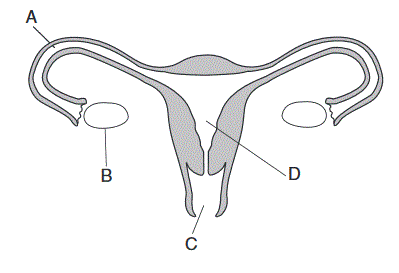
The diagram below represents structures found in the female reproductive system. If the areas labeled A were completely blocked on both sides, the most likely result would be that

1

egg production would stop

2

sperm production would stop

3

fertilization would not occur

4

an embryo would develop

4

media

5

Multiple Choice

Question image
What is structure #3
1
Ovary
2
Fundus
3
Fallopian Tube
4
I don't know

6

media

7

Fill in the Blank

8

media

9

media

10

Multiple Choice

What is the primary function of the fallopian tubes?

1

Transport ova to the uterus

2

Produce hormones

3

Support fetal development

4

Facilitate menstruation

11

media

12

Multiple Choice

Which layer of the uterus serves as the site of implantation?

1

endometrium

2

cervix

3

myometrium

4

fundus

5

perimetrium

13

media

14

Multiple Choice

What is the function of the cervix in the female reproductive system?

1

To produce eggs

2

To act as a passage for the baby

3

To support the uterus

4

To regulate hormones

15

media

16

Multiple Choice

What is the function of the vagina in the female reproductive system?

1

To connect the internal reproductive organs with the external genitalia

2

To produce eggs

3

To support the uterus

4

To regulate menstrual cycles

17

media

18

Multiple Select

What are the main features of the vulva?

1

Labia majora

2

Labia minora

3

Clitoris

4

Urethral opening

19

media

20

Multiple Choice

Question image

Identify hormones O and P

1

O: Progesterone

P: Testosterone

2

O: Progesterone

P: Oestrogen

3

O: Oestrogen

P: Progesterone

4

O: Oestrogen

P: Testosterone

21

media

22

Open Ended

What happens during each stage of the menstrual cycle and the ovarian cycle?

23

media

24

media

25

Multiple Select

What are the four technical terms related to the female reproductive system mentioned in the image?

1

Menstruation

2

Menarche

3

Menopause

4

Feedback Mechanism

26

media

27

Multiple Choice

Which of the following statements about the menstrual cycle is false?

1

Progesterone levels rise during the luteal phase of the ovarian cycle and the secretory phase of the uterine cycle

2

Menstruation occurs just after LH and FSH levels peak

3

Menstruation occurs after progesterone levels drop

4

Estrogen levels rise before ovulation, while progesterone levels rise after

28

media

29

Multiple Choice

What are the key phases of the menstrual cycle as illustrated in the diagram?

1

Menstruation

2

Follicular phase

3

Luteal phase

4

Ovulation

30

media

31

Multiple Select

What are the key hormonal changes that occur during the Follicular Phase of the Menstrual Cycle?

1

Estradiol (E2) increases

2

Progesterone decreases

3

Luteinizing hormone (LH) decreases

4

Follicle-stimulating hormone (FSH) increases

32

media

33

Multiple Choice

What hormonal changes occur during ovulation on Day 14 of the menstrual cycle?

1

Increase in Estradiol (E2)

2

Decrease in Follicle-stimulating hormone (FSH)

3

Increase in Luteinizing hormone (LH)

4

Decrease in Progesterone

34

media

35

Multiple Choice

What hormones are primarily involved during the luteal phase of the menstrual cycle?

1

Luteinizing hormone (LH)

2

Follicle-stimulating hormone (FSH)

3

Estradiol (E2)

4

Progesterone

36

media

37

Multiple Choice

What are the three phases of the ovarian cycle?

1

Follicular phase

2

Ovulation phase

3

Luteal phase

4

Menstrual phase

38

media

39

Multiple Choice

What are the days of the average menstrual cycle when ovulation occurs?

1

1-5 days

2

11-15 days

3

16-20 days

4

21-28 days

40

media

41

Open Ended

Question image

Looking at the image, state if this a positive or negative feedback system. Explain your choice.

42

media

43

Multiple Choice

What is the role of shivering and sweating in the negative feedback mechanism of body temperature regulation?

1

Shivering increases body temperature

2

Sweating decreases body temperature

3

Both are heating mechanisms

4

Both are cooling mechanisms

44

media

45

media

46

Multiple Choice

Question image

The diagram demonstrates a feedback process involving antidiuretic hormone (ADH). ADH increases the permeability of parts of the nephrons of the kidney, resulting in less water in the urine.This feedback loop is likely to be activated when—

A) the body experiences dehydration B) blood glucose levels are stable C) body temperature drops D) the urinary tract is infected

1

A

2

B

3

C

4

D

47

media

48

Open Ended

Describe the feedback mechanism illustrated in the diagram. How do the hormones interact during the follicular phase?

49

media

50

media

51

media
media

Show answer

Auto Play

Slide 1 / 51

SLIDE