Search Header Logo
Classical Empires: Asia & The Americas

Classical Empires: Asia & The Americas

Assessment

Presentation

Social Studies

1st - 5th Grade

Practice Problem

Medium

Created by

Sean Falasca

Used 3+ times

FREE Resource

15 Slides • 39 Questions

1

​Unit 2 Chapter 4: Classical Empires - Asia & The Americas

2

media

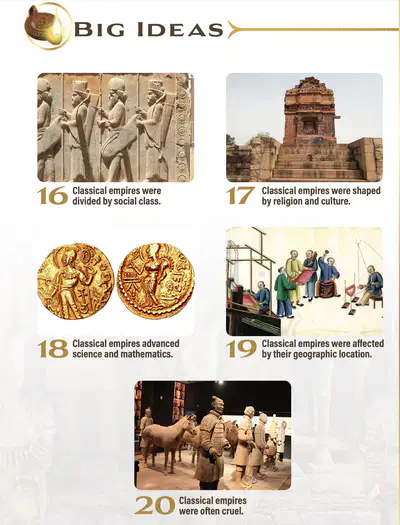
Big Ideas

3

Beginning of Lesson 16.
Turn to pages 68 + 69

4

Multiple Choice

A line of rulers from one family

1

Caste

2

Dynasty

3

Empire

5

Multiple Choice

A hereditary class in Hindu culture that set

a person’s social and political position

1

Caste

2

Dynasty

3

Empire

6

Multiple Choice

A group of states or nations ruled by one powerful government

1

Caste

2

Dynasty

3

Empire

7

Multiple Choice

The powerful ruler of an empire

1

Empire

2

Dynasty

3

Emperor

8

Multiple Choice

A ranking of people in a society Based upon their role, wealth, or job.

1

Slavery

2

City-State

3

Social Class

9

Multiple Choice

An army of trained soliders.

1

Conqueror

2

Military

3

Subject

10

Multiple Choice

A set of beliefs that incklude a higher power, like a god

1

Religion

2

Century

3

Architectutre

11

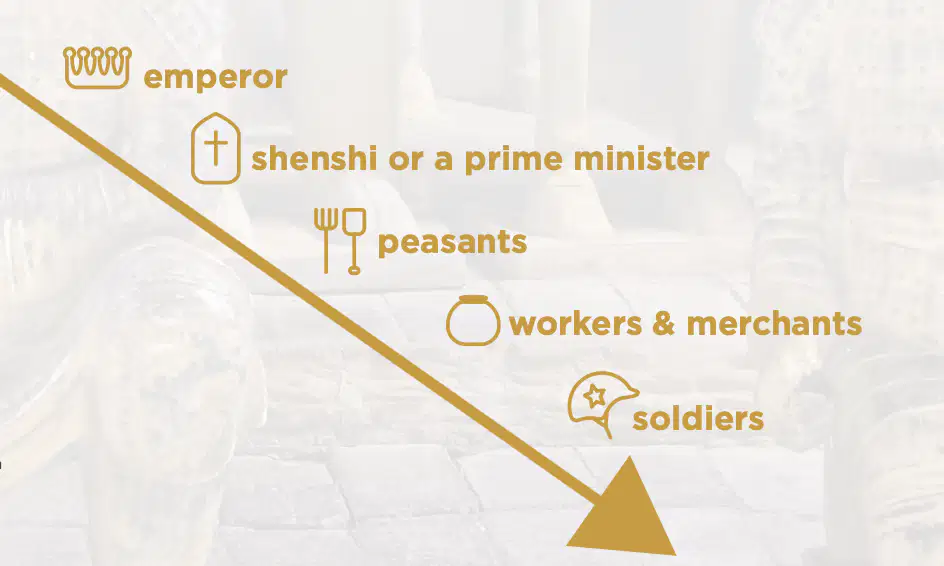
Classical empires were divded by social classes

12

media

13

Multiple Choice

Who was in the top of the social class in China?

1

The Emperor

2

The religious leader

3

The Prime Minister

14

Multiple Choice

Which social class has the most people?

1

The upper class

2

The middle class

3

The lower class

15

Multiple Choice

Question image

What was important in the Han Dynasty?

1

Taxes

2

Social Classes

3

Sleeping In

16

media

17

Multiple Choice

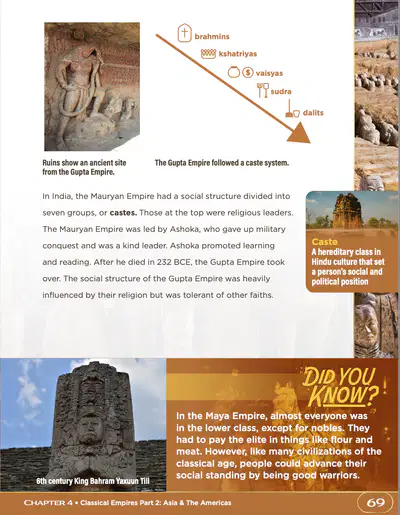
Who was at the top of the Mauryan Empire?

1

Emperor

2

Peasents

3

Religious Leaders

18

Multiple Choice

What empire followed a caste system? (Hint: Look at the top of page 69!)

1

The Romans

2

The Persian

3

The Gupta

4

The British

19

Multiple Choice

What does caste mean?

1

A hereditary class in Hindu culture that set

a person’s social and political position

2

Forcing people to live and work

with no freedom or payment

3

A religion and philosophy from

eastern and central Asia based

upon the teachings of Buddha

20

Multiple Choice

Who was in the top social class in China?

1

Peasents

2

Merchants

3

The Emperor

21

Multiple Choice

What influenced the social structure

of the Gupta Empire?

1

Religion

2

Ashoka

3

Soldiers

22

Beginning of Chapter 4 Lesson 17 pgs. 70 +71

23

Multiple Choice

The oldest major religion, primarily in India.

Hindus believe in one supreme god in addition

to an infinite number of lower-level gods.

1

Hinduism

2

Buddism

3

Christianity

24

Multiple Choice

A religion and philosophy from

eastern and central Asia based

upon the teachings of Buddha

1

Hinduism

2

Buddism

3

Judaism

25

Multiple Choice

A group of states or nations ruled

by one powerful government (Old Vocab pages 28 +29)

1

City-State

2

Empire

3

Civilization

26

Multiple Choice

A set of beliefs that include a

higher power, like a god. (Older vocab pages 48 + 49)

1

Hinduism

2

Buddism

3

Religion

27

Multiple Choice

A line of rulers from one family

1

Dynasty

2

Emperor

3

Caste

28

Fill in the Blanks

Type answer...

29

media

30

Multiple Choice

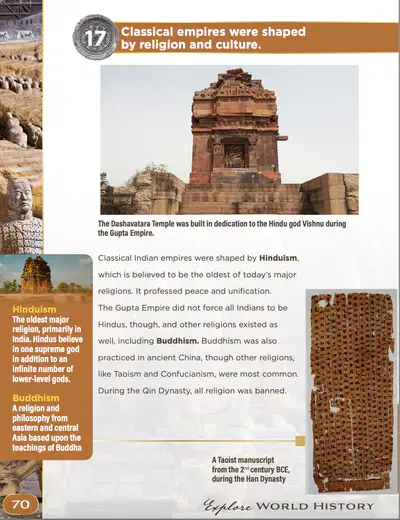
What did Hinduism profess?

1

Peace & Unification

2

Violence & Division

3

Nothing

31

media

32

Fill in the Blanks

Type answer...

33

Multiple Select

Question image

What are these gods of?

1

Maize

2

Wisdom

3

The Sun

4

The Oceans

34

Open Ended

Why would the Mayans pray to a god of maize? What might they be asking for?

35

Multiple Choice

What is the oldest of today’s major religions?

1

Hinduism

2

Buddism

3

Taoism

36

Multiple Choice

What god did Mayans believe in?

1

Jesus Christ

2

Adnois

3

Many different ones

37

End of Chapter 4 Lesson 17

38

Beginning of Chapter 4 Lesson 18 (Pages 72-73)

39

Multiple Choice

The technology used to provide clean

drinking water and sewage removal

1

Mineral

2

Natural Resource

3

Sanitation

40

Multiple Choice

A period of 100 years (Page 49, Older Vocab)

1

Century

2

Decade

3

Year

41

Multiple Choice

An abbreviation for Before the Common

Era, used to tell when something occurred (Page 11, Older Vocab)

1

BCE

2

Era

3

Century

42

Multiple Choice

A line of rulers from one family

1

CIty-State

2

Dynasty

3

Emperor

43

Open Ended

Look at the top of page 72, what did classical empires advance?

44

Open Ended

Question image

These coins were made during the Gupta Empire. It shows their ruler on one side and a goddess on the other. We don't know their value, but we know they were used in trade.

What are some ways that these coins are different from the coins we use today in our country?

45

media

46

Multiple Choice

What is one example of an advancement made in China?

1

Cars

2

Compasses

3

Coffee

4

Writing Utensils

47

Multiple Choice

Question image

When were bronze sculptures common? (Hint: Bottom of page 72)

1

Han Dynasty

2

Qin Dynasty

3

Duck Dynasty

48

media

49

Multiple Choice

What was one important advancement made by the Mayans?

1

Electricity

2

Sanitation

3

Weapons

50

Multiple Choice

Question image

Where it Chichén Itzá?

1

Mexico

2

North America

3

South America

51

Could you read this calendar?

media

52

Multiple Choice

Where was the decimal system invented?

1

India

2

China

3

Mexico

53

Multiple Choice

What was an important Mayan creation?

1

The decimal system

2

The compass

3

Rubber

54

End of Lesson 18

​Unit 2 Chapter 4: Classical Empires - Asia & The Americas

Show answer

Auto Play

Slide 1 / 54

SLIDE