

Physical Science 5-3: Gravity & Motion

Presentation
•
Science
•
10th Grade
•
Easy
+6
Standards-aligned

Abby Fancsali
Used 2+ times
FREE Resource
21 Slides • 15 Questions
1

2
Multiple Choice
What is the definition of a force?
When there is no change in the object's motion
the overall force acting on an object after all forces are combined
a push or a pull that acts on an object
Whenever an object accelerates
3
Multiple Choice

What is the magnitude and direction of the force in the diagram shown?
70 N right
70 N left
50 N right
50 N left
4
Multiple Choice
Which of the following Forces is an example of a Contact Force?
Friction
Gravitational
Electric
Magnetic
5
Multiple Choice
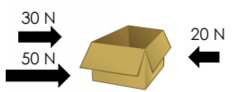
Calculate the Net Force.
60N, Left
40N, Right
0N
60N, Right
6
Define Gravity
Differentiate between weight & Mass
Describe how gravity affects objects
Show how air resistance affects falling objects
Define Free Fall
Explain the path shown by a horizontally thrown path

7
Gravity: a force of attraction between objects that is due to their masses
All Matter experiences gravity because gravity is caused by having mass
The amount of gravity is directly related to the amount of mass an object has
8
Sir Isaac Newton was the first to describe gravity and its relationship with objects
Watched an apple falling from a tree, and realized that there had to be some force that pulls objects to the Earth
Newton summarized his ideas as the Law of Universal Gravitation
Gravity depends on the masses of the objects and the Distance between them
9
The Gravitational force between objects depends on the mass of the two objects
Mass and gravity have a direct relationship with each other. As one increases, so does the other at the same rate
It is easier to lift a smaller object than a larger object
10
Gravity and Distance have an indirect relationship
As you increase the distance between two objects, the amount of gravity between them decreases by the distance squared (d2)
The indirect relationship is why objects fall back down to Earth, even though there are larger planets and stars in the solar system
11
Mass: The measure of the amount of Matter in an object
Can not be changed without directly changing the object itself
Weight: A measure of the gravitational force on an object
weight can be easily changed by changing the location of the object
12
Gravity can cause an object to move because it is a type of force
Gravity acts on objects even if they are not moving due to other forces
In Ancient times, it was thought that the larger an object is, the faster it falls
Galileo performed experiments that disproved this idea, showing that all objects will hit the ground at the same time if dropped from the same height
13
Multiple Choice
How much gravity an object has depends on its _________.
Weight
Speed
Momentum
Mass
14
Multiple Choice

Which of the following has the strongest gravitational pull?
A bowling ball
A car
The Earth
The Sun
15
Multiple Choice
What scientist is credited with first describing the mathematics of gravity?
Thomas Edison
Robert Hooke
Galileo
Isaac Newton
16
Multiple Choice
What do we call the force of gravity on an object?
Weight
Mass
Speed
Acceleration
17
Multiple Choice
When will gravity be the strongest?
The further away you are from an object
The closer you are to an object
The faster your relative speed is to an object
None of the above
18
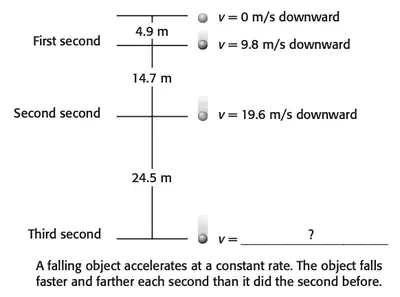
All objects accelerate toward Earth at the rate of 9.8 m/s2
Every second, an object falls, its velocity increases by 9.8 m/s
19
If an object starts at rest, you can relate the velocity, time, and acceleration of the object from Gravity to determine different facts about the movement of the object
Vf = Final Velocity
g = acceleration due to gravity = 9.8 m/s2
t =Time
20
A rock is dropped from the top of a cliff. It takes 4 seconds to hit the ground. What was the velocity of the rock on impact?
Step 1: Identify the equation we want to use
Vf = g × t
Step 2: Identify the Variables that we know
Vf =?
g = 9.8
t = 4 seconds
Step 3: Plug your values into your equation and solve
21
Fill in the Blanks
A rock is dropped from the top of a cliff. It takes 4 seconds to hit the ground. What was the velocity of the rock on impact?
Type answer...
22
A construction worker is building a bridge and drops a bolt from the top of the bridge. When the bolt hits the ground, it was moving 49 m/s. How long did it take the bolt to fall?
Step 1: Identify the equation we want to use
Vf = g × t
Can we rearrange this to make it easer?
23
Multiple Choice
How can we rearrange the following equation to solve for time: Vf = g × t
t =Vf + g
t = g / Vf
t = Vf - g
t = Vf / g
24
A construction worker is building a bridge and drops a bolt from the top of the bridge. When the bolt hits the ground, it was moving 49 m/s. How long did it take the bolt to fall?
Step 1: Identify the equation we want to use
t = Vf / g
Step 2: Identify the Variables that we know
Vf = 49 m/s
g = 9.8
t = ?
Step 3: Plug your values into your equation and solve
25
Fill in the Blanks
A construction worker is building a bridge and drops a bolt from the top of the bridge. When the bolt hits the ground, it was moving 49 m/s. How long did it take the bolt to fall?
Type answer...
26
A rock at rest falls off a cliff and hits the ground after 3.5 s. What is the
rock’s velocity just before it hits the ground?
Step 1: Identify the equation we want to use
Vf = g × t
Step 2: Identify the Variables that we know
Vf =
g =
t =
27
A rock at rest falls off a cliff and hits the ground after 3.5 s. What is the
rock’s velocity just before it hits the ground?
Step 1: Identify the equation we want to use
Vf = g × t
Step 2: Identify the Variables that we know
Vf = ?
g = 9.8
t =3.5
28
Fill in the Blanks
A rock at rest falls off a cliff and hits the ground after 3.5 s. What is the rock’s velocity just before it hits the ground?
Type answer...
29
Gravity causes objects of different masses to fall at the same rate, but other factors can alter the motion of an object
Think of dropping a ball and a piece of paper
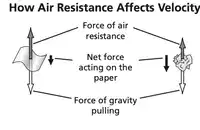
Air Resistance: A force that opposes the motion of falling objects
Caused by air making contact with the surface of an object and pushing opposite the motion
Affected by:
Size/Shape of Object
Speed of Object
30
As the speed of a falling object increases, air resistance also increases
At some point, air resistance will increase to the point where it is equal to the force of gravity on the object
The object will continue to move, but will no longer accelerate
Terminal Velocity: is the speed of an object when the force of air resistance equals the force of gravity
The object maintains a constant speed as it falls and has a net force of 0
31
Free Fall: The motion of an object when gravity is the only force acting on the object
Only occurs in when air resistance in negligible, like outerspace
32
Recall: Weight measures how much gravity pulls on an object
All objects exert gravity on all other objects, because they all have mass
As an object moves farther away from Earth, Earth still pulls on the object along with every other object in space
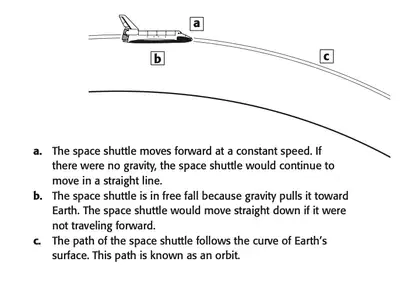
If an object starts movement with enough force, it will fall at the same rate that the Earth Curves and orbits the object
Orbit: a curved path around an object
33
When an object is in orbit, it goes around another object in space
The only way for this to happen is for the orbiting object to have forces balanced so that it will continue to move at the same velocity forever
Centripetal Force: The force that keeps an object moving in a circular path
34
Projectile Motion: The curved path that an object follows when thrown, launched, or otherwise projected near the surface of Earth
All Projectile Motion has two parts to it
A Horizontal motion
A Vertical Motion from gravity
Can be drawn out on a Free Body diagram

35
Multiple Choice
A(n) _____ is the curved path of an object around a point/object in space.
orbit
rotation
revolution
phase
36
Multiple Choice
the moon has more mass, and therefore more gravity
Show answer
Auto Play
Slide 1 / 36
SLIDE
Similar Resources on Wayground

32 questions
SI Units and measurement
Presentation
•
KG
28 questions
Genetic Mutation
Presentation
•
10th Grade
30 questions
Patterns and Inductive Reasoning
Presentation
•
10th Grade
30 questions
Early Middle Ages
Presentation
•
10th Grade
32 questions
Waves Part 2
Presentation
•
9th - 11th Grade
27 questions
Solar System
Presentation
•
10th Grade
26 questions
Types of chemical reactions
Presentation
•
10th Grade
29 questions
Mendelian Genetics
Presentation
•
9th - 10th Grade
Popular Resources on Wayground
10 questions
Safety Day 2026 – Student Review

Quiz
•
9th Grade
21 questions
Continents and Oceans
Quiz
•
6th Grade
20 questions
Parts of Speech
Quiz
•
5th Grade
16 questions
Subject & Predicate
Quiz
•
5th Grade
25 questions
Multiplication Facts
Quiz
•
5th Grade
12 questions
Map Skills
Quiz
•
3rd Grade
22 questions
Continents and Oceans
Quiz
•
5th Grade
15 questions
Rounding Decimals
Quiz
•
5th Grade
Discover more resources for Science
10 questions
Exploring Chemical and Physical Changes

Interactive video
•
6th - 10th Grade
10 questions
Exploring the Electromagnetic Spectrum for Middle School Science
Interactive video
•
6th - 10th Grade
10 questions
Exploring Force and Motion Concepts
Interactive video
•
6th - 10th Grade
10 questions
Exploring Air Masses and Weather Fronts
Interactive video
•
6th - 10th Grade
10 questions
Exploring the States of Matter
Interactive video
•
6th - 10th Grade
10 questions
Exploring Forces: Net Force, Normal Force, Gravity, and Friction
Interactive video
•
6th - 10th Grade
10 questions
Differentiating Thermal Energy and Temperature
Interactive video
•
6th - 10th Grade
10 questions
Exploring the States of Matter and Thermal Energy
Interactive video
•
6th - 10th Grade