

Presentación sin título

Presentation
•
Chemistry
•
Professional Development
•
Practice Problem
•
Hard

Elena Torres
FREE Resource
30 Slides • 32 Questions
1

2
Multiple Choice

Which statement best describes these two molecules?
Sugar molecules are inorganic and fat molecules are organic.
Sugar molecules are organic and fat molecules are inorganic.
Energy for life processes can be stored within the chemical bonds of both molecules.
Energy for life processes can be stored within the chemical bonds of sugar molecules, only.
3

4
Multiple Choice

Which of the following is not a function of a lipid?
Provides insulation for organisms
A major component of cell membranes
Provides long term energy storage
Speeds up chemical reactions
5

6
Multiple Choice
What are the two main classifications of lipids mentioned in the text?
Saponificables
Non-saponificables
Acids
Eicosanoids
7

8
Multiple Choice

Which is shown in the picture?
Fatty Acid
Monsaccharide
Amino Acid
Nucleotide
9

10
Multiple Choice
What are the main characteristics of saturated fatty acids?
They contain double bonds
They are liquid at room temperature
They usually contain between 10 and 20 carbons
They are only found in plant oils
11

12
Multiple Choice
What are the common names of the saturated fatty acids listed in the table?
Butyric
Caproic
Lauric
Palmitic
13

14
Multiple Choice
What is the structure of saturated fatty acids as shown in the image?
Linear chain with single bonds
Branched chain with double bonds
Cyclic structure
No specific structure
15

16
Multiple Choice
What are the implications of saturated fatty acids on health according to the text?
They are always harmful
They have no effect on health
They can provide health benefits
They are only beneficial in small amounts
17

18
Multiple Choice
What are the characteristics of unsaturated fatty acids?
They have one or more double bonds in their structure
They are usually solid at room temperature
They are classified as saturated or trans fats
They are found abundantly in animal products
19

20
Multiple Choice
What are the common characteristics of monounsaturated fatty acids?
They solidify easily at low temperatures
They are liquid at room temperature
They contain multiple double bonds
They are found in animal fats
21
Multiple Choice
22
Multiple Choice
23
Multiple Choice
24

25
Multiple Choice
What are the common names of the following monounsaturated fatty acids: C14:1n-5, C16:1n-7, C18:1n-9, C18:1n-7, and C22:1n-9?
Mantequilla
Palmitoleico
Oleico
Erúcido
26

27
Multiple Choice
What are the characteristics of polyunsaturated fatty acids?
They have more than one double bond in the molecule
They are solid at room temperature
They are not essential for the diet
They are only found in animal products
28
Multiple Choice
What are the fatty acids that must be eaten in our diet because our bodies cannot produce them?
saturated fats
unsaturated fats
29
Multiple Choice
component of fats that is necessary to the body but cannot be produced by it
essential fatty acids
wax
steroids
lipid
30
Multiple Choice
What are they fatty acids that must be eaten in our diet because our bodies cannot produce them?
saturated fats
unsaturated fats
31
Multiple Choice
components of fats that is necessary to the body but cannot be produced by it
essential fatty acids
wax
steriods
lipid
32

33
Multiple Choice
What are the common names of the following polyunsaturated fatty acids: C18:2n-6, C18:3n-6, C20:3n-6?
Linoleico, γ-Linoleico, Dihomo-γ-linoleico
Araquidónico, α-Linoleico, Timnodónico
Clupadónico, Cervónico, C20:5n-3
C22:5n-3, C22:6n-3, C20:4n-6
34

35

36
Multiple Choice
What are the three types of omega fatty acids mentioned in the text?
Omega 3
Omega 6
Omega 7
Omega 9
37

38

39
Multiple Choice
What are trans fatty acids (AGT) and where are they commonly found?
Unsaturated fats with double bonds
Only found in industrial processes
Only found in natural sources
Only found in animal products
40

41
Multiple Choice
What is the relationship between trans fats and cardiovascular diseases?
They have no relationship
They are beneficial
They are harmful
They are only harmful in industrial foods
42

43
Multiple Choice
What is the percentage of saturated fatty acids (AGS) in Aceite de oliva?
13.5
14.4
12.7
6.6
44

45
Multiple Choice
What are the components of acylglycerols?
One glycerol molecule and one fatty acid
One glycerol molecule and two fatty acids
One glycerol molecule and three fatty acids
One glycerol molecule and no fatty acids
46

47
Multiple Choice
What are the components of triglycerides as shown in the diagram?
Glycerol
Fatty acids
Glucose
Amino acids
48

49
Multiple Choice
What are the three types of eicosanoids mentioned in the text?
Prostaglandins
Leukotrienes
Thromboxanes
Fatty acids
50

51
Multiple Choice
What are the characteristics of ceres as described in the text?
They are soluble in water
They are esters of long-chain fatty acids
They cover the body for protection
They are hydrophilic
52
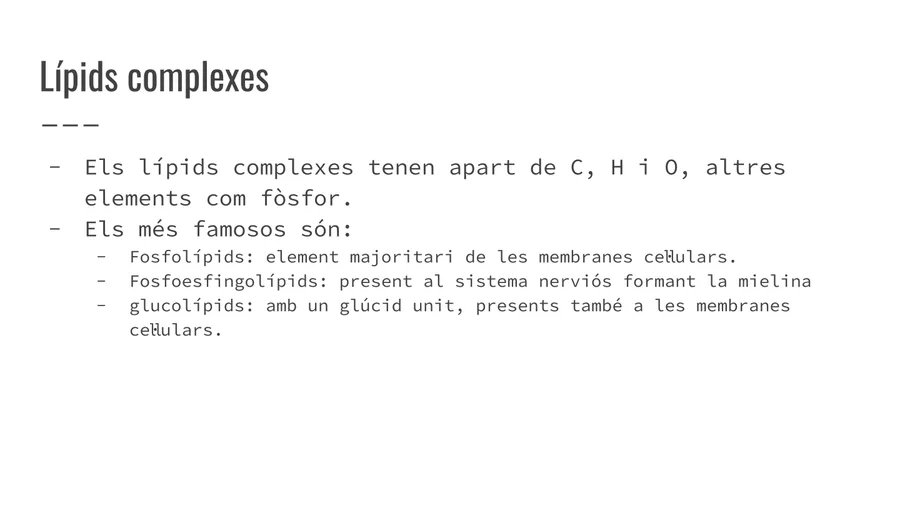
53
Multiple Choice

This image is an example of a phospholipid. Which part of a phospholipid is HYDROPHOBIC?
the phosphate "head"
the lipid "tails"
54
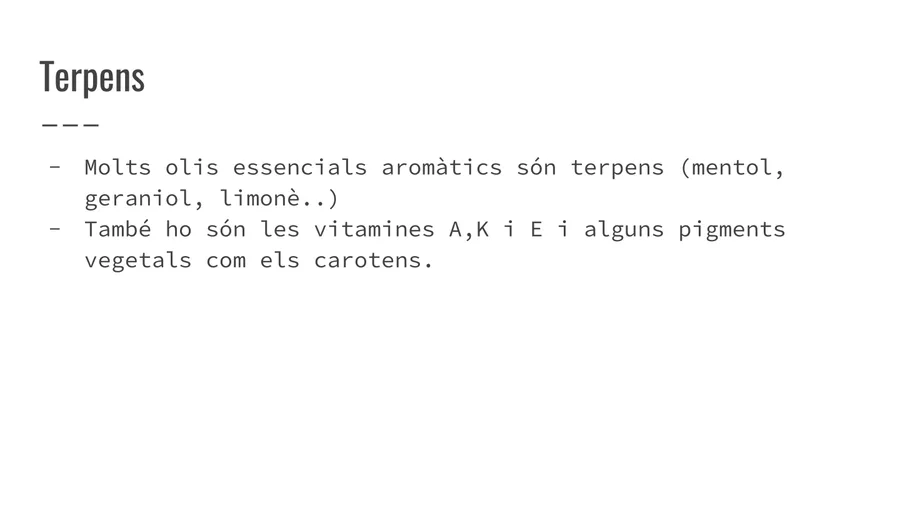
55
Multiple Choice
What are terpenes and what are some examples of them?
Vitamins
Essential oils
Minerals
Proteins
56

57
Multiple Choice
58

59

60

61

62
Poll
¿Qué tan seguro te sientes acerca de este tema ahora?
Show answer
Auto Play
Slide 1 / 62
SLIDE
Similar Resources on Wayground

58 questions
Level 2: Accurate Appointment Scheduling Power Hour
Presentation
•
Professional Development
58 questions
TEST CH6 part 1
Presentation
•
Professional Development
54 questions
1st, Unit 7, Lesson 6
Presentation
•
KG - Professional Dev...
57 questions
STDs
Presentation
•
Professional Development
56 questions
Present continuous
Presentation
•
Professional Development
55 questions
Chapter 5- Molecules and Compounds
Presentation
•
University
56 questions
24-25 LPN Orientation Day -1
Presentation
•
Professional Development
58 questions
Level 1 C4: The time
Presentation
•
Professional Development
Popular Resources on Wayground
20 questions
"What is the question asking??" Grades 3-5

Quiz
•
1st - 5th Grade
20 questions
“What is the question asking??” Grades 6-8
Quiz
•
6th - 8th Grade
10 questions
Fire Safety Quiz
Quiz
•
12th Grade
20 questions
Equivalent Fractions
Quiz
•
3rd Grade
34 questions
STAAR Review 6th - 8th grade Reading Part 1
Quiz
•
6th - 8th Grade
20 questions
“What is the question asking??” English I-II
Quiz
•
9th - 12th Grade
20 questions
Main Idea and Details
Quiz
•
5th Grade
47 questions
8th Grade Reading STAAR Ultimate Review!
Quiz
•
8th Grade