Christmas Quiz
Presentation
•
Chemistry
•
6th - 8th Grade
•
Practice Problem
•
Hard
Nestor Sienes
FREE Resource
26 Slides • 28 Questions
1
Multiple Choice
What is the theme of Classroom S7 quiz?
Math
History
Science
Art
2
3
Multiple Choice
What is the theme of Round 1?
Winter Sports
Winter Trivia
Winter Holidays
Winter Fashion
4
Multiple Choice
Why does salt melt ice on winter roads?
It raises the boiling point of water
It lowers the freezing point of water
It warms the surface through friction
5
Multiple Choice
At what temperature does water freeze?
-0 degrees
6
Multiple Choice
Why can you see your breath on a cold winter morning?
Your breath freezes instantly
Water vapour condenses into tiny droplets
The cold air makes carbon dioxide visible
7
Multiple Choice
Why do evergreens (Christmas trees) photosynthesise less in winter?
They lose chlorophyll in the cold
There is less sunlight available
They stop taking in carbon dioxide
They absorb more water
8
9
10
Multiple Choice
Which adaptation helps Arctic animals survive freezing winter temperatures?
Thin skin with large pores
Light-coloured fur that absorbs heat
Insulating layers such as thick fur or blubber
11
Multiple Choice
What temperature does water freeze at when forming snow or ice?
-10°C
0°C
10°C
12
Multiple Choice
13
Open Ended
The teapot will take longer to cool down and the cup will cool down quickly. Why do you think this is?
14
Multiple Choice
Why do snowy paths become slippery after many people walk on them?
Snow is crushed into smooth, compacted ice
Footsteps warm the snow so it evaporates
Pressure turns the snow into water
15
16
Multiple Choice
What is the focus of Round 2?
Which Came Last?
Which Came First?
Which is Better?
Which is More Popular?
17
Multiple Choice
Which invention came first?
The invention of the thermometer
The invention of the microscope
18
Multiple Choice
Which event occurred first?
Marie Curie's work on radioactivity
The first electric Christmas lights
The invention of the telephone
The first manned moon landing
19
Multiple Choice
How was radium first used?
to make glass
to make coins
to cure tumors
to make bombs
20
21
Multiple Choice
Which came first? A. Edward Jenner's first vaccine B. Louis Pasteur's germ theory
Edward Jenner's first vaccine
Louis Pasteur's germ theory
Both occurred at the same time
Neither is historically accurate
22
23
Multiple Choice
Which event occurred first? A. The invention of the commercially-available light bulb B. The discovery of the electron
The invention of the commercially-available light bulb
The discovery of the electron
The invention of the telephone
The discovery of radio waves
24
Multiple Choice
Who invented the telephone?
Bill Gates
John Dunlop
Benjamin Franklin
Alexander Graham Bell
MR. GANGL
25
26
27
Multiple Choice
Which came first? A. The discovery of DNA's structure B. The invention of man-made plastics
The discovery of DNA's structure
The invention of man-made plastics
Neither
Both
28
29
Multiple Choice
Which came first? A. Einstein's theory of relativity B. The discovery of X-rays
Einstein's theory of relativity
The discovery of X-rays
Both occurred at the same time
Neither is correct
30
Multiple Choice
________ tells space-time how to curve.
gravity
Mass
Light
31
Multiple Choice
How do black holes provide evidence to test Einstein's theory of general relativity and its predictions about gravity and spacetime?
Stephen Hawking
Plato
Galileo
Albert Einstein
32
Multiple Choice
Whose theory of relativity is tested by Black Holes?
Stephen Hawking
Plato
Galileo
Albert Einstein
33
34
Multiple Choice
Which came first: A. The first scientific study of reindeer migration or B. The first successful photo of snowflakes?
The first scientific study of reindeer migration
The first successful photo of snowflakes
Both happened at the same time
Neither happened
35
36
Multiple Choice
Which event occurred first: A. The discovery that vitamin C prevents scurvy or B. The invention of the modern insulated "thermos" flask?
A. The discovery that vitamin C prevents scurvy
B. The invention of the modern insulated "thermos" flask
C. Both occurred at the same time
D. Neither event occurred
37
38
Multiple Choice
Which of the following statements explains how science impacts society?
Science does not affect society
Science creates new technology without creating any problems
Science creates new technology that benefits society but may also create problems
Science does not help us understand the world
39
40
Multiple Choice
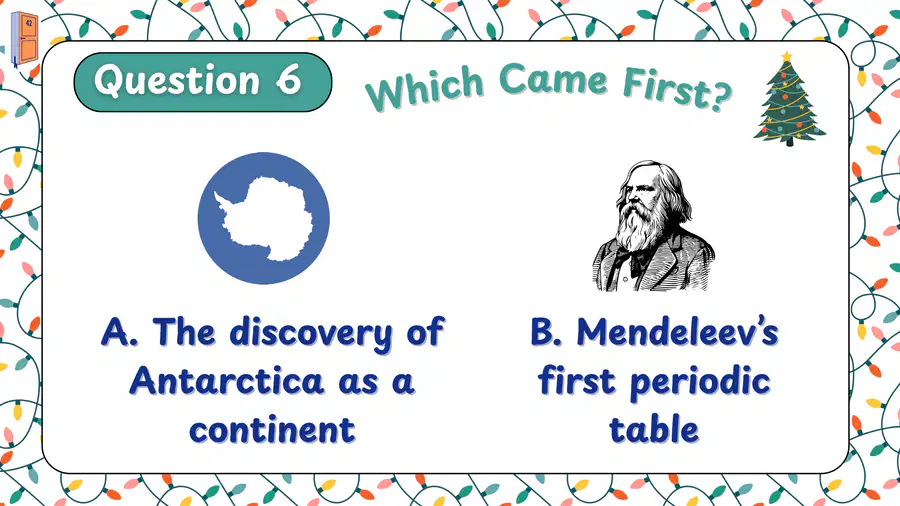
What was discovered in 1820 and 1869?
Discovery of Antarctica
Discovery of X-rays
Invention of man-made plastics
Discovery of vitamin C
41
42
43
44
45
46
47
48
49
50
51
52
53
54
Poll
How confident do you feel about this topic now?
What is the theme of Classroom S7 quiz?
Math
History
Science
Art
Show answer
Auto Play
Slide 1 / 54
MULTIPLE CHOICE

Similar Resources on Wayground
48 questions
Texas Revolution
Presentation
•
7th Grade
49 questions
Unit 2: Functions Review
Presentation
•
8th Grade
55 questions
Atoms and Elements Review
Presentation
•
6th - 8th Grade
49 questions
The Principles of Design
Presentation
•
6th - 8th Grade
51 questions
European Economic Factors
Presentation
•
6th - 8th Grade
49 questions
Contact and Noncontact Forces
Presentation
•
6th - 9th Grade
52 questions
7.1 Energy Transformations
Presentation
•
6th - 8th Grade
49 questions
Conflicts and Compromises (Pre-Civil War)
Presentation
•
6th - 9th Grade
Popular Resources on Wayground
6 questions
Secondary Safety Quiz
Presentation
•
9th - 12th Grade
10 questions
MyPath Diagnostic Overview
Presentation
•
6th - 8th Grade
20 questions
Lab Safety Quiz
Quiz
•
6th Grade
21 questions
Continents and Oceans
Quiz
•
6th Grade
20 questions
Adding and Subtracting Decimals
Quiz
•
5th Grade
20 questions
Parts of Speech
Quiz
•
5th Grade
16 questions
Subject & Predicate
Quiz
•
5th Grade
21 questions
Lab Safety
Quiz
•
10th Grade
Discover more resources for Chemistry
20 questions
Counting Atoms Practice
Quiz
•
8th Grade
5 questions
Parts of an Atom
Presentation
•
8th - 9th Grade
13 questions
Practice with Chemical Formulas
Presentation
•
7th Grade
15 questions
States of Matter 6th grade
Quiz
•
6th Grade
21 questions
Lab Tools - 8th Grade Science
Quiz
•
8th Grade
20 questions
Elements. Compounds. and Mixtures
Quiz
•
5th - 8th Grade
35 questions
Elements, Compounds, and Mixtures Review
Quiz
•
6th - 8th Grade
10 questions
Calculating Average Atomic Mass and Isotope Abundance
Interactive video
•
6th - 10th Grade