

RNA

Presentation
•
Science
•
9th - 12th Grade
•
Medium
Standards-aligned

Barbara White
Used 9+ times
FREE Resource
16 Slides • 10 Questions
1

High School
2
Define the structure of RNA and compare it with the structure of DNA.
Describe the main types of RNA and their roles in making proteins.
Explain the process of transcription, including its stages and specific base-pairing rules.
Summarize the changes mRNA undergoes after transcription before it is ready for translation.


3
Key Vocabulary

Ribonucleic Acid (RNA)
A single-stranded nucleic acid that is essential for making proteins inside the cell.
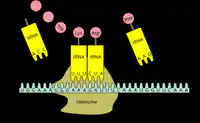
Transcription
The process of copying genetic info from DNA into a new molecule of messenger RNA.

Messenger RNA (mRNA)
Carries the genetic code from DNA in the nucleus to the ribosomes for protein synthesis.

Transfer RNA (tRNA)
Brings the correct amino acids to the ribosome during the process of building new proteins.

Ribosomal RNA (rRNA)
A key molecular component of the ribosome, which is the actual site of protein assembly.
4
What is RNA?
RNA, or Ribonucleic Acid, is a single-stranded molecule vital for protein synthesis.
An RNA strand has a phosphate group, a ribose sugar, and nitrogenous bases.
Its four bases are Adenine (A), Guanine (G), Cytosine (C), and Uracil (U).
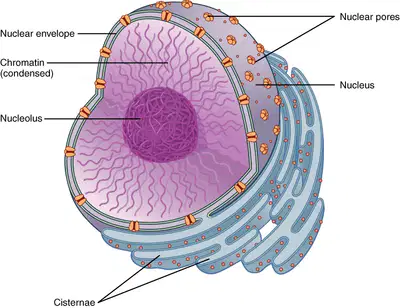
Uracil replaces Thymine, and RNA is found anywhere inside a cell.

5
Solved Example 1
During transcription, a DNA template strand has the sequence 3'-ATG-GCC-TAG-5'. What is the corresponding mRNA sequence that will be produced?
Step 1: Analyze and Sketch the Problem
Goal: Determine the mRNA sequence transcribed from a given DNA strand.
Knowns: The DNA template strand sequence is 3'-ATG-GCC-TAG-5'.
Unknown: The corresponding mRNA sequence.
Transcription Pairing Rules: A (DNA) pairs with U (RNA), T (DNA) pairs with A (RNA), G (DNA) pairs with C (RNA), and C (DNA) pairs with G (RNA).
6
Solved Example 1
During transcription, a DNA template strand has the sequence 3'-ATG-GCC-TAG-5'. What is the corresponding mRNA sequence that will be produced?
Step 2: Solve for the Unknown
Apply the base-pairing rules to each DNA base to find the complementary mRNA base.
For DNA 3'-A-T-G-5', the mRNA will be 5'-U-A-C-3'.
For DNA 3'-G-C-C-5', the mRNA will be 5'-C-G-G-3'.
For DNA 3'-T-A-G-5', the mRNA will be 5'-A-U-C-3'.
Combine the transcribed codons to get the full mRNA sequence.
7
Solved Example 1
During transcription, a DNA template strand has the sequence 3'-ATG-GCC-TAG-5'. What is the corresponding mRNA sequence that will be produced?
Step 3: Evaluate the Answer
The final mRNA sequence is 5'-UAC-CGG-AUC-3'.
To verify the answer, check the base pairings (A with U, T with A, G with C) and the direction. The 3' to 5' DNA template correctly produces a 5' to 3' mRNA strand. The sequence and direction are correct.
8
Multiple Choice
Which of the following is a key structural difference between RNA and DNA?
RNA is only found in the nucleus, while DNA can be found anywhere in the cell.
RNA contains the base Thymine, while DNA contains the base Uracil.
RNA is a double-stranded helix, while DNA is single-stranded.
RNA contains the sugar ribose and the base Uracil, while DNA has deoxyribose and Thymine.
9
Types of RNA

Messenger RNA
Copies genetic instructions from a DNA gene in the nucleus.
It then carries these instructions out of the nucleus.
The instructions are delivered to the ribosomes in the cytoplasm.

Transfer RNA
This RNA molecule transports specific amino acids to the ribosomes.
It reads the coded message on the messenger RNA sequence.
It brings the correct amino acid to the growing protein chain.

Ribosomal RNA
This is a structural component of the ribosomes themselves.
It helps to form the overall structure of the ribosome.
It helps assemble amino acids into a functioning protein chain.
10
Multiple Choice
Which type of RNA is responsible for copying the genetic code from DNA and carrying it to the cytoplasm?
dRNA
rRNA
mRNA
tRNA
11
What Is the Central Dogma?
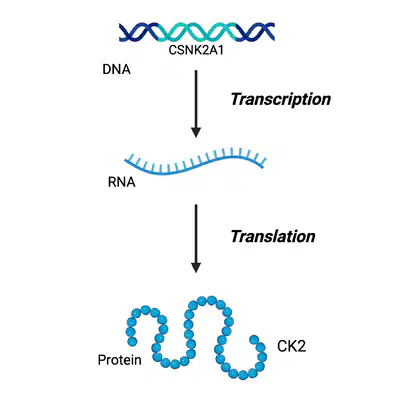
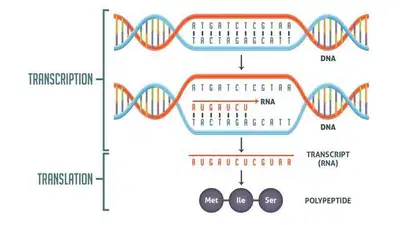
The Central Dogma describes the flow of genetic information: DNA → RNA → Protein.
This two-step process of transcription and translation determines an organism's traits.
Transcription copies a DNA segment into a complementary messenger RNA (mRNA) strand.
In transcription, Adenine (A) pairs with Uracil (U), and Cytosine (C) pairs with Guanine (G).
12
Multiple Choice
According to the Central Dogma, what is the primary role of transcription?
To directly form a protein from a DNA template.
To create a permanent, exact copy of the entire DNA molecule.
To translate the RNA sequence into a chain of amino acids.
To copy the genetic information from DNA into a strand of mRNA.
13
The 3 Steps of Transcription
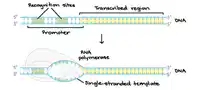
1. Initiation
RNA polymerase binds to a specific region on the DNA called a promoter.
This binding signals the DNA double helix to unwind and separate.
This allows the enzyme to access and read one of the DNA strands.
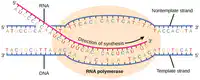
2. Elongation
RNA polymerase moves along the unwound DNA, creating a complementary mRNA molecule.
It adds nucleotides one by one, following the base-pairing rules.
For a short time, the newly created mRNA is bound to the DNA.
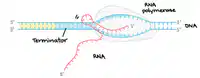
3. Termination
Transcription ends when RNA polymerase reaches a specific stop sequence on the gene.
The newly made mRNA strand then detaches from the DNA template.
Finally, the process of transcription is completed, and the enzyme is released.
14
Multiple Choice
In which stage of transcription does the enzyme RNA polymerase bind to the promoter region of a gene?
Elongation
Splicing
Initiation
Termination
15
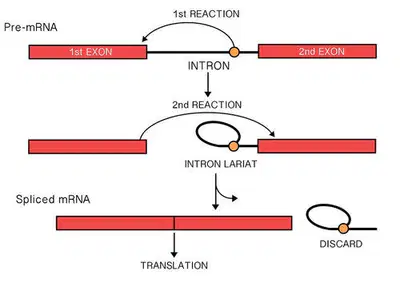
Post-Transcriptional Modifications
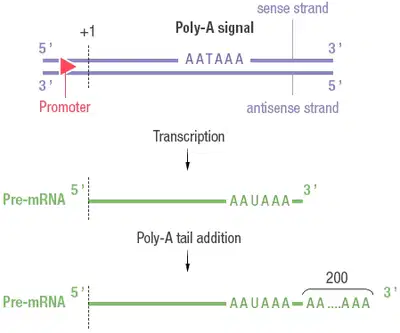
New mRNA must be processed before it can be used for translation.
Splicing removes non-coding introns and joins the coding exons together.
Editing alters nucleotides, allowing a single gene to make multiple proteins.
A poly-A tail is added to protect the mRNA and signal its end.
16
Solved Example 5
A pre-mRNA transcript is 2500 nucleotides long. Splicing removes two introns of 300 and 450 nucleotides, and polyadenylation adds a 150-nucleotide poly-A tail. What is the final length of the mature mRNA molecule?
Step 1: Analyze and Sketch the Problem
Goal: Determine the final length of the mature mRNA.
Knowns: Initial length = 2500 nucleotides, Intron 1 length = 300 nucleotides, Intron 2 length = 450 nucleotides, Poly-A tail length = 150 nucleotides.
Unknown: Final mRNA length.
Formula: Final Length = Initial Length − Total Intron Length + Poly-A Tail Length
17
Solved Example 5
A pre-mRNA transcript is 2500 nucleotides long. Splicing removes two introns of 300 and 450 nucleotides, and polyadenylation adds a 150-nucleotide poly-A tail. What is the final length of the mature mRNA molecule?
Step 2: Solve for the Unknown
18
Solved Example 5
A pre-mRNA transcript is 2500 nucleotides long. Splicing removes two introns of 300 and 450 nucleotides, and polyadenylation adds a 150-nucleotide poly-A tail. What is the final length of the mature mRNA molecule?
Step 3: Evaluate the Answer
The final mature mRNA is 1900 nucleotides long.
This makes sense, as splicing shortens the transcript by removing introns, while polyadenylation adds a tail, resulting in a net change to the original length.
19
Multiple Choice
What is the purpose of 'splicing' the mRNA molecule after transcription?
To remove non-coding introns and join the coding exons together.
To attach the mRNA molecule to the ribosome for translation.
To add a protective tail of adenine units to the end of the mRNA.
To change some of the nucleotides to create different protein forms.
20
Misconception | Correction |
|---|---|
RNA is just a simple copy of DNA. | RNA has diverse roles, like messenger (mRNA) and transporter (tRNA). |
Transcription and DNA replication are the same process. | Replication copies all DNA; transcription copies specific genes into RNA. |
All parts of a gene are translated into protein. | Only coding regions (exons) are translated; non-coding introns are removed. |
mRNA is immediately ready for translation after transcription. | In eukaryotes, mRNA is processed (e.g., splicing) before translation. |
21
Multiple Choice
How does the function of mRNA explain why it is single-stranded and able to leave the nucleus, unlike DNA?
Its single strand is less stable, which is why it can be translated into proteins.
It must be small and flexible to pass through nuclear pores and carry the genetic code to the ribosomes in the cytoplasm.
Being single-stranded allows it to replicate itself quickly in the cytoplasm.
It remains in the nucleus to give instructions directly to the DNA.
22
Multiple Choice
What is the fundamental difference in the outcome of transcription versus DNA replication?
Transcription produces a single-stranded RNA molecule from a gene, while replication creates a complete double-stranded DNA copy.
Replication results in a protein, while transcription results in an amino acid.
Transcription happens in the cytoplasm, while replication happens in the nucleus.
Transcription uses Uracil to pair with Guanine, while replication uses Thymine to pair with Adenine.
23
Multiple Choice
A genetic mutation prevents the termination sequence of a gene from being recognized by RNA polymerase. What is the most likely outcome of this mutation?
The cell will produce a shortened protein from the resulting mRNA.
The process of transcription will not be able to start for this gene.
The RNA polymerase will continue to transcribe DNA beyond the end of the gene, creating an abnormally long mRNA strand.
The mRNA strand will be unable to leave the nucleus.
24
Multiple Choice
If the splicing process were to fail and an intron was not removed from an mRNA molecule, what would be the effect on the resulting protein?
The mRNA would not be able to attach to the ribosome for translation.
The protein would likely be non-functional because it would contain extra, incorrect amino acids.
There would be no effect, as introns do not contain genetic information.
The protein would be shorter than usual due to a premature stop codon.
25
RNA is a single-stranded nucleic acid with three main types: mRNA, tRNA, and rRNA.
The Central Dogma describes the flow of information from DNA to RNA to Protein.
Transcription is the process where an mRNA copy is created from a DNA template.
Transcription involves initiation, elongation, and termination, followed by mRNA processing.
26
Poll
On a scale of 1-4, how confident are you about the concepts covered in today's review?
1
2
3
4
High School
Show answer
Auto Play
Slide 1 / 26
SLIDE
Similar Resources on Wayground

22 questions
Ion Formation and Ionic Bonding
Presentation
•
10th - 12th Grade
20 questions
Cell Division
Presentation
•
9th - 12th Grade
21 questions
Atmosphere Refresher
Presentation
•
9th - 12th Grade
19 questions
3.4 Behavior of Gases
Presentation
•
9th - 12th Grade
21 questions
Wave Equation
Presentation
•
9th - 11th Grade
18 questions
Intro to Nucleic Acids
Presentation
•
9th - 12th Grade
19 questions
Layers of the Earth
Presentation
•
10th - 12th Grade
22 questions
Carbohydrates
Presentation
•
9th - 11th Grade
Popular Resources on Wayground
10 questions
Safety Day 2026 – Student Review

Quiz
•
9th Grade
21 questions
Continents and Oceans
Quiz
•
6th Grade
20 questions
Parts of Speech
Quiz
•
5th Grade
16 questions
Subject & Predicate
Quiz
•
5th Grade
25 questions
Multiplication Facts
Quiz
•
5th Grade
12 questions
Map Skills
Quiz
•
3rd Grade
22 questions
Continents and Oceans
Quiz
•
5th Grade
15 questions
Rounding Decimals
Quiz
•
5th Grade
Discover more resources for Science
10 questions
Exploring Chemical and Physical Changes

Interactive video
•
6th - 10th Grade
20 questions
Atomic Structure
Quiz
•
9th Grade
10 questions
Exploring the Electromagnetic Spectrum for Middle School Science
Interactive video
•
6th - 10th Grade
10 questions
Exploring Force and Motion Concepts
Interactive video
•
6th - 10th Grade
10 questions
Exploring Air Masses and Weather Fronts
Interactive video
•
6th - 10th Grade
14 questions
Periodic Trends
Interactive video
•
11th Grade
10 questions
Exploring the States of Matter
Interactive video
•
6th - 10th Grade
10 questions
Exploring Forces: Net Force, Normal Force, Gravity, and Friction
Interactive video
•
6th - 10th Grade