

Presentación sin título

Presentation
•
Special Education
•
Professional Development
•
Practice Problem
•
Hard

VANESSA VIRIDIANA Vázquez Peña
FREE Resource
22 Slides • 37 Questions
1

2
Multiple Choice
What are the specific learning disorders mentioned in the image?
Dyslexia
Dysgraphia
Dyscalculia
All of the above
3

4
Multiple Choice
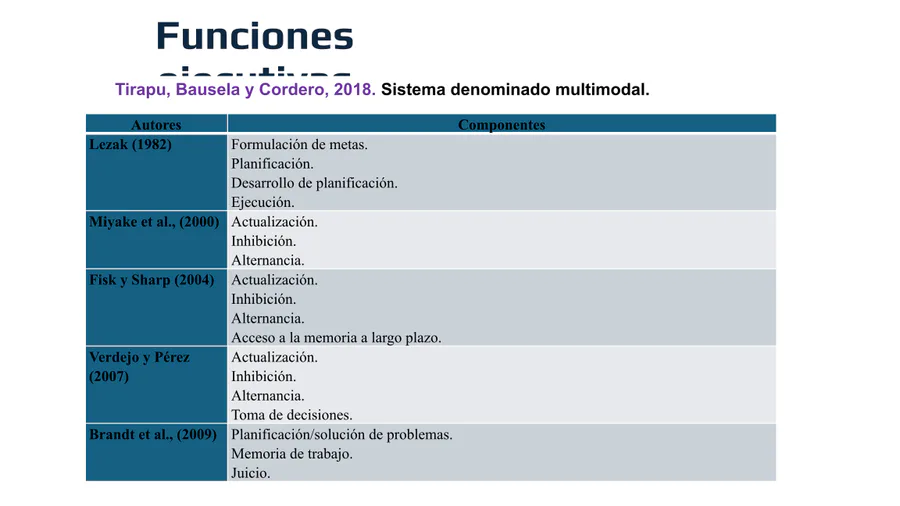
What are executive functions according to Lezak (1982)?
Processes that regulate human behavior
Strategies for problem-solving
Ability to find solutions to new problems
Functions of self-regulation
5
6

7
Multiple Choice
What does 'Flexibilidad Cognitiva' refer to in executive functions?
Ability to switch tasks flexibly
Memory retention
Speed of processing
Verbal fluency
8

9
Multiple Choice
What are the dominant dimensions related to executive tasks in children aged 7 years?
Flexibility
Inhibition
Working Memory
All of the above
10

11
Multiple Choice
What is the purpose of the BRIEF®-2 evaluation?
To assess academic performance
To evaluate executive function aspects
To measure emotional intelligence
To analyze social skills
12

13
Multiple Choice
What are the different components that can be evaluated in the assessment of executive functions?
Phonological loop
Visuospatial agenda
Central executive system
All of the above
14

15
Multiple Choice
What are the symptoms of Specific Learning Disorder according to DSM-V?
Imprecise or slow reading
Difficulty understanding the meaning of what is read
Orthographic difficulties
Mathematical reasoning difficulties
16
Multiple Choice
Maya, a student, has been identified as having SLD. What type of disability does Maya have?
Special Language Deficit
Specific Language Disability
Specific Learning Deficit
Specific Learning Disability
17

18
Multiple Choice
What are the academic skills affected according to DSM-V?
Quantifiable skills
Social skills
Physical skills
Creative skills
19

20
Multiple Choice
What are the specific difficulties in learning that are not explained by intellectual disabilities or other disorders?
Visual impairments
Psychosocial adversity
Lack of academic instruction
All of the above
21
Multiple Choice
All learning disabilities are classified as
physical disorders
fake disorders
neurological disorders
hypothetical disorders
22

23
Multiple Choice
What is the definition of dyslexia according to the International Dyslexia Association?
A specific learning difficulty
A type of neurological disorder
A condition affecting reading and writing
A normal condition
24

25
Multiple Choice
What are the types of reading errors based on their severity?
Leve
Grave
Moderate
Critical
26

27
Multiple Choice
What are some risk factors for preschool children related to learning difficulties?
Difficulty remembering days of the week
Ability to write their name
Understanding spatial concepts
Memorizing nursery rhymes
28

29
Multiple Choice
What are some persistent difficulties that children aged 6 to 7 may face when learning to read and write?
Difficulty in learning to read and write
Excessive mirror writing frequency
Understanding spatial concepts
All of the above
30

31
Multiple Choice
What are some common reading difficulties faced by children aged 7-8 in primary school?
Confusing similar letters
Difficulty with multiplication tables
Struggling with punctuation
All of the above
32

33
Multiple Choice
What are some factors that can affect the learning process of children aged 8 to 12 years?
Rejection of written compositions
High self-esteem
Difficulty in mathematics
Strong vocabulary
34
Multiple Choice
This specific LD is associated with difficulty in the area of reversing letters, inaccurate copying, and coordination.
Dyslexia
Aphasia/Dysphasia
Dysgraphia
Visual Perception/Visual Motor
35
Multiple Choice
This specific LD is associated with difficulty in the area of written language.
Dyslexia
Dyscalculia
Dysgraphia
Aphasia/Dysphasia
36

37
Fill in the Blanks
Type answer...
38
Multiple Choice
Which area is responsible for the formulation of linguistic and verbal programming?
Wernicke
Broca
Angular gyrus
Supramarginal gyrus
39
Multiple Choice
What is the function of the primary auditory area?
Receives visual stimuli
Receives auditory stimuli
Recognizes graphemes
Controls eye movements
40

41
Multiple Choice
What are the key components of the intervention for dyslexia as mentioned in the image?
Visual functionality
Auditory functionality
Memory
All of the above
42

43
Fill in the Blanks
Type answer...
44
Multiple Select
Identify the auditory functionality exercises listed in the image.
Identify syllables
Mark a number in a word search
Select the sound of a car
Distinguish similar sounds
45
Multiple Choice
What are some strategies for visual functionality mentioned in the image?
Follow the movement of a flashlight
Identify sounds with eyes closed
Mark a letter in a phrase
Select the sound of a boat
46

47
Open Ended
Describe how psychomotor skills can be developed according to the image.
48
Fill in the Blanks
Type answer...
49
Multiple Select
What activities are suggested for developing visuospatial skills?
Laberintos, tangram
Memorizing drawings
Indicating directions
Reproducing figures
50
Multiple Choice
What strategies can be used to enhance memory skills according to the image?
Memorizing drawings, letters, and numbers
Solving mazes and tangrams
Indicating images to the right or left
Completing missing parts in a figure
51

52
Open Ended
Contar el número de sílabas de una palabra dando palmas.
53
Multiple Choice
¿Qué queda si a cesto le quitas ces-?
to
c
s
e
54
Multiple Choice
¿Cuántos sonidos tiene la palabra cama?
2
3
4
5
55
Multiple Choice
Which strategy would help a student blend phonemes to form a word?
Listening to a song
Saying each sound slowly and then quickly
Writing each sound separately
Drawing a picture of the word
56
Multiple Choice
Which strategy would help a student identify the number of phonemes in a word?
Clapping for each syllable
Counting on fingers for each sound
Writing the word
Drawing a picture of the word
57

58
Multiple Choice
What strategies do good readers use while reading?
They ask questions and then search the text for answers as they read
They highlight important information as they read
They identify the main idea for each paragraph they read
They visualize and make connections to the reading
All of the above
59
Poll
¿Qué tan seguro te sientes acerca de este tema ahora?
Show answer
Auto Play
Slide 1 / 59
SLIDE
Similar Resources on Wayground

55 questions
PANDUAN PENGGUNAAN QUIZIZZ
Presentation
•
Professional Development
55 questions
Meeting With Vendors
Presentation
•
Professional Development
54 questions
LITERATURA 2 ENERO JUNIO 2023
Presentation
•
Professional Development
52 questions
Famous clothesชทธ67-2 เก็บตก
Presentation
•
Professional Development
56 questions
GRAMMAR FOR RECEPTION
Presentation
•
KG
54 questions
D4.2. SparkEd 2023
Presentation
•
Professional Development
55 questions
Pembelajaran Melalui Quizizz dan Kahoot - SMKN 55 Jakarta
Presentation
•
Professional Development
55 questions
Facebook: insights e inserzioni
Presentation
•
Professional Development
Popular Resources on Wayground
6 questions
Secondary Safety Quiz
Presentation
•
9th - 12th Grade
10 questions
MyPath Diagnostic Overview
Presentation
•
6th - 8th Grade
20 questions
Lab Safety Quiz

Quiz
•
6th Grade
21 questions
Continents and Oceans
Quiz
•
6th Grade
20 questions
Adding and Subtracting Decimals
Quiz
•
5th Grade
20 questions
Parts of Speech
Quiz
•
5th Grade
16 questions
Subject & Predicate
Quiz
•
5th Grade
21 questions
Lab Safety
Quiz
•
10th Grade
Discover more resources for Special Education
5 questions
Setting goals for the year
Quiz
•
Professional Development
87 questions
STEM Academy
Quiz
•
Professional Development
20 questions
Employability Skills
Quiz
•
Professional Development
20 questions
Interval & Set Notation
Quiz
•
9th Grade - Professio...
10 questions
How to Email your Teacher
Quiz
•
Professional Development