

3GENBIO2 - CENTRAL DOGMA OF MOLECULAR BIOLOGY

Presentation
•
Biology
•
11th Grade
•
Easy

Noah Shen Datinginoo
Used 35+ times
FREE Resource
65 Slides • 19 Questions
1

2

3
4

5

6
Multiple Choice
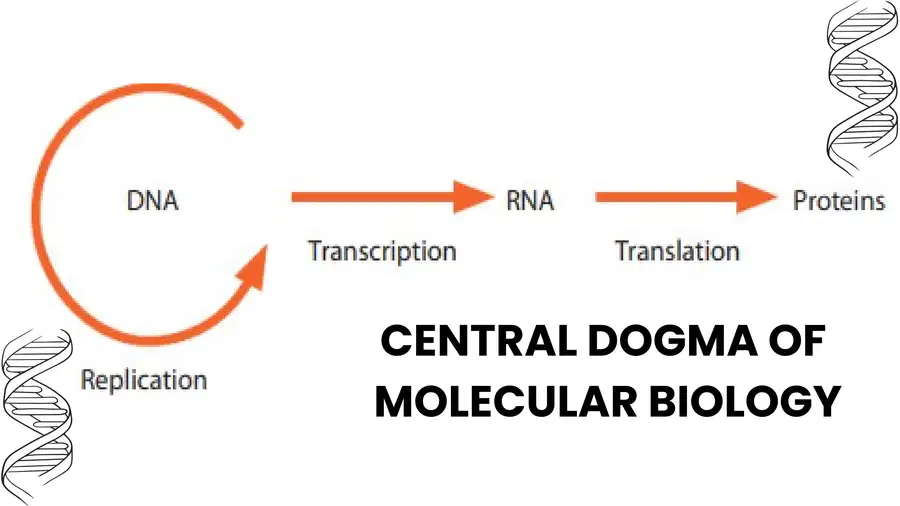
Which process describes the flow of genetic information from DNA to RNA to proteins?
Replication
Transcription and Translation
Translation and Replication
Transcription only
7
Multiple Select
Select all correct statements about the central dogma of molecular biology.
DNA is transcribed to RNA.
RNA is translated to protein.
Proteins are transcribed to DNA.
DNA is replicated to form new DNA.
8

9

10

11
Fill in the Blanks
The process by which DNA is copied to produce a new DNA molecule is called
12
Multiple Choice

AATCATGGA
13

14

15
16
Multiple Choice
Which of the following statements about DNA replication is correct?
DNA replication occurs in the cytoplasm.
DNA replication produces a new copy of DNA inside the nucleus.
DNA replication creates proteins from DNA.
DNA replication converts RNA into DNA.
17
Multiple Choice
Which DNA replication model results in each daughter molecule having one parental strand and one newly synthesized strand after two replication cycles?
Semiconservative model
Conservative model
Dispersive model
Random model
18
Fill in the Blanks
DNA synthesis always proceeds in the ___ to ___ direction.
19
Multiple Choice
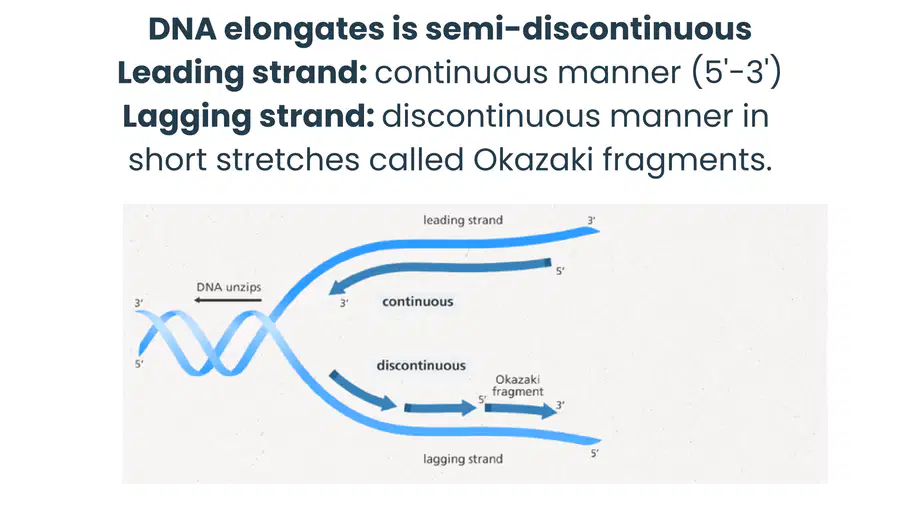
Which of the following statements about DNA elongation is correct?
The leading strand is synthesized continuously in the 5' to 3' direction.
The lagging strand is synthesized continuously in the 3' to 5' direction.
Both strands are synthesized in a discontinuous manner.
Okazaki fragments are found on the leading strand.
20

21

22

23

24

25
26
Open Ended
Compare and contrast the roles of DNA helicase and RNA primase in DNA replication.
27
Multiple Choice
Which enzymes are directly involved in the initiation of DNA replication?
DNA helicase and RNA primase
DNA polymerase and DNA ligase
RNA polymerase and DNA gyrase
Topoisomerase and DNA polymerase
28
Multiple Choice
What is the main difference between the leading and lagging strands during DNA replication?
The leading strand is synthesized continuously, while the lagging strand is synthesized in fragments.
The leading strand is made of RNA, while the lagging strand is made of DNA.
The leading strand is synthesized in the 3' to 5' direction, while the lagging strand is synthesized in the 5' to 3' direction.
The leading strand is only found in prokaryotes, while the lagging strand is only found in eukaryotes.
29
Multiple Choice
Which enzyme is responsible for binding to the primer and synthesizing a new DNA strand in the 5' to 3' direction?
DNA polymerase
Helicase
Ligase
Topoisomerase
30
Multiple Choice
Which enzyme replaces RNA primers with DNA nucleotides during continuous DNA synthesis?
DNA polymerase I
DNA polymerase III
Exonuclease
Ligase
31
32

33
34

35

36

37
38

39

40
41
Multiple Choice
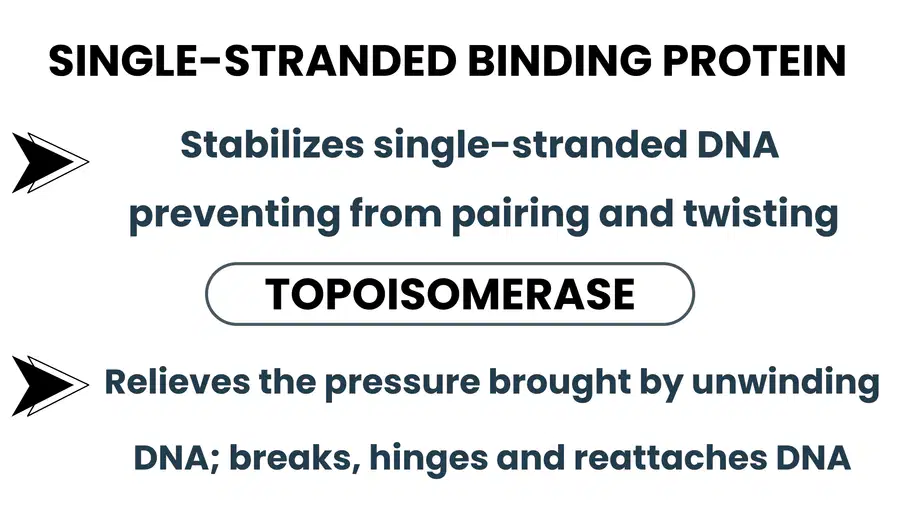
Arrange the following steps of DNA replication in the correct order: (1) Topoisomerase untwists the double helix, (2) Helicase separates the strand, (3) Single-stranded binding proteins prevent the unwound strands from rejoining.
2, 3, 1
1, 2, 3
2, 1, 3
3, 2, 1
42
Multiple Choice
Which enzyme is responsible for adding DNA nucleotides to the RNA primer during DNA replication?
Primase
DNA Polymerase
Ligase
Helicase
43
Multiple Choice
What is the main difference between the synthesis of the leading and lagging strands during DNA replication?
The leading strand is synthesized continuously, while the lagging strand is synthesized discontinuously.
The leading strand uses RNA nucleotides, while the lagging strand uses DNA nucleotides.
The leading strand is synthesized in the 3' to 5' direction, while the lagging strand is synthesized in the 5' to 3' direction.
The leading strand requires ligase, while the lagging strand does not.
44
Multiple Choice
Which of the following enzymes is involved in unwinding the DNA double helix during replication?
Ligase
Helicase
DNA Polymerase
Primase
45
46
Fill in the Blanks
DNA replication proceeds in the ___ to ___ direction on the leading strand.
47
Multiple Choice
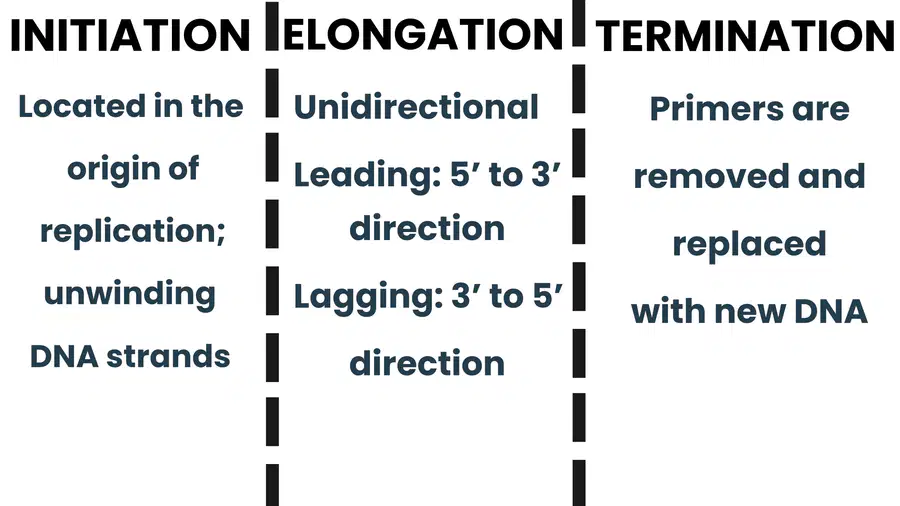
Match the following stages of DNA replication with their correct descriptions: Initiation, Elongation, Termination.
Initiation - Unwinding DNA strands; Elongation - Synthesis of new DNA strands; Termination - Removal of primers and replacement with DNA
Initiation - Synthesis of new DNA strands; Elongation - Unwinding DNA strands; Termination - Removal of primers and replacement with DNA
Initiation - Removal of primers and replacement with DNA; Elongation - Synthesis of new DNA strands; Termination - Unwinding DNA strands
Initiation - Synthesis of Okazaki fragments; Elongation - Unwinding DNA strands; Termination - Synthesis of new DNA strands
48

49

50
51
52

53
54

55
56

57
58
59

60

61

62

63
64

65

66

67
68

69

70
71

72
73

74

75

76

77
78

79

80

81

82

83
84
Show answer
Auto Play
Slide 1 / 84
SLIDE
Similar Resources on Wayground

77 questions
Ch. 7 L. 4 Cellular Transport Review
Presentation
•
9th - 12th Grade
78 questions
Eukaryotes, Prokaryotes, Plant Cells and Animal Cells
Presentation
•
KG
82 questions
LabBioCh4Slides
Presentation
•
9th - 12th Grade
72 questions
Hair Evidence Notes
Presentation
•
11th Grade
72 questions
Unit 1 Review
Presentation
•
9th - 12th Grade
76 questions
Cell Structure and Function
Presentation
•
9th - 11th Grade
79 questions
Classification
Presentation
•
10th Grade
76 questions
CP Bio : Cell Structure and Function Notes
Presentation
•
10th Grade
Popular Resources on Wayground
10 questions
Safety Day 2026 – Student Review

Quiz
•
9th Grade
21 questions
Continents and Oceans
Quiz
•
6th Grade
20 questions
Parts of Speech
Quiz
•
5th Grade
16 questions
Subject & Predicate
Quiz
•
5th Grade
25 questions
Multiplication Facts
Quiz
•
5th Grade
12 questions
Map Skills
Quiz
•
3rd Grade
22 questions
Continents and Oceans
Quiz
•
5th Grade
15 questions
Rounding Decimals
Quiz
•
5th Grade
Discover more resources for Biology
20 questions
Cell Transport
Quiz
•
9th - 12th Grade
8 questions
DNA vs. RNA
Presentation
•
9th - 12th Grade
16 questions
Epithelial tissues
Quiz
•
11th - 12th Grade
15 questions
DNA Structure and Replication
Quiz
•
9th - 12th Grade
20 questions
Ecological Succession Review
Quiz
•
9th - 12th Grade
22 questions
Photosynthesis and Cellular Respiration Review
Quiz
•
9th - 11th Grade
3 questions
Enzymes & Energy
Quiz
•
9th - 12th Grade
38 questions
Mitosis & Meiosis
Quiz
•
9th - 12th Grade