

FAA Part 107 Jan 26

Presentation
•
Computers
•
9th - 12th Grade
•
Hard

Edward King
FREE Resource
10 Slides • 9 Questions
1
FAA Part 107
2
Multiple Choice
A local TV station has hired a remote pilot to operate their small UA to cover new stories. The remote pilot has had multiple near misses with obstacles on the ground and two small UAS accidents. What would be a solution for the news station to improve their operating safety culture?
The news station does not need to make any changes; there are times that an accident is unavoidable
The news station should implement a policy of no more than five crashes/incidents within 6 months.
The news station should recognize Hazardous attitues and situations and develop standard operating procedures that emphasize safety.
3
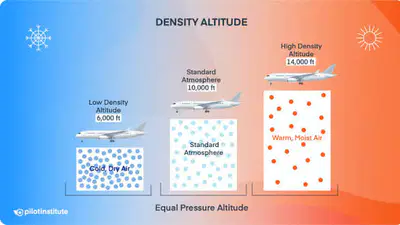
High density altitude decreases a Unmanned Aircraft (UA) propeller's efficiency because the air is thinner (less dense), meaning there are fewer air molecules for the propeller blades to push against, resulting in less thrust and reduced overall performance, requiring longer takeoffs and slower climbs.
4
Multiple Choice
What does High density altitude have on the efficiency of a UA propellor?
Density altitude does not affect propellor efficiency
Propellor efficiency is Decreased
Propellor efficiency is increased
5
What is Class C airspace
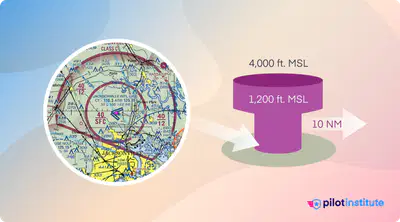
Class C airspace surrounds busy, medium-sized airports with moderate air traffic, featuring an "upside-down wedding cake" shape with an inner 5-mile radius (surface to 4,000 ft AGL) and an outer 10-mile radius (1,200 ft to 4,000 ft AGL), requiring pilots to establish two-way radio contact with ATC and use an altitude-reporting transponder for safe traffic separation.
6
What you need to operate in Class C airspace
To operate a drone in Class C airspace under 14 CFR Part 107, you must first get prior authorization from Air Traffic Control (ATC), typically through the FAA's LAANC system or DroneZone, because Part 107.41 requires authorization in controlled airspace, and you must also meet all other Part 107 requirements like pilot certification and registration.
7
Multiple Choice
According to 14 CFR part 107, what is required to operate an unmanned aircraft in Class C airspace?
The remote pilot must monitor the Air Traffic Control (ATC) frequency from launch to recovery.
The remote must have prior authorization from the Air Traffic Control (ATC) facility having jurisdiction over that airspace.
The remote pilot must contact the Air Traffic Control (ATC) facility after launching the unmanned aircraft.
8
Multiple Choice
According to 14 CFR part 107, an RPIC planning to operate within Class C airspace
Is required to receive ATC authorization
Is required to file a flight plan
Must use a visual observer
9
Preparing for a night flight
After using bright lights for a night sUAS preflight, a pilot must be aware that their eyes need 15 to 30 minutes to fully adapt to the dark, meaning night vision is significantly reduced initially, requiring them to avoid bright lights and use low-intensity or red lights to maintain situational awareness and see their drone and surroundings.
10
Why this matters for night flights
Dark Adaptation: The human eye's rods, crucial for low-light vision, get bleached by bright light, taking time to recover.
Impaired Vision: Bright white light drastically reduces your ability to see in the dark, making it hard to spot your aircraft or other obstacles.
Situational Awareness: Without proper adaptation, you risk losing visual contact with your drone or failing to see other hazards, compromising safety.
11
Multiple Choice
When preparing for a night flight, what should an sUAS pilot be aware of after assembling and conducting a preflight of an aircraft while using a bright flashlight or work light?
It takes approximately 30 minutes for persons eyes to fully adapt to darkness.
Once adapted to darkness, a person's eyes are relatively immune to bright lights.
The person should use a flash light equipped with LED lights to facilitate their night vision
12
Reading METARs
METAR KINK 121845Z 11012G18KT 15SM SCK 25/17 A3000
METAR KBOI 121854Z 13004KT 30SM SCT150 17/6 A3015
METAR KLAX 121852Z 25004KT 6SM BR SCT007 SCT250 16/15 A2991
SPECI KMDW 121856Z 32005KT 1 1/2SM RA OVC007 17/16 A2980 RMK RAB35
SPECI KJFK 121853Z 18004KT 1/2SM FG R04/2200 OVC005 20/18 A3006
13
METAR/SPECI Breakdown (KJFK Example)
SPECI KJFK 121853Z 18004KT 1/2SM FG R04/2200 OVC005 20/18 A3006
SPECI: Special observation (not on a fixed schedule).
KJFK: Airport identifier (John F. Kennedy International).
121853Z: Date (12th day) and Time (18:53 Zulu/UTC).
18004KT: Wind from 180° (South) at 4 knots.
1/2SM: Visibility 1/2 Statute Mile.
FG: Fog (weather phenomenon).
R04/2200: Runway visual range (RVR) for Runway 04 is 2200 feet (a remark).
OVC005: Overcast clouds at 500 feet above ground level (AGL).
20/18: Temperature 20°C / Dewpoint 18°C.
A3006: Altimeter setting 30.06 inches.
14
Multiple Choice
METAR KINK 121845Z 11012G18KT 15SM SCK 25/17 A3000
METAR KBOI 121854Z 13004KT 30SM SCT150 17/6 A3015
METAR KLAX 121852Z 25004KT 6SM BR SCT007 SCT250 16/15 A2991
SPECI KMDW 121856Z 32005KT 1 1/2SM RA OVC007 17/16 A2980 RMK RAB35
SPECI KJFK 121853Z 18004KT 1/2SM FG R04/2200 OVC005 20/18 A3006
The wind direction and velocity at KJFK is from?
180 degrees true at 4 knots
180 degrees magnetic at 4 knots
040 degrees true at 18 knots
15
Multiple Choice
AN RPIC who is employed by an energy Co-Op provider will use their small UA to inspect power lines in a remote area that is a 15-hour drive from their home office. After the long, fatigue has impacted the RPIC's ability to complete the assignment on time. Fatigue can be recognized
Easily by an experienced pilot.
As being in impaired state.
By an ability to overcome sleep deprivation
16
What it means
The key takeaway is that fatigue constitutes an impaired state, and the law prohibits flying while impaired [3, 4].
This scenario describes a situation where a Remote Pilot in Command (RPIC) operating a small Unmanned Aircraft (sUA) for power line inspection is likely in violation of Federal Aviation Administration (FAA) regulations regarding fatigue and potentially other operational rules [3, 4].
17
Temporary Flight restriction
A TFR, or Temporary Flight Restriction, is an FAA-issued order restricting aircraft (including drones) from flying in a specific area for safety or security, often due to VIP movements, natural disasters (fires, hurricanes), large sporting events, or national security. These temporary rules prevent non-participating aircraft from interfering with emergency operations, protecting the public, and ensuring safe airspace management, similar to closing a road for an event.
18
Multiple Choice
Your surveying company is a title sponsor for a race team at the Indianapolis 500. To promote your new aerial surveying department, you decide to video part of the race using a small UA. The FAA has issued a Temporary Restriction (TFR) for the race in the area you plan to fly. In this situation
You may fly your Drone in the TFR since your company is sponsoring a team in the race.
The TFR applies to all aircraft; you may not fly in the area without a certificate of Waiver or Authorization
Flying your Drone is allowed if you notify all non-participating people of the closed course UA operation.
19
Multiple Choice
When a Remote Pilot-in-command and a visual observer define their roles and responsibilities prior to and during the operation of a small UA
Crew resource management
Authoritarian Resource management
Risk management
FAA Part 107
Show answer
Auto Play
Slide 1 / 19
SLIDE
Similar Resources on Wayground

13 questions
Types of Chemical Reactions
Presentation
•
9th - 12th Grade
13 questions
Properties of Parallelograms
Presentation
•
9th - 12th Grade
13 questions
El alfabeto/Abecedario
Presentation
•
9th - 12th Grade
13 questions
Theme Review
Presentation
•
9th - 12th Grade
15 questions
Globalization
Presentation
•
9th - 12th Grade
13 questions
Part 2 Mastering Microsoft PowerPoint
Presentation
•
9th - 12th Grade
14 questions
Percent Yield
Presentation
•
9th - 12th Grade
13 questions
Warstwy protokołów TCP/IP
Presentation
•
9th - 12th Grade
Popular Resources on Wayground
16 questions
Grade 3 Simulation Assessment 2

Quiz
•
3rd Grade
19 questions
HCS Grade 5 Simulation Assessment_1 2526sy
Quiz
•
5th Grade
10 questions
Cinco de Mayo Trivia Questions

Interactive video
•
3rd - 5th Grade
17 questions
HCS Grade 4 Simulation Assessment_2 2526sy
Quiz
•
4th Grade
24 questions
HCS Grade 5 Simulation Assessment_2 2526sy
Quiz
•
5th Grade
13 questions
Cinco de mayo
Interactive video
•
6th - 8th Grade
20 questions
Math Review
Quiz
•
3rd Grade
30 questions
GVMS House Trivia 2026
Quiz
•
6th - 8th Grade