Tracing Patterns in the Sky
Presentation
•
Science
•
9th - 12th Grade
•
Hard
Standards-aligned
Eizhen Gisella undefined
Used 1+ times
FREE Resource
30 Slides • 14 Questions
1
2
3
4
5
6
Multiple Choice
sort of cool, dim (not too much light), and red?
Betelgeuse
7
Multiple Choice
Which type of star has low temperature and high luminosity?
Blue Giants
Red Giants
White Dwarfs
Red Supergiants
8
9
10
11
12
13
14
Multiple Choice
Use the HR-diagram on the left to answer the following question:
Which of the following statements accurately describes one of the stars in the HR diagram?
Star A is the brightest star.
Star B is a red star.
Star C is the dimmest star.
Star D is the hottest star.
15
16
Multiple Choice
What is the primary reason constellations were created and used by ancient civilizations?
For entertainment by creating stories and myths
To aid in the design of their buildings
For navigation and to mark the seasons
To predict the future through astrology
17
18
Multiple Choice
What role did ancient star maps play in the lives of travelers and cultures?
They were used only for navigation
They explained natural phenomena
They were only for decoration
They had no significance
19
20
Multiple Choice
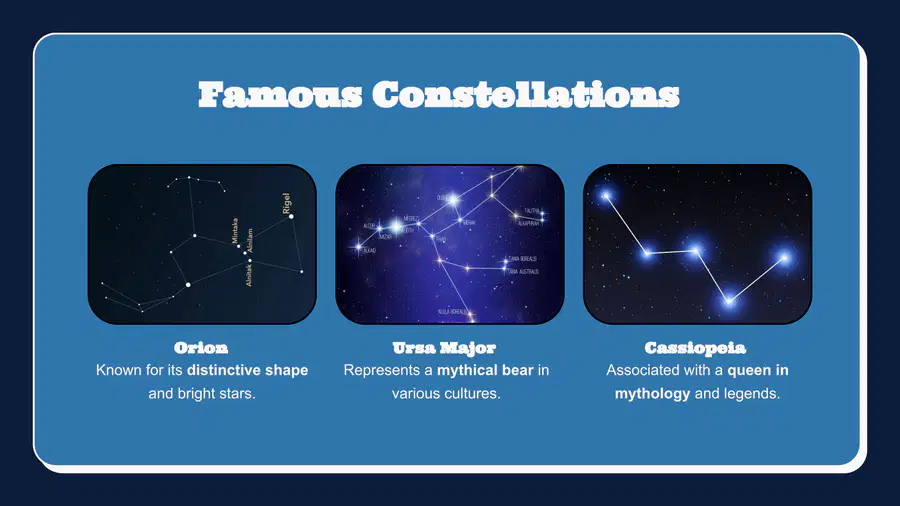
Examine the constellation in the image. Which of the following statements is true about it?
The stars are inside the Solar System, among the Outer Planets (like Jupiter).
The stars are all the same distance from Earth.
The stars are all close to each other in the universe.
The stars are actually nowhere near each other as they are vastly different distances from each other.
21
22
23
24
25
Multiple Choice
What is the name of the brightest star in the constellation Ursa Minor?
Sirius
Betelgeuse
Polaris
Vega
26
Multiple Choice
Why is Polaris important for navigation?
It is the brightest star in the sky
It always appears in the southern sky
It is located nearly at the north celestial pole
It changes colors frequently
27
28
Fill in the Blanks
Constellations that never disappear below the horizon and can be seen year round:
29
30
Open Ended
Name the northern latitude constellation that is easily recognized by 5 bright stars forming an irregular "W", some observers seeing not only a W but also a chair. One of the brightest novae on record appeared in this constellation in 1572.
31
32
33
34
35
Multiple Choice
Which zodiac sign corresponds to the symbol of the Ram?
Taurus
Gemini
Aries
Cancer
36
Multiple Choice
What are Zodiac signs?
Constellations that are used in navigation.
Signs used in astronomy to identify stars.
Astrological signs based on the position of the sun, moon, and planets at the time of a person's birth.
Symbols used in space technology.
37
Multiple Choice
There are ____ zodiac constellations.
6
9
12
16
38
Multiple Choice
An observer in New York State sees different constellations in the winter nighttime sky than she sees in the summer nighttime sky. Which statement best explains the reason for this difference?
The Earth rotates on its axis.
The Earth revolves around the Sun.
Constellations revolve around the Earth.
Constellations revolve around the Sun.
39
40
41
42
43
44
Show answer
Auto Play
Slide 1 / 44
SLIDE

Similar Resources on Wayground
35 questions
Color (light Waves)
Presentation
•
9th - 12th Grade
35 questions
13.1 Solutions
Presentation
•
9th - 12th Grade
39 questions
Earth Materials: Minerals
Presentation
•
9th - 12th Grade
39 questions
Historical Skills & Evaluating Sources
Presentation
•
9th - 12th Grade
38 questions
2/3 Intro to Forensics FBISD Austin HS
Presentation
•
9th - 12th Grade
37 questions
Passive and Active Transport
Presentation
•
9th - 12th Grade
37 questions
Periodic Table Review
Presentation
•
9th - 12th Grade
Popular Resources on Wayground
6 questions
PRIDE Always and Everywhere
Presentation
•
12th Grade
20 questions
Lab Safety Quiz
Quiz
•
6th Grade
26 questions
KOR Review Kahoot Questions
Quiz
•
8th Grade
21 questions
Continents and Oceans
Quiz
•
6th Grade
12 questions
Unit Zero lesson 2 cafeteria
Presentation
•
9th - 12th Grade
20 questions
Parts of Speech
Quiz
•
5th Grade
10 questions
Riddles Riddles fun Riddles
Quiz
•
6th - 12th Grade
16 questions
Subject & Predicate
Quiz
•
5th Grade
Discover more resources for Science
10 questions
Scientific Method (The scientific method)
Interactive video
•
9th Grade
10 questions
Exploring Chemical and Physical Changes
Interactive video
•
6th - 10th Grade
10 questions
Exploring the States of Matter
Interactive video
•
6th - 10th Grade
20 questions
Atomic Structure
Quiz
•
9th Grade
30 questions
Atomic Structure and Periodic Table Review
Quiz
•
10th Grade
9 questions
Exploring the Steps of the Scientific Method
Interactive video
•
6th - 10th Grade
16 questions
Identify Key Characteristics of Living Organisms
Quiz
•
9th - 12th Grade
20 questions
Photosynthesis
Quiz
•
9th Grade