KIP: Plate Tectonics & Earth's Surface
Presentation
•
Science
•
7th Grade
•
Medium
+2
Standards-aligned
Miricle Hawkins
Used 16+ times
FREE Resource
11 Slides • 9 Questions
1
2
3
4
5
Multiple Choice
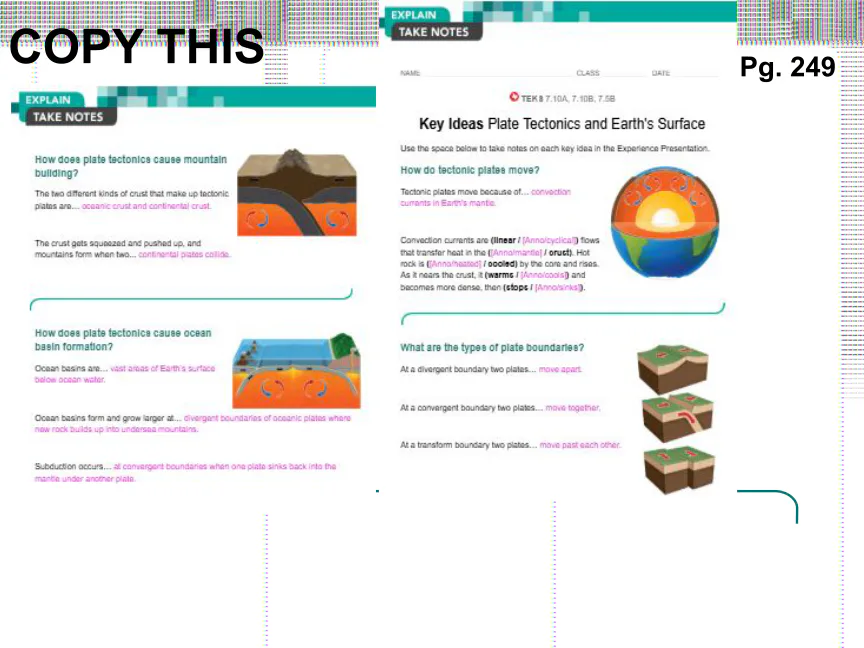
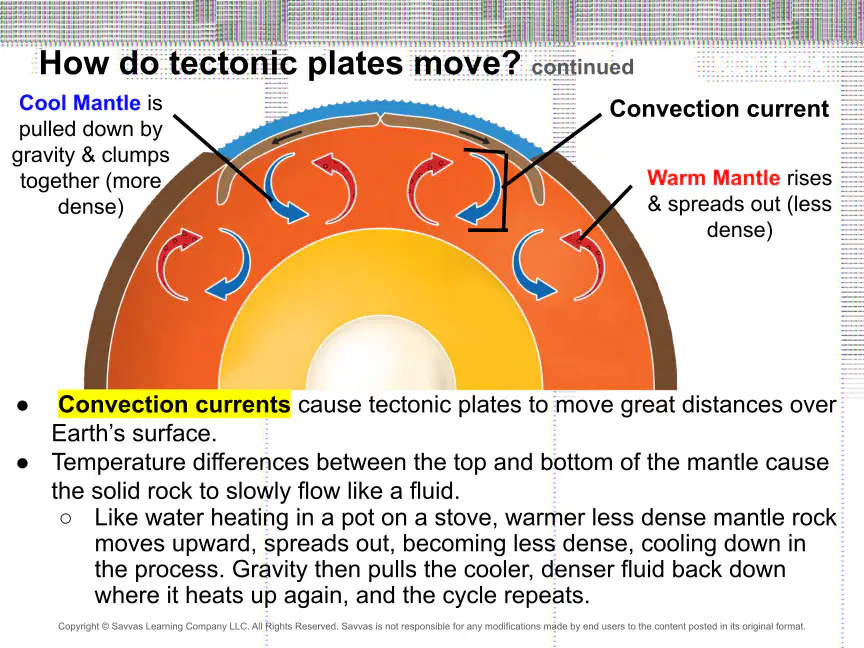
Which of the following statements best explains how convection currents move tectonic plates?
Convection currents in the mantle cause the plates to move by heating and cooling the rock, creating a cycle of rising and sinking material.
The core directly pushes the plates apart with its heat.
The crust expands and contracts, causing the plates to move.
Earthquakes alone are responsible for plate movement.
6
7
8
9
Labelling
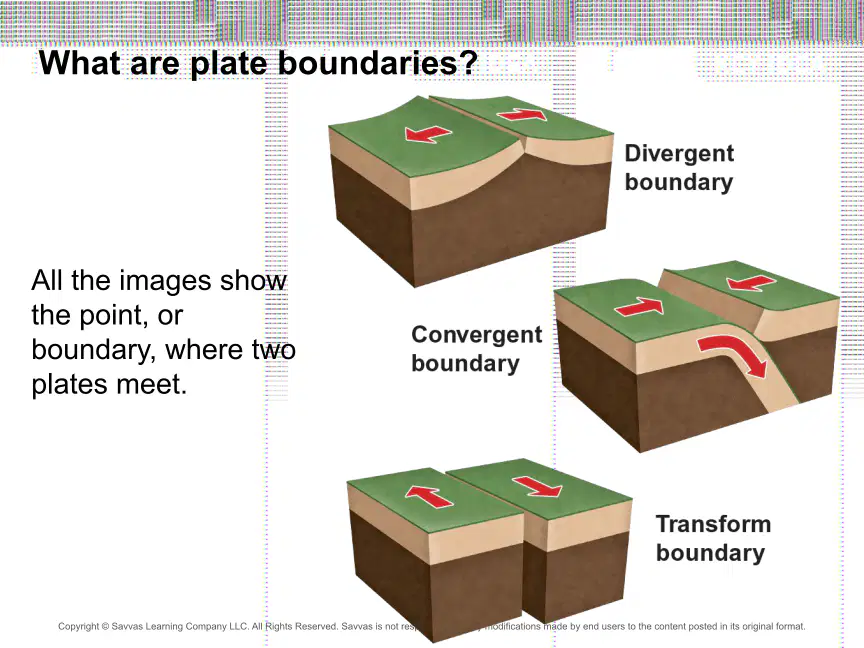
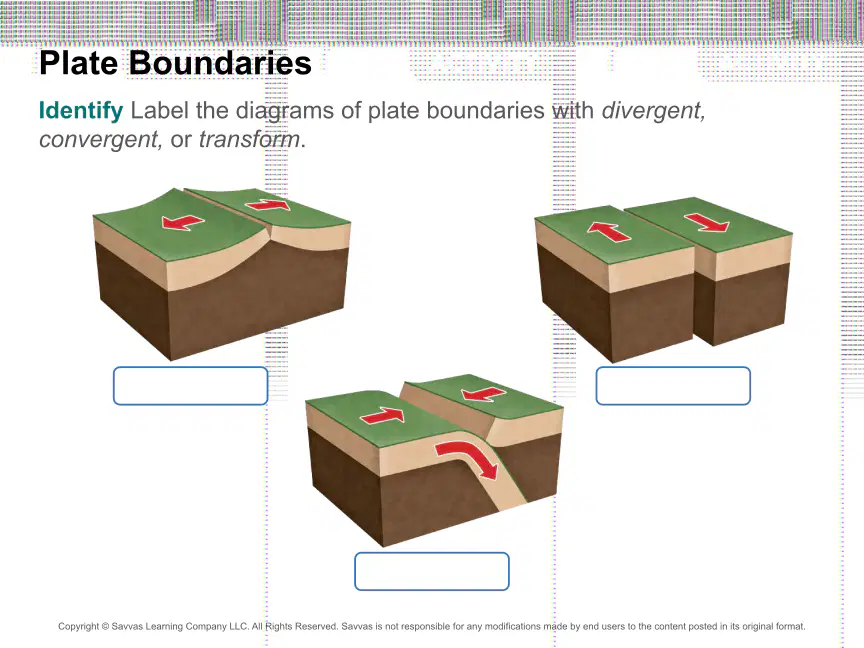
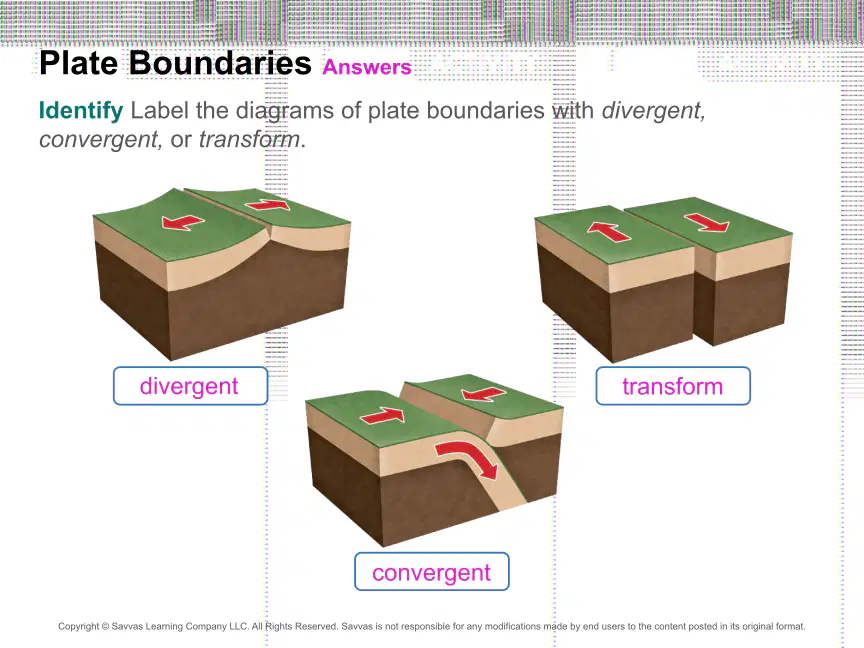
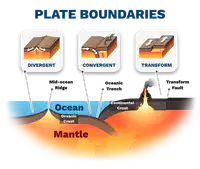
Label the diagrams of plate boundaries with divergent, convergent, or transform.
Transform
Divergent
Convergent
10
11
Multiple Choice
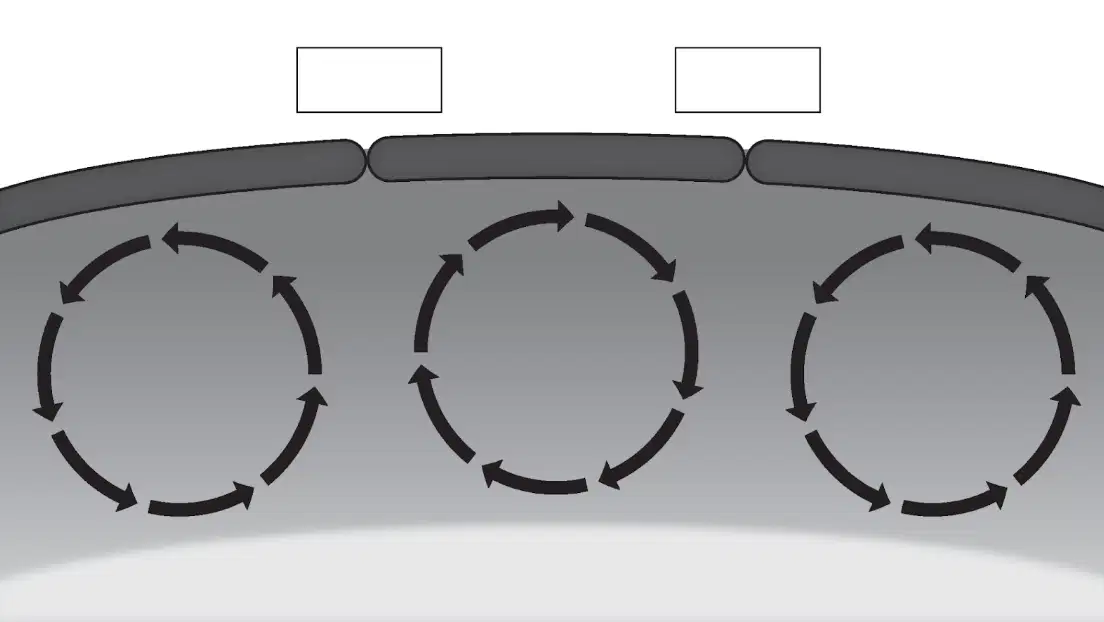
Look at the image with two empty boxes for labels.
How can you correctly label the boundary type in each box?
Both labels should say transform boundary.
Both labels should say divergent boundary.
From left to right, the labels should say convergent boundary, then transform boundary.
From left to right, the labels should say divergent boundary, then convergent boundary.
12
13
Multiple Choice
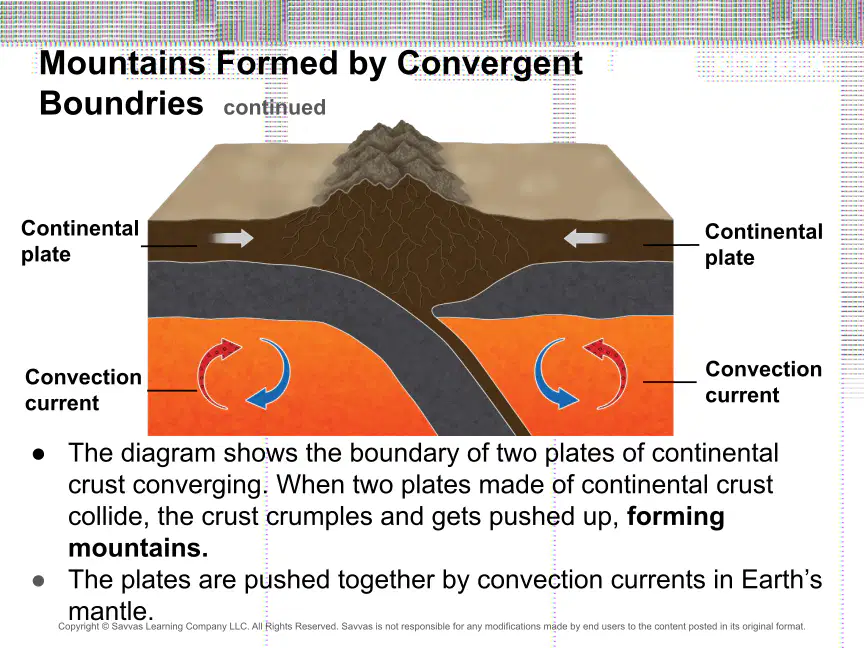
At which boundary type are mountains usually formed?
Convergent
Divergent
Transform
Convection
14
15
Multiple Choice
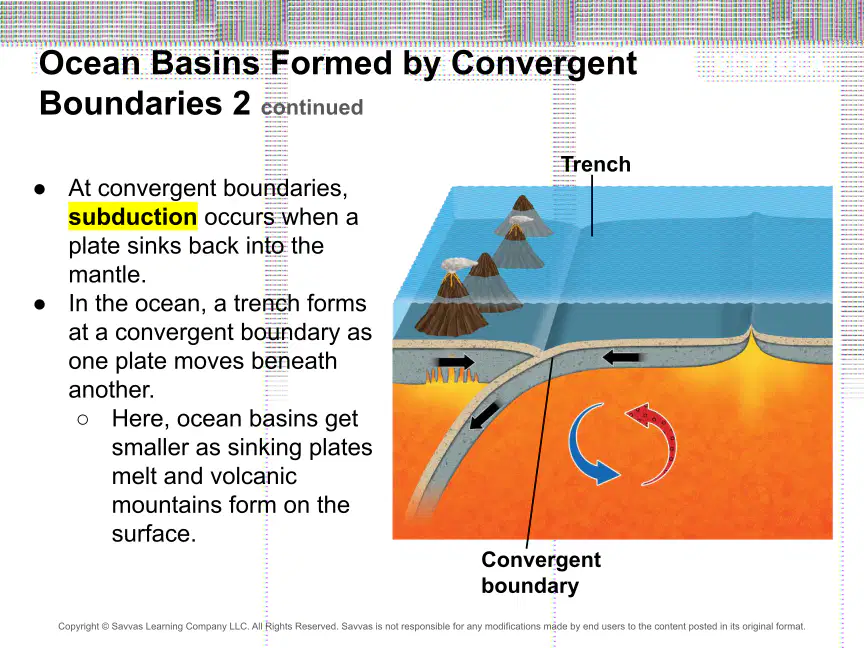
How does plate tectonics cause ocean basin formation?
New crust forms due to seafloor spreading at convergent boundaries.
New crust forms due to seafloor spreading at divergent boundaries.
Oceanic trenches form at transform boundaries.
Oceanic trenches form at divergent boundaries.
16
Multiple Choice
Which statement best explains how tectonic plates form ocean basins?
Ocean basins form at convergent boundaries when one plate sinks beneath another, creating trenches and mountain ranges.
Ocean basins form at divergent boundaries when convection currents in the mantle push magma upward, pulling plates apart so magma cools and forms new seafloor.
Ocean basins form at transform boundaries when plates slide past each other, causing earthquakes that create new seafloor.
Ocean basins form when erosion wears away land, allowing ocean water to fill the space.
17
Multiple Choice
Which seafloor features are most commonly found where new ocean basins form?
Deep-sea trenches and folded mountains
Coral reefs and barrier islands
Sand dunes and river deltas
Mid-ocean ridges, rift valleys, and volcanoes
18
19
Multiple Choice
Subduction zones can result in all of the following geologic features EXCEPT:
Volcanoes
Mountains
Mid-ocean ridges
Trenches
20
Open Ended
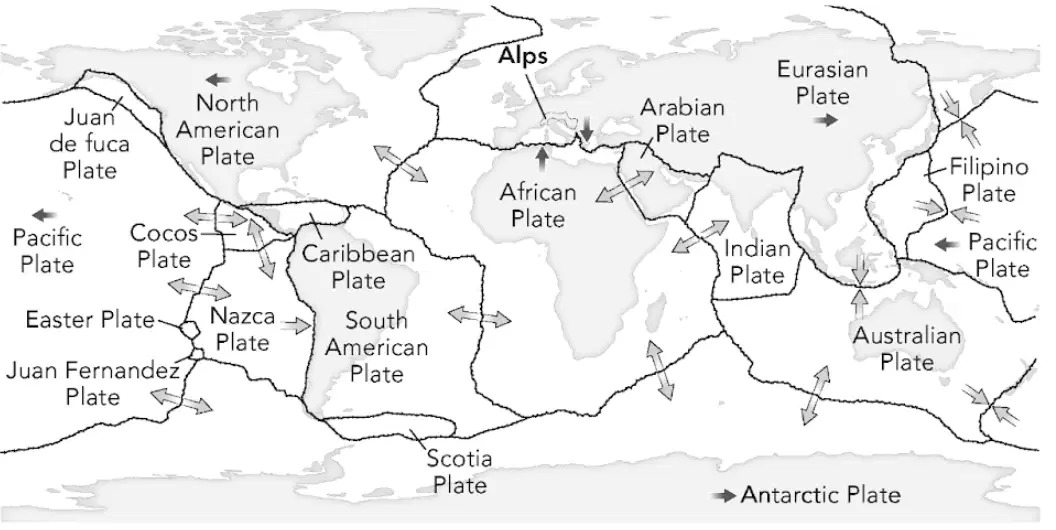
Satellite technology has allowed scientists to detect vertical movements of rock on Earth. Over a 4-year period, satellites measured locations in the central portion of the Alps Mountains and determined there was an increase of approximately +2.5 mm per year. The Alps are located on the Eurasian plate and are labeled on the map.
Describe the geologic process that is most likely responsible for the Alps continuing to grow taller. Refer to specific plates when describing movement.
Show answer
Auto Play
Slide 1 / 20
SLIDE

Similar Resources on Wayground
14 questions
Plate Tectonics
Presentation
•
7th Grade
19 questions
Skeletal system
Presentation
•
7th Grade
17 questions
Activity 14: What Makes the Plates Move?
Presentation
•
7th Grade
15 questions
Ocean Floor and Mapping
Presentation
•
6th - 8th Grade
17 questions
Predicting the Weather
Presentation
•
6th Grade
16 questions
Evolution on Earth
Presentation
•
8th Grade
10 questions
MS-ESS2-3 Plate Tectonics and Seafloor Spreading
Presentation
•
7th Grade
18 questions
Weather Patterns
Presentation
•
6th Grade
Popular Resources on Wayground
15 questions
Grade 3 Simulation Assessment 1
Quiz
•
3rd Grade
22 questions
HCS Grade 4 Simulation Assessment_1 2526sy
Quiz
•
4th Grade
16 questions
Grade 3 Simulation Assessment 2
Quiz
•
3rd Grade
19 questions
HCS Grade 5 Simulation Assessment_1 2526sy
Quiz
•
5th Grade
17 questions
HCS Grade 4 Simulation Assessment_2 2526sy
Quiz
•
4th Grade
20 questions
Equivalent Fractions
Quiz
•
3rd Grade
24 questions
HCS Grade 5 Simulation Assessment_2 2526sy
Quiz
•
5th Grade
20 questions
Math Review
Quiz
•
3rd Grade
Discover more resources for Science
16 questions
Interactions within Ecosystems
Presentation
•
6th - 8th Grade
20 questions
Earth Day
Quiz
•
3rd - 12th Grade
20 questions
genetics, punnett squares, heredity
Quiz
•
7th Grade
16 questions
Photosynthesis and Cellular Respiration Review
Quiz
•
7th Grade
20 questions
Abiotic & Biotic Factors
Quiz
•
7th Grade
20 questions
Asexual/Sexual Reproduction
Quiz
•
7th Grade
5 questions
History of Earth Day
Passage
•
6th - 8th Grade
20 questions
Food Webs + Energy Pyramids
Quiz
•
7th Grade