

ICS 700 Lesson 2

Presentation
•
Other
•
12th Grade
•
Practice Problem
•
Medium

Cecilia Ogle
Used 3+ times
FREE Resource
30 Slides • 28 Questions
1
2
3
Open Ended
What do you think are the most important challenges in managing resources during emergencies?
4
Multiple Choice
Why is effective resource management crucial during an incident according to NIMS?
It ensures resources are available for future use.
It helps in minimizing costs only.
It can be a matter of life and death.
It is required for legal compliance only.
5
6
Multiple Choice
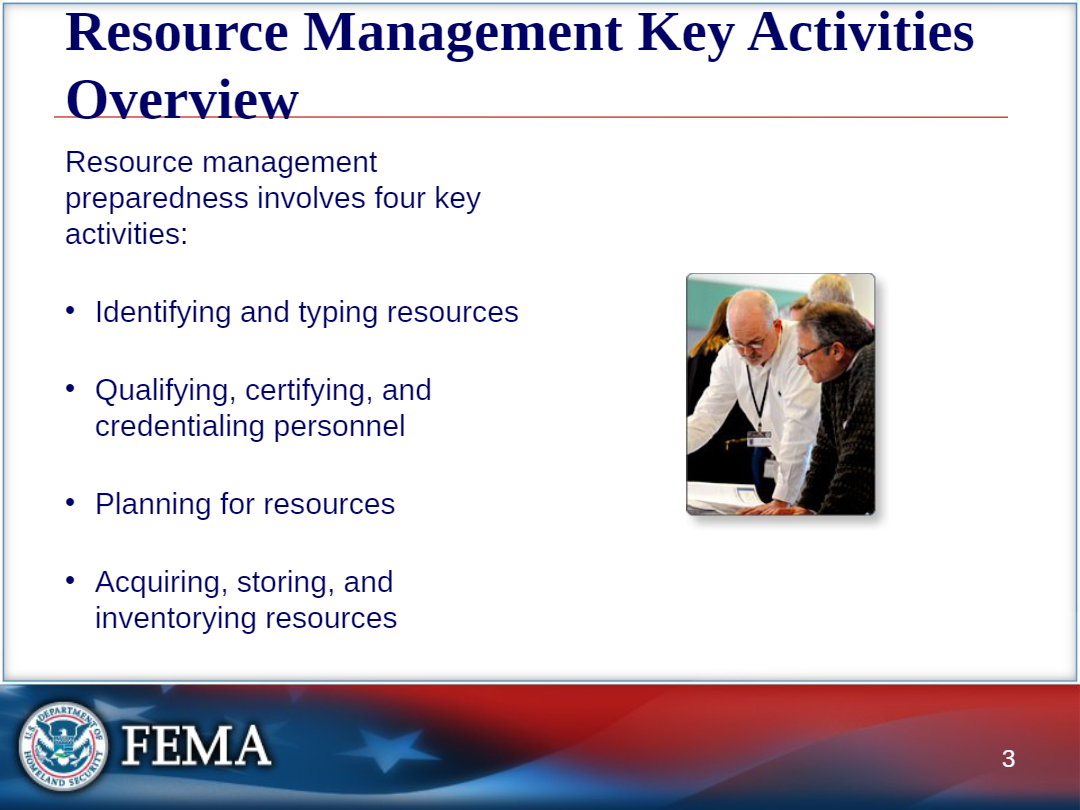
Which of the following is NOT one of the four key activities involved in resource management preparedness?
Identifying and typing resources
Qualifying, certifying, and credentialing personnel
Planning for resources
Disposing of unused resources
7
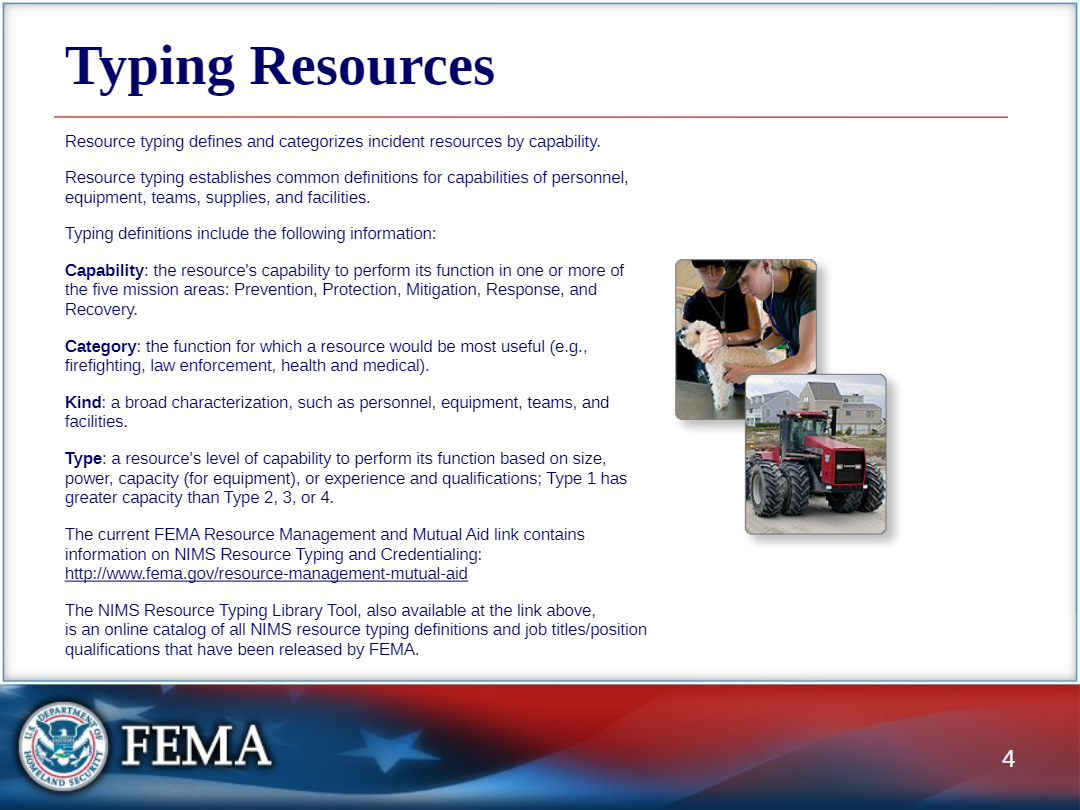
Resource typing defines and categorizes incident resources by capability.
Resource typing establishes common definitions for capabilities of personnel, equipment, teams, supplies, and facilities.
Typing definitions include the following information:
Capability: the resource's capability to perform its function in one or more of the five mission areas: Prevention, Protection, Mitigation, Response, and Recovery.
Category: the function for which a resource would be most useful (e.g., firefighting, law enforcement, health and medical).
Kind: a broad characterization, such as personnel, equipment, teams, and facilities.
Type: a resource's level of capability to perform its function based on size, power, capacity (for equipment), or experience and qualifications; Type 1 has greater capacity than Type 2, 3, or 4.
The current FEMA Resource Management and Mutual Aid link contains information on NIMS Resource Typing and Credentialing: http://www.fema.gov/resource-management-mutual-aid
The NIMS Resource Typing Library Tool, also available at the link above, is an online catalog of all NIMS resource typing definitions and job titles/position qualifications that have been released by FEMA.
8
Open Ended
Explain the differences between 'capability,' 'category,' 'kind,' and 'type' as used in resource typing.
9
10
Open Ended
What are the benefits of typing resources?
11
12
Multiple Choice
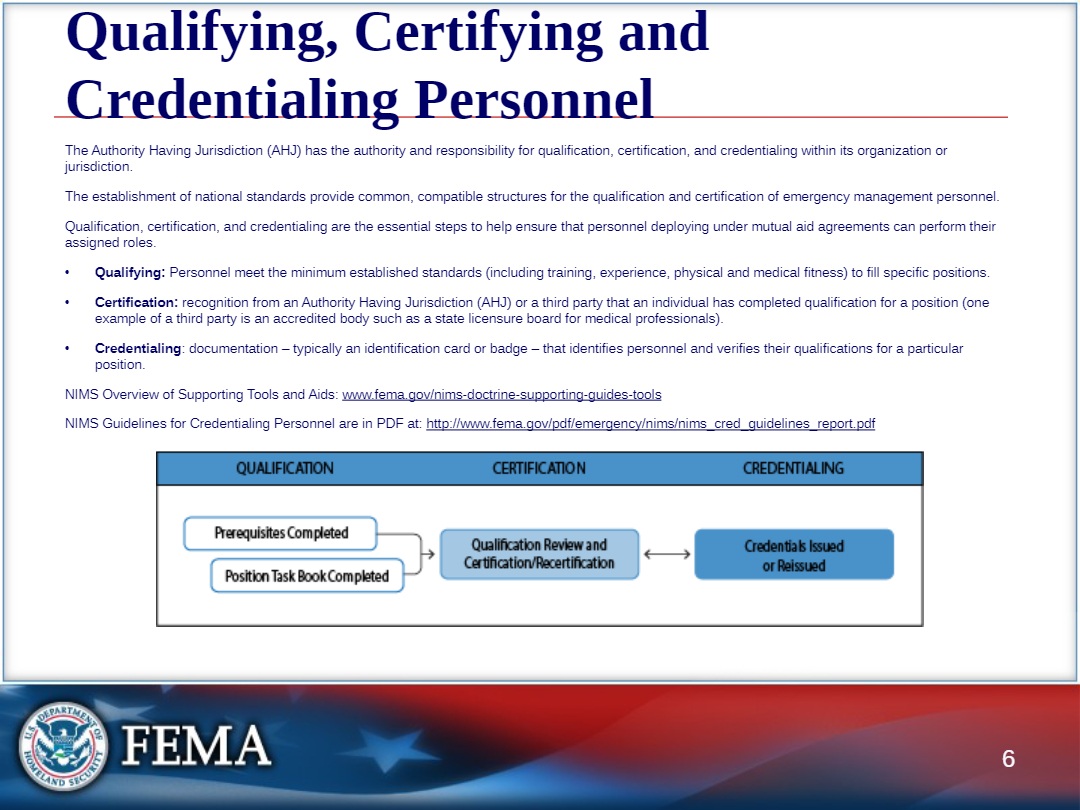
Which steps are essential for ensuring personnel can perform their assigned roles under mutual aid agreements?
Qualification
Certification
Credentialing
All of the above
13
Fill in the Blanks
Fill in the blank: Documentation that identifies personnel and verifies their qualifications for a particular position is called
Type answer...
14
15
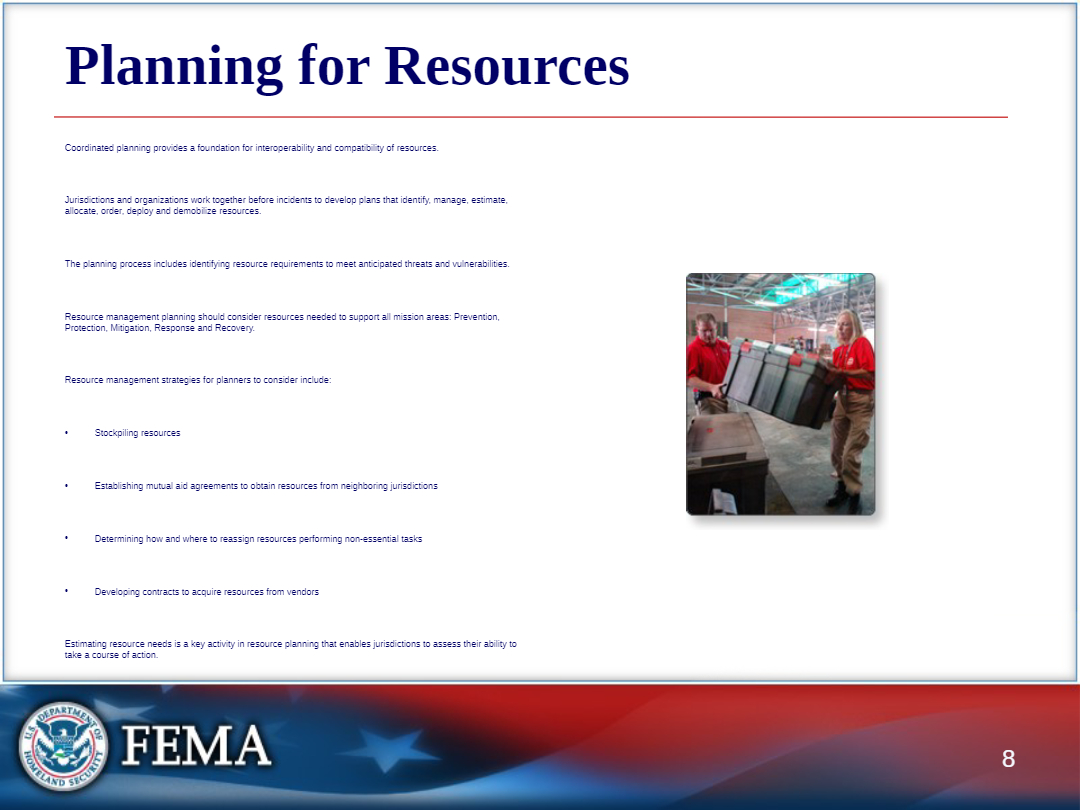
Coordinated planning provides a foundation for interoperability and compatibility of resources.
Jurisdictions and organizations work together before incidents to develop plans that identify, manage, estimate, allocate, order, deploy and demobilize resources.
The planning process includes identifying resource requirements to meet anticipated threats and vulnerabilities.
Resource management planning should consider resources needed to support all mission areas: Prevention, Protection, Mitigation, Response and Recovery.
Resource management strategies for planners to consider include:
•Stockpiling resources
•Establishing mutual aid agreements to obtain resources from neighboring jurisdictions
•Determining how and where to reassign resources performing non-essential tasks
•Developing contracts to acquire resources from vendors
Estimating resource needs is a key activity in resource planning that enables jurisdictions to assess their ability to take a course of action.
16
Multiple Select
Which of the following are resource management strategies planners should consider when planning for resources?
Stockpiling resources
Establishing mutual aid agreements
Developing contracts to acquire resources
Ignoring non-essential tasks
17
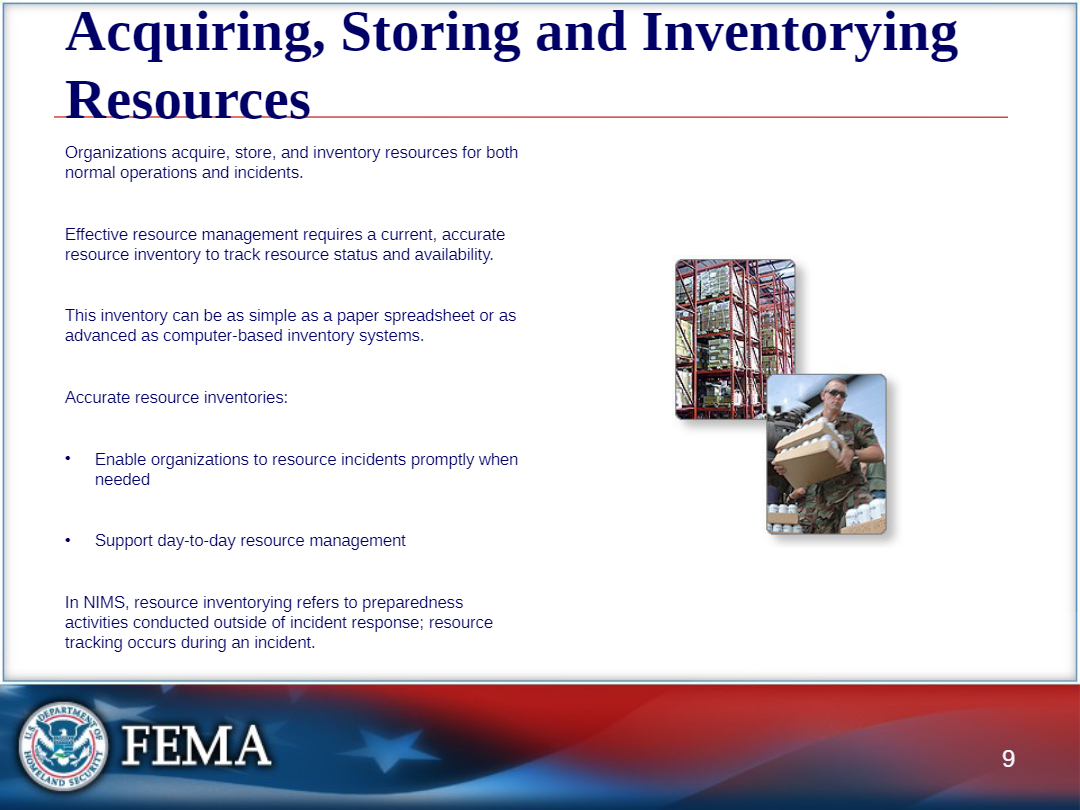
Organizations acquire, store, and inventory resources for both normal operations and incidents.
Effective resource management requires a current, accurate resource inventory to track resource status and availability.
This inventory can be as simple as a paper spreadsheet or as advanced as computer-based inventory systems.
Accurate resource inventories:
•Enable organizations to resource incidents promptly when needed
•Support day-to-day resource management
In NIMS, resource inventorying refers to preparedness activities conducted outside of incident response; resource tracking occurs during an incident.
18
Multiple Choice
What are two main reasons why organizations need to maintain accurate resource inventories?
To enable prompt incident response and support day-to-day management
To reduce paperwork and minimize staff training
To increase profits and reduce costs
To comply with government regulations
19
Resource Management Words of Advice
Kristy Plourde, Emergency Management Specialist, U.S. Coast Guard
"With standardized resource management of type and kind you know, when I order a type 2 law enforcement vessel and I've standardized that vessel, I know what capability I’m getting and because I’ve standardized it before the incident, I know exactly what I am getting and it is, it is very cool."
20
Multiple Choice
How does standardized resource management benefit emergency response operations, according to Kristy Plourde?
It reduces the need for training
It ensures predictable capabilities and outcomes
It eliminates the need for inventories
It allows for improvisation during incidents
21
Resource Management Words of Advice
Daryl Lee Spiewak, Former Emergency Programs Manager, Brazos River Authority, TX
"Resource management is certainly important. We know each jurisdiction is going to have to have some resources available but they’re never going to have enough, there is always going to be shortfalls, and part of resource management is to manage those gaps in the availability of the resources. So, resource management under NIMS gives us a structure and a process to be able to do that. Part of it was the resource typing, so it streamlines the requesting of equipment, particularly among different jurisdictions and agencies. If I ask for a particular type of vehicle with certain equipment and with the right number of people, then I only need to make one request and I’ll get all of that. If there is something else, I ask for a different type of equipment. So the typing is going to help us tremendously under resource management. It also requires that we do inventories. Inventories let us know what equipment we have on hand. We compare that to what we think we’re going to need based on our planning and our exercising, we identified some of the gaps, and then we start looking for ways of filling those shortfalls. Mutual aid is one of those activities under resource management that is important in helping us use resources across levels, among different agencies, helps the taxpayers, helps the responders, helps the whole Nation."
22
Resource Management Words of Advice
Ron Britton, Former NIMS Coordinator, FEMA, Region 10
"Resource management is much bigger than just identifying and moving vehicles or planes or so forth, that really, really involves the entire credentialing process of knowing all of our personnel resources capabilities and training background and so forth, that all needs to be done in a prior preparation event, so that we really know that when those folks arrive on scene, they’re capable of doing the job we’re asking them to do. So it starts with those folks, their credentialing, their qualifications, and then as well knowing the types of equipment that we would need to have on scene. So the equipment and the things that need to be there, and that would go under the communications as well because resource typing would involve the radios, the satellite phones, and all of the kinds of support communications that we would need for something to respond. So resource management is huge, and it really has to be done prior to the event."
23
Open Ended
What challenges might arise when managing resources during an emergency incident?
24
Multiple Choice
Based on the experiences shared by Daryl Lee Spiewak and Ron Britton, what are some key activities involved in resource management under NIMS?
Resource typing, inventorying, credentialing, and mutual aid
Only ordering equipment
Focusing on communications only
Ignoring personnel qualifications
25
26
Open Ended
Has anyone been involved in any of these key activities? What are some of the challenges you experienced?
27
28
Fill in the Blanks
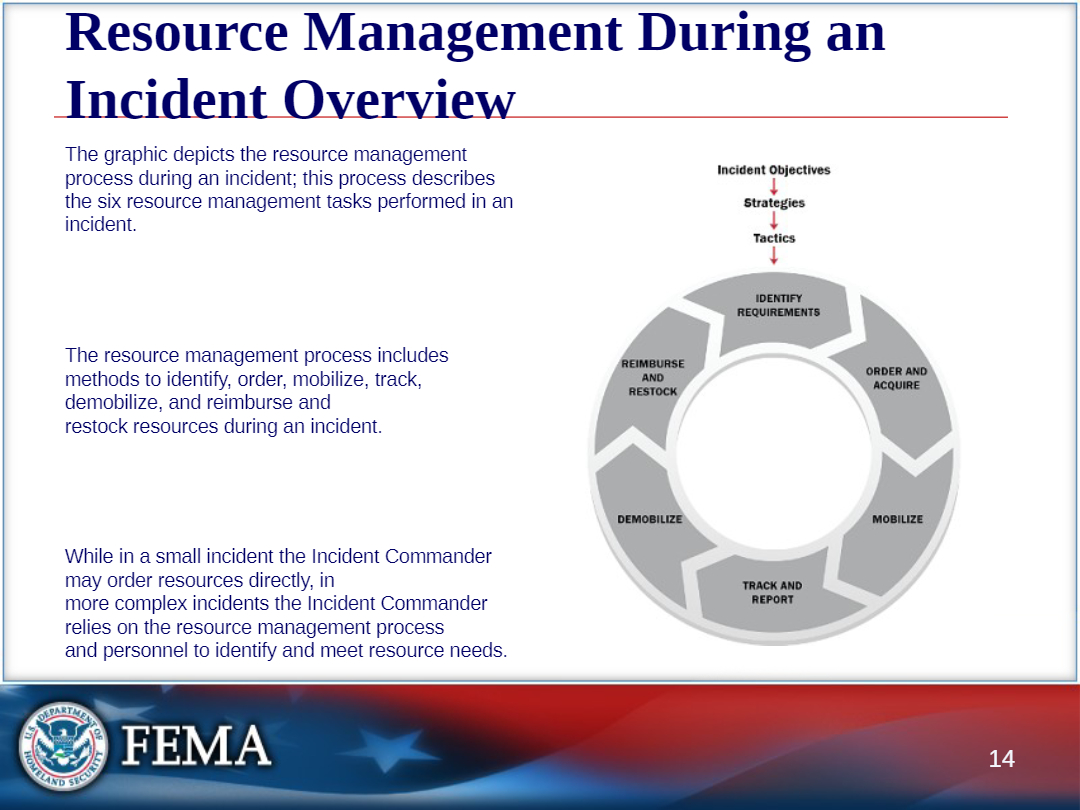
The resource management process during an incident includes methods to identify, order, mobilize, track, demobilize, and
Type answer...
29
30
Multiple Choice
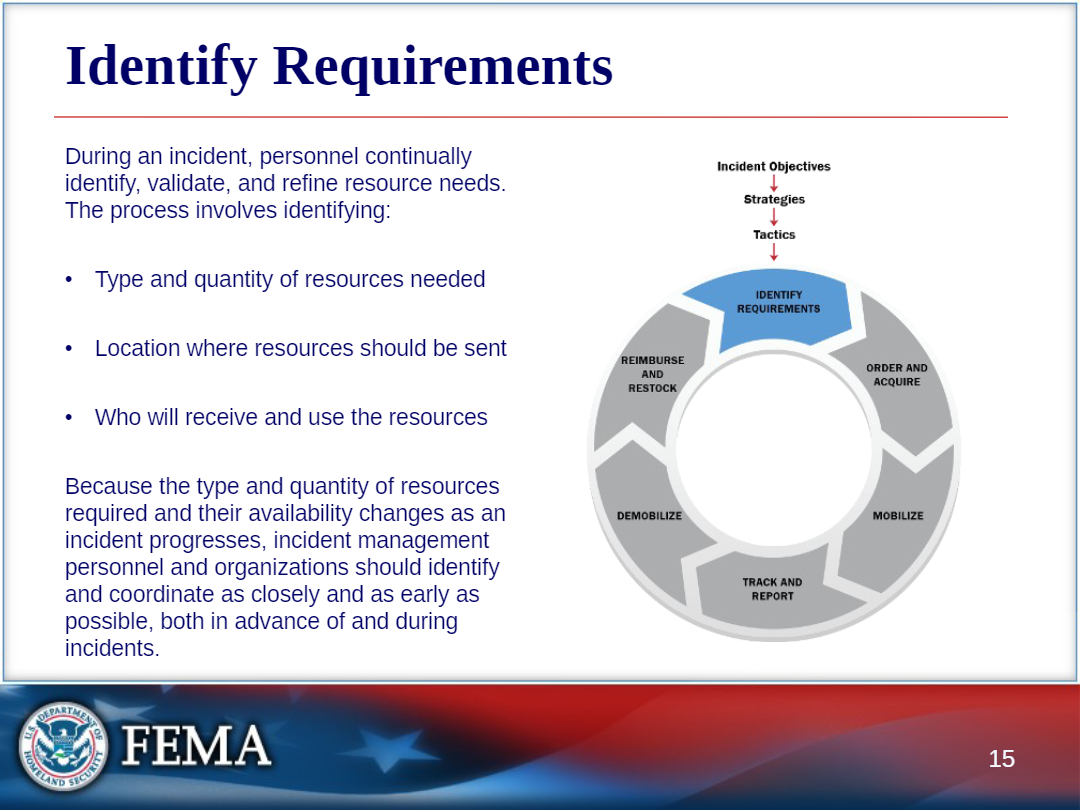
Which step in the incident resource management cycle involves determining the type and quantity of resources needed, their location, and who will use them?
Order and Acquire
Mobilize
Identify Requirements
Track and Report
31
32
Open Ended
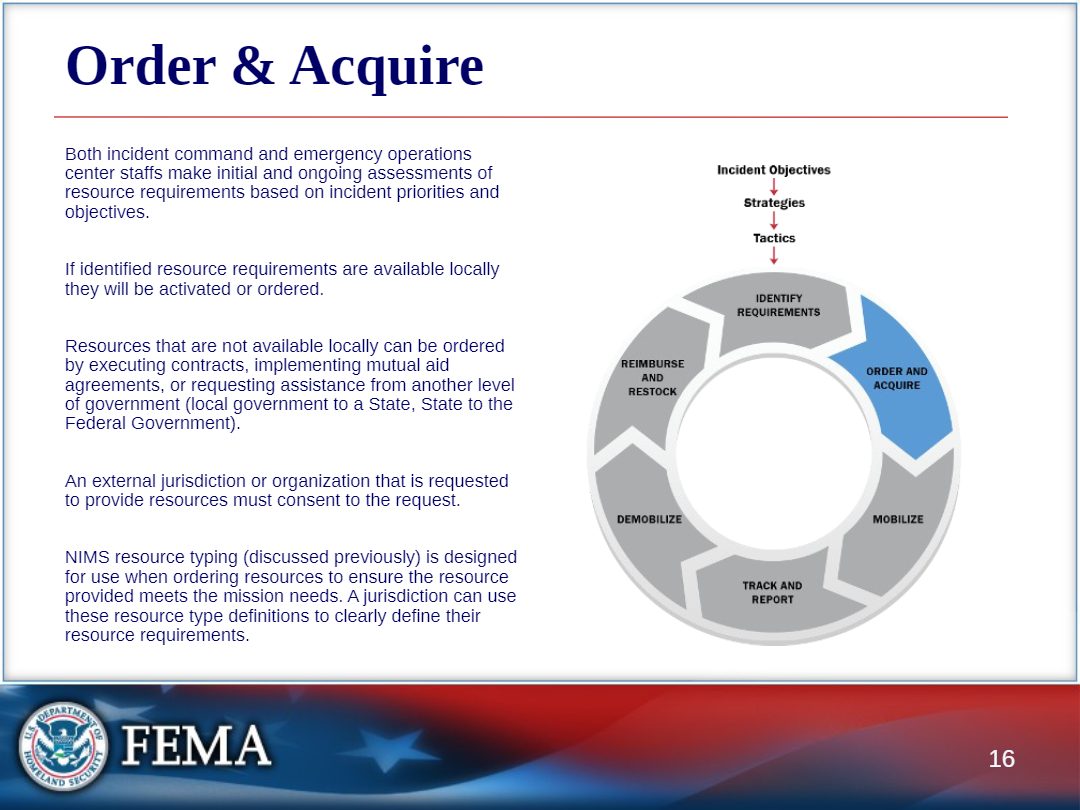
Explain how resource requirements are ordered and acquired during an incident, and what factors influence whether resources are activated locally or requested externally.
33
34
Multiple Select
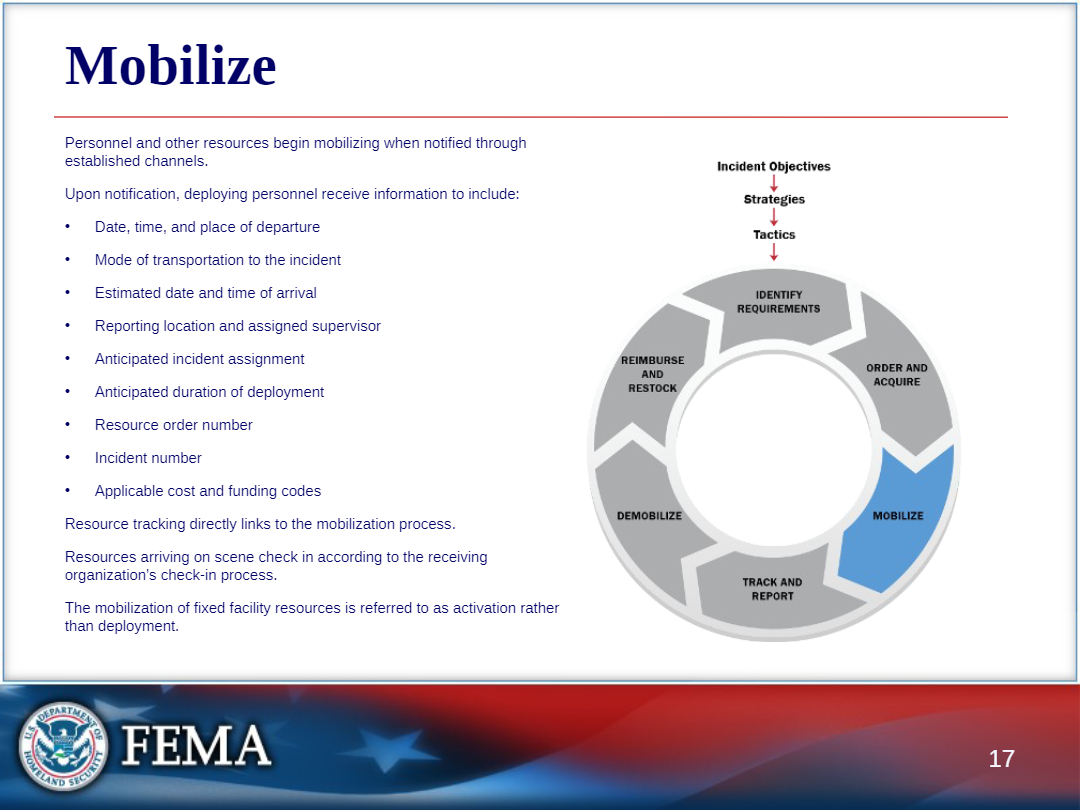
When personnel are mobilized for an incident, which pieces of information are typically provided to them? Select all that apply.
Estimated date and time of arrival
Reporting location and assigned supervisor
Applicable cost and funding codes
Incident objectives
35
36
Fill in the Blanks
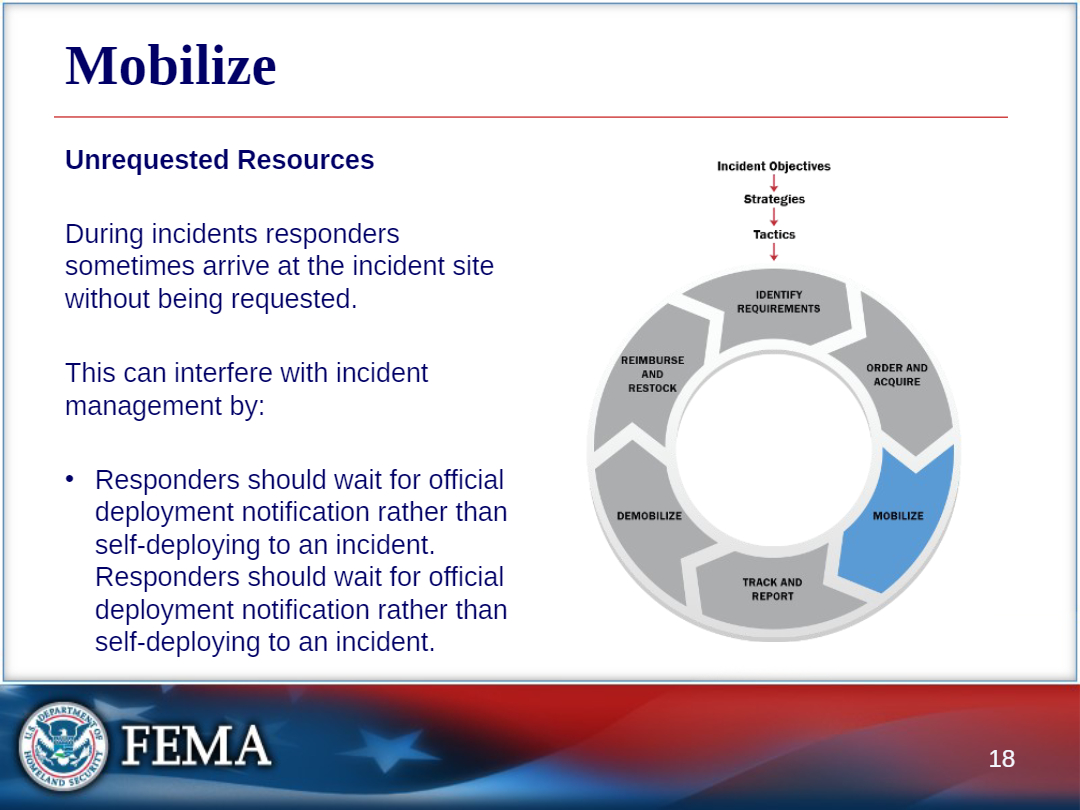
Responders should wait for official
Type answer...
37
38
Open Ended
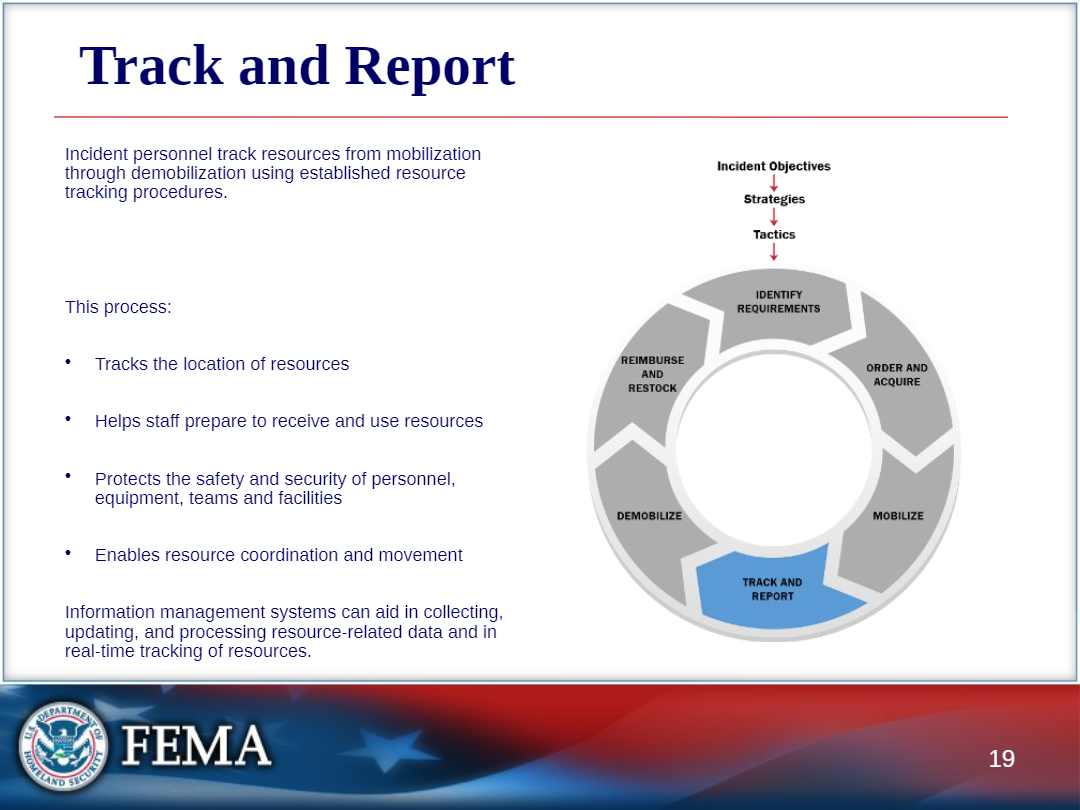
What are the main purposes of tracking and reporting resources during an incident?
39
40
Multiple Choice
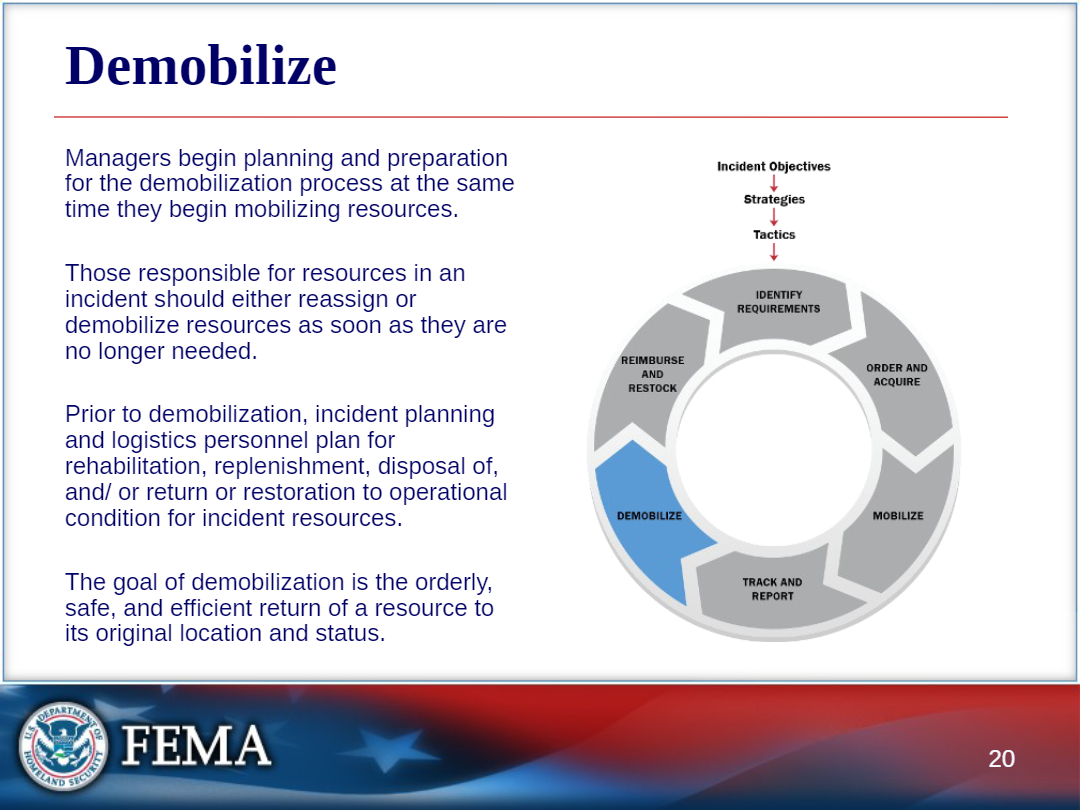
What is the primary goal of demobilization in incident resource management?
To acquire new resources
To track the location of resources
To return resources to their original location and status
To mobilize additional personnel
41
42
Multiple Choice
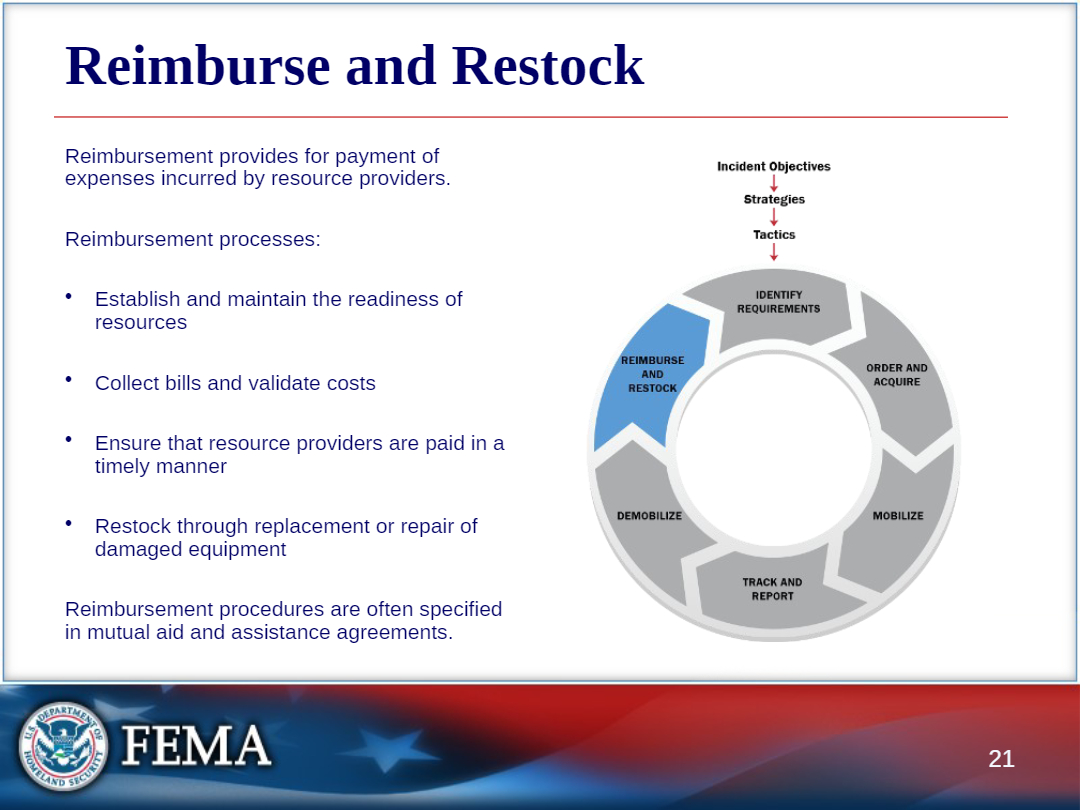
Which of the following is NOT a step in the reimbursement process for resource providers?
Establish and maintain the readiness of resources
Collect bills and validate costs
Order and acquire resources
Ensure timely payment to resource providers
43
44
Open Ended
Where have you seen this process used before?
45
46
Open Ended
Why is it important to begin demobilization planning as soon as feasible?
47
48
Fill in the Blanks
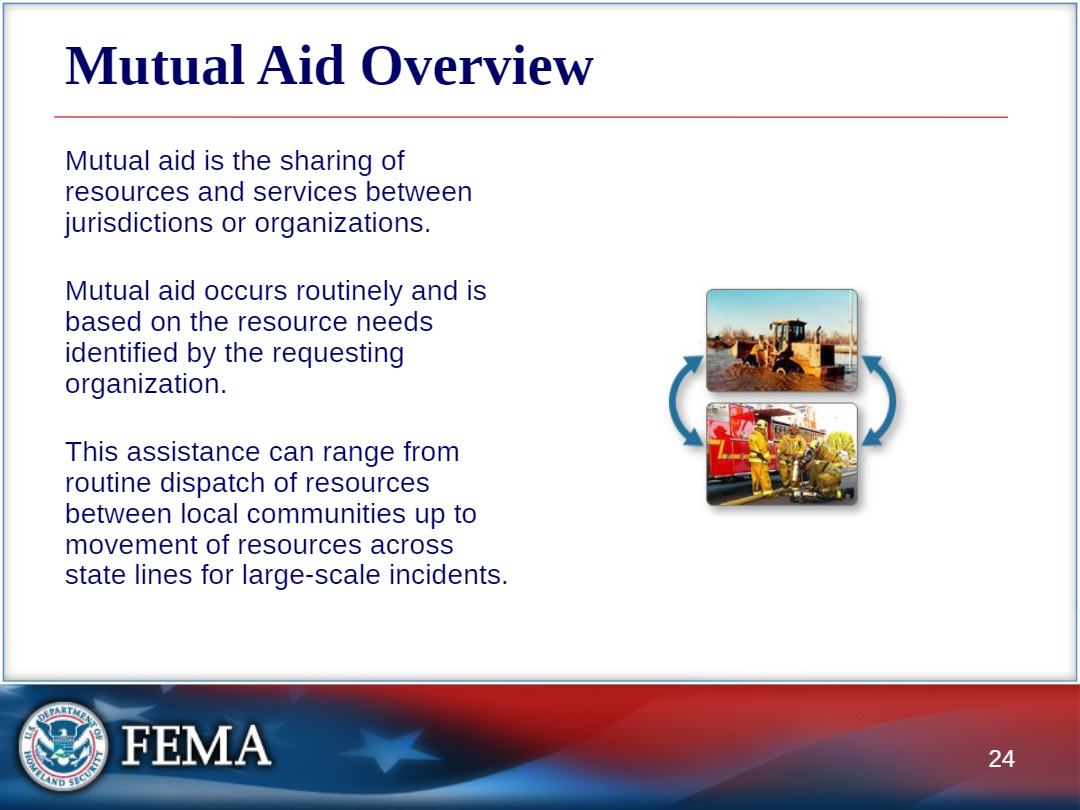
Mutual aid is the sharing of resources and services between
Type answer...
49
Mutual Aid Agreements and Assistance Agreements
Bill Bullock, Retired Battalion Chief, Fairfax County Fire Department, VA
"Traditionally we’ve always considered mutual aid between fire departments, EMS agencies, or law enforcement agencies. In today’s world it is expanded to virtually every emergency function identified in either the national, State, or local response plan. It includes communications assets, public health assets. Some cases may include military affairs, may include animal refuge, may include search and rescue assets, and a host of others."
50
Multiple Select
Which of the following emergency functions may be included in mutual aid agreements, according to Bill Bullock's experience?
Animal refuge
Search and rescue
Communications assets
All of the above
51
Mutual Aid Agreements and Assistance Agreements
Bill Metcalf, Former Fire Chief, North County Fire Protection District, CA
"At its simplest level, mutual aid is neighbor helping neighbor. It is adjoining fire departments sharing resources to suppress a fire that’s bigger than one agency can handle. It’s adjoining water companies helping each other replace a broken pipeline in an emergency because they don’t have sufficient manpower or equipment to do it. It’s anytime that neighboring agencies leave their jurisdictions to help each other."
52
Multiple Choice
Based on Bill Metcalf's experience, what is a key characteristic of mutual aid at its simplest level?
Neighbor helping neighbor
Competition between agencies
Resource hoarding
Strictly limited to fire departments
53
Mutual Aid Agreements and Assistance Agreements
Leon Shaifer, Senior EMAC Advisor, National Emergency Management Association
"NIMS has proposed a number of solutions that could be applied very readily to mutual aid. One of the problems with mutual aid in the past has been a common terminology, a common nomenclature, speaking the same language. One term to one particular level of government doesn’t necessarily mean the same thing to another, and NIMS addresses those particular types of issues. We all try to speak in a common language, plain English. The other real benefit that NIMS can bring is resource typing. We all know that when you need something that is not readily available within your jurisdiction, you need it fast. It speeds up the process when a person that has an asset can understand very quickly what you are asking for, and if those resources are typed, the benefit to one of the NIMS requirements is that a person requesting something and asks for it knows what they are going to get when they follow a typing scheme."
54
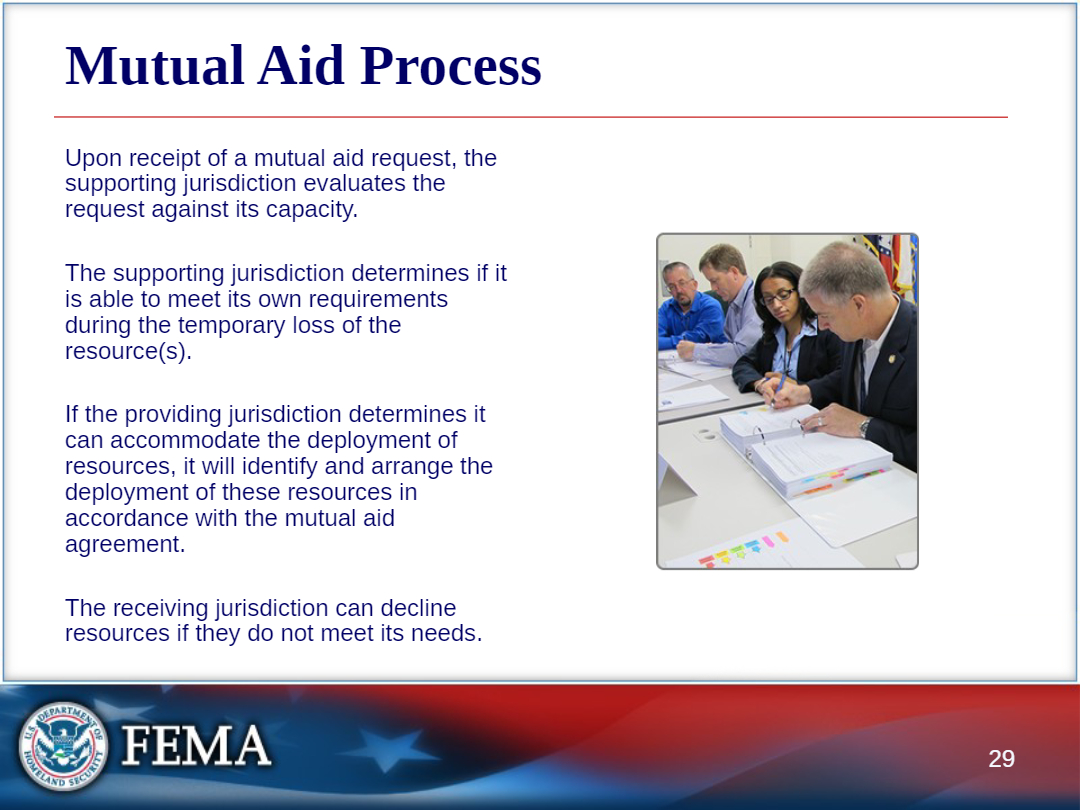
Mutual aid agreements establish the legal basis for two or more entities to share resources.
Various forms of mutual aid agreements and compacts exist among and between all levels of government in the United States.
These agreements may authorize mutual aid:
•Between two or more neighboring communities
•Among all jurisdictions within an state
•Between States, Territories and Tribal Governments
•Between Federal agencies
•Internationally
•Between government and NGOs and/or the private sector
•Among NGOs and/or private sector entities
55
56
57
Open Ended
What questions do you still have about NIMS Resource Management, or is there any aspect you would like to explore further?
58
Multiple Choice
Why is it important to get the right resources to the right place at the right time during an incident?
It can be a matter of life and death
It saves money
It reduces paperwork
It improves public relations
Show answer
Auto Play
Slide 1 / 58
SLIDE
Similar Resources on Wayground

51 questions
Unit 111 LCS Hand tools and Power tools
Presentation
•
12th Grade
50 questions
Micro-Enterprise Review
Presentation
•
11th - 12th Grade
54 questions
IMMUNE SYSTEM - HH
Presentation
•
KG - University
53 questions
Present Perfect Subjunctive
Presentation
•
11th - 12th Grade
55 questions
V-NET
Presentation
•
University
54 questions
GENERAL CHEMISTRY 2
Presentation
•
12th Grade
55 questions
The Market
Presentation
•
12th Grade
52 questions
3.2 Machines & Work
Presentation
•
12th Grade
Popular Resources on Wayground
10 questions
Safety Day 2026 – Student Review

Quiz
•
9th Grade
21 questions
Continents and Oceans
Quiz
•
6th Grade
20 questions
Parts of Speech
Quiz
•
5th Grade
16 questions
Subject & Predicate
Quiz
•
5th Grade
25 questions
Multiplication Facts
Quiz
•
5th Grade
12 questions
Map Skills
Quiz
•
3rd Grade
22 questions
Continents and Oceans
Quiz
•
5th Grade
15 questions
Rounding Decimals
Quiz
•
5th Grade
Discover more resources for Other
26 questions
SLIME!!!!!
Quiz
•
KG - 12th Grade
21 questions
Los paises hispanohablantes y sus capitales
Quiz
•
12th Grade
20 questions
Cell Transport
Quiz
•
9th - 12th Grade
20 questions
Budgeting
Quiz
•
9th - 12th Grade
20 questions
Investing
Quiz
•
9th - 12th Grade
8 questions
DNA vs. RNA
Presentation
•
9th - 12th Grade
12 questions
Identify Rigid Transformations
Quiz
•
8th - 12th Grade
10 questions
Complementary, Supplementary, Vertical, and Linear Pairs
Quiz
•
9th - 12th Grade