Plate tectonics
Presentation
•
Science
•
6th Grade
•
Practice Problem
•
Medium
+6
Standards-aligned
Amber Soldo
Used 4+ times
FREE Resource
13 Slides • 24 Questions
1
2
3
PBS Earthquakes and volcanoes interactive
Visit the interactive at the following link and consider the following:
Why are most earthquakes, volcanoes, and mountain ranges clustered together on edges of continents?
What inferences and conclusions can you draw after observing the global patterns of earthquakes and volcanic activity?
4
Open Ended
Why are most earthquakes, volcanoes, and mountain ranges clustered together on edges of continents?
5
Open Ended
What inferences and conclusions can you draw after observing the global patterns of earthquakes and volcanic activity?
6
Multiple Choice
The line of volcanoes that surround the Pacific Ocean's subduction zone is referred to as the
Trench Ridge
Hot Spot
Ring of Fire
Mid-Ocean Ridge
7
PBS Interactive
Visit this interactive to explore plate tectonic activity
Observe what happens to the land as you click on each circle. Then read the information that accompanies it.
8
Multiple Choice
What is the name Earth's longest mountain range and where is it located?
Mid-ocean ridge, it runs down the middle of the Atlantic Ocean (surfacing at Iceland), around Africa, through the Indian Ocean, between Australia and Antarctica, and north through the Pacific Ocean.
the Rocky Mountains, stretching from New Mexico in the southwestern U.S. up through Canada's British Columbia and Alberta, forming the continent's major mountain system.
9
Multiple Choice
Which of these tectonic plate boundaries is most likely to form a volcano?
a continental plate colliding with a continental plate
an oceanic plate sliding past a continental plate
a continental plate sliding past a continental plate
an oceanic plate colliding into a continental plate
10
11
Multiple Choice
The reason plates are moving, is because _______
Magma is semi-liquid and moves under the crust.
The earth is spinning.
The weather systems in the atmosphere.
The Earth's core is spinning very fast.
12
Multiple Choice
The idea that the continents move around the Earth's surface is called?
Pangea
continental drift
plate tectonics
sea-floor spreading
13
Multiple Choice
Most scientists rejected the theory of continental drift because Wegner
did not have enough evidence to support the idea of Pangaea.
had no evidence to support his theory.
could not explain what force caused the continents to move.
was not well known in the scientific community.
14
Multiple Choice
15
Multiple Choice
According to the continental drift hypothesis, the presence of similar fossils in South America and Africa supports which scientific idea?
Animals easily and frequently travel from Africa to South America.
Species of animals probably traveled between continents on natural rafts (such as trees destroyed in tsunamis).
Land bridges once existed that connected the continents.
South America and Africa were once connected together.
16
Open Ended
How does the picture of landforms and rock layers below support the theory of continental drift?
17
18
Fill in the Blank
Type answer...
19
20
Multiple Choice
Which diagram shows what happens at a convergent plate boundary?
A
B
A and B
None of the above
21
22
Multiple Choice
23
24
Multiple Choice
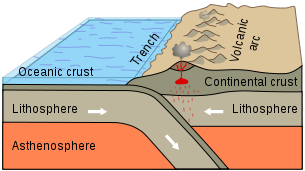
When oceanic and continental crust converge, the oceanic plate will dive beneath the continental plate. What best explains the results of this action?
The oceanic crust is moved upward by the radiation of heat
The oceanic crust will melt as it moves deeper in the earth.
The continental crust will form a mountain range.
The two crusts will form an ocean basin
25
26
Open Ended
Compare and contrast divergent plate boundaries and convergent plate boundaries. (Think about how do the plates move? What landforms are formed? How do the plates interact with the mantle at this boundary?
27
28
Multiple Choice
Sea-floor spreading explains how.....
new crust is created at a divergent boundary
volcanoes are formed on continents
deep sea trenches are formed
29
30
Multiple Choice
What geological event can be created in the plate boundary shown below?
Rift Valley
Sea Floor Spreading
Earthquakes
Volcanoes
31
32
Multiple Choice
Which type of plate boundary is likely responsible for this landform?
convergent
divergent
transform
none of the above
33
Multiple Choice
Which type of plate boundary is likely responsible for this landform?
convergent
divergent
transform
none of the above
34
Multiple Choice
Which type of plate boundary is most likely responsible?
convergent
divergent
transform
none of the above
35
Multiple Choice
Which block diagram best represents the relative direction of plate motion at the San Andreas Fault?
36
Multiple Choice
Tsunami
37
Poll
How confident do you feel about this topic now?
Show answer
Auto Play
Slide 1 / 37
SLIDE

Similar Resources on Wayground
30 questions
Balanced and Unbalanced Forces
Presentation
•
6th Grade
28 questions
Animal Classification and Web
Presentation
•
6th Grade
30 questions
Non Renewable Energy Resources Lesson
Presentation
•
6th Grade
28 questions
Unit 3 Lesson 3 - Types of Rocks
Presentation
•
6th Grade
33 questions
ENERGY TRANSFORMATION
Presentation
•
6th Grade
31 questions
Composition of the Atmosphere
Presentation
•
6th Grade
30 questions
Characteristics of Life
Presentation
•
6th Grade
30 questions
Density
Presentation
•
6th Grade
Popular Resources on Wayground
10 questions
5.P.1.3 Distance/Time Graphs
Quiz
•
5th Grade
10 questions
Fire Drill
Quiz
•
2nd - 5th Grade
20 questions
Equivalent Fractions
Quiz
•
3rd Grade
22 questions
School Wide Vocab Group 1 Master
Quiz
•
6th - 8th Grade
20 questions
Main Idea and Details
Quiz
•
5th Grade
20 questions
Context Clues
Quiz
•
6th Grade
20 questions
Inferences
Quiz
•
4th Grade
12 questions
What makes Nebraska's government unique?
Quiz
•
4th - 5th Grade
Discover more resources for Science
19 questions
Introduction to Properties of Waves
Presentation
•
6th - 8th Grade
16 questions
Interactions within Ecosystems
Presentation
•
6th - 8th Grade
10 questions
Exploring the Layers of the Earth
Interactive video
•
6th - 10th Grade
15 questions
Punnett Squares
Quiz
•
6th Grade
20 questions
Energy Transformations
Quiz
•
6th - 8th Grade
20 questions
Cell Organelles and Functions
Quiz
•
6th - 8th Grade
10 questions
Ecosystem levels of organization
Quiz
•
6th Grade
20 questions
Levels of Organization
Quiz
•
6th Grade