

5.2.1

Presentation
•
English
•
1st - 5th Grade
•
Practice Problem
•
Easy
+41
Standards-aligned

Angelia Ross
Used 2+ times
FREE Resource
54 Slides • 18 Questions
1

2

Learners can:
read, spell, and write words with broad o (aw, au, augh)
identify and read multisyllabic words, including VCe syllables
identify, read, and spell words with the suffix -ible
identify, read, and spell words with Latin root vis and vid

3
Broad o Spelling Patterns
Today, you will focus on three spelling patterns with broad o:
aw,
au,
and augh.
These spelling patterns can be found in many different words.

Words with broad o can have these spelling patterns.
4
Spelling Pattern: aw
Look at the picture and read the word.
The word “claw" is using the letters a and w to say “aw" at the end of this word.
These letters work together to make this sound.
For example:
The crab pinched me with its claw.

5
Spelling Pattern: au
Look at the picture and read the word.
The word “pause" is using the letters a and u to say “aw" in the middle of the word. These letters work together to make this sound.
For example:
The comma tells a reader to pause.

6
Spelling Pattern: augh
Look at the picture and read the word.
The word “caught" is using the letters a, u, g, and h to say “aw" in the middle of this word. These letters work together to make this sound.
For example:
The fish are caught in the net.
Read some nonsense words on the next slide

7
Nonsense Words
Remember, nonsense words do not have real meaning.
Today, you will read some nonsense words to practice reading VCe syllables.
Words that have VCe syllables have a silent e that helps you know that the vowel sound in the syllable is long.
Next, let's review VCe syllables and the jobs of silent e.

Look for syllable types you know to help you read the whole word.
8
Seven Jobs of the Silent e


9


10


11

12
Now, use what you know about VCe syllables and words with broad o to read the words below.
Use your knowledge of the syllable types and sounds to read each nonsense word aloud.
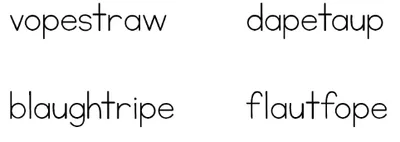
Nice job reading nonsense words! Go on to learn about the suffix -ible, and the Latin roots vis and vid.
13
Suffix -ible
The suffix -ible means “able to be.“
You can add this suffix to root words and base words.
When you add the suffix -ible to the Latin root word leg, the word becomes “legible.”
The word “legible“ means “able to be read.”
For example:
The child was learning how to write neat and legible letters.

14
The suffix -ible changes nouns and verbs into adjectives.


Excellent work exploring the suffix -ible!
Next up... the Latin roots vis and vid.
15

Latin Roots vis and vid
Root words cannot stand alone. They need a prefix or a suffix to hold their whole meaning.
You can use what you know about a root word to determine what the word might mean.
The Latin root words vis and vid both mean “to see.“
For example:
The word “visible” has the Latin root word vis and the suffix -ible. The word “visible“ means “able to be seen.”
16
Television
The word “television" is broken down into three parts:
The prefix tele- which means “far" or “distant."
The Latin root vis which means “to see."
The suffix -ion which makes the word a noun.
The word “television” means “a system for sending moving pictures and sound from one place to another."
For example:
The family likes to watch a movie on the television after dinner.

17
Invisible
The word “invisible" is broken down into three parts.
The prefix in means “not" or “without."
The Latin root vis means “see." The suffix -ible means “able to be."
The word “invisible” means “not able to be seen."
For example:
The magician made the rabbit invisible with a wave of his wand.

18
Provide
The word “provide" is broken down into three parts.
The prefix pro- means “forward" or “for."
The Latin root vid means “see."
The word part -e makes the word a verb. The word “provide” means “to make something available for someone."
For example:
The sea anemone can provide shelter for the clown fish.

19
Evidence
The word “evidence" is broken down into three parts.
The prefix e- means “out of" or “from."
The Latin root vid means “see.”
The suffix -ence makes the word a noun.
The word “evidence means “something that gives proof or a reason to believe."
For example:
The detective found fingerprints as evidence of who was at the scene.

20
Excellent work exploring words with the Latin root words vis and vid.
Now, read words with these morphemes in the blending lines below.

21

22
Draw
Read each word part. Decide if the suffix –ible or –able should be used. Write the whole word on the line.
If the base word can stand alone, you likely add –able.
If the root word cannot stand alone or ends with soft c or g, you likely add –ible.
23

24
Audio Response

Today, you will practice reading a short passage with words that have the suffix -ible and Latin roots vis and vid.
zooxanthellae is pronounced
zow·uh·zan·theh·lai

25
Open Ended

Reread the passage.
Write down three words from the passage with the suffix -ible or the Latin roots vis or vid.
26
Multiple Choice

Which definition would best fit the word “invisible"?
able to be eaten
able to be seen
not able to be seen
not able to be eaten
27
Match
Match each definition with the correct word.
able to be heard
able to be eaten
able to be seen
able to be bent and stretched
audible
edible
visible
flexible
audible
edible
visible
flexible
28
Open Ended

Read the sentence from the passage. Type the meaning of the word “provide."
Corals provide the algae with shelter.
You can start your answer with:
The word “provide" means
29
30
Learners can:
determine the meaning of words and phrases as they are used in the text, including interpretation of figurative language
use evidence from a literary text to support analysis and reflection


31
Today, you will begin reading a biography about a farmer named Will Allen.
Farmer Will Allen grows all kinds of different foods, including potatoes.
Have you ever grown your own food, such as potatoes?

Home-grown potatoes are fresher and more flavorful than those bought from stores.
32

Play the video on page 2 in Edio
33

34
Get Ready to Read
Today, you will begin reading a new biography, Farmer Will Allen and the Growing Table. Before you begin reading, press through the screens to preview the book.

35


36
Open Ended
A biography is a story written about the life of a real person. Do you know any farmers in real life? If you wrote a biography about a farmer, what kind of information might you include?
37

38
Vocabulary to Unlock the Text
Earlier in the lesson, you learned that the word abandoned meant something was left alone, deserted, or rejected.
Sometimes, things are abandoned because they are no longer used, needed, or wanted.
When a place is abandoned, it is no longer taken care of, and it can become unclean and unkempt.

The abandoned lot is overgrown and not taken care of.
39
Multiple Choice
On page 6, the text says, “Farmer Will Allen looked at an abandoned lot and saw a huge table heaped with food."
What does this tell you about his character?
Farmer Will Allen does not see things clearly.
Farmer Will Allen is positive and sees the potential in things.
Farmer Will Allen is a tall farmer who farms in Wisconsin.
Farmer Will Allen does not believe you can grow food in a city.
40
You also learned about the word “drooped,“ meaning bent or hung downward limply.
The text says that Will Allen remembers how people would come to dinner looking “drooped” but then leave laughing after a good meal.
Have you ever felt so tired, sad, or upset that your body or emotions drooped? What made you feel better?
You can share your thoughts with your learning coach. Then, answer the question.

41
Draw
Which image shows an example of the word “drooped"?
42
Open Ended

Why does the author write that Will Allen can “see what others can't see”? What does this tell you about Will Allen as a person?
43

44
Open Ended

What does Will Allen do when he moves to Belgium?
45

46
Open Ended

Look at the illustrations on pages 10 and 11. How does the illustrator show how Will Allen changes his mind about working to grow food?
47

48
Figurative Language
In previous lessons, you learned that when authors write books, they include both literal and figurative language to make the story interesting and engaging.
Figurative language is words, phrases, or expressions that mean something different from the literal meaning.
Authors use figurative language to make comparisons or for dramatic effect.
On the next slide we will review 3 types.
49

50


Examples of Figurative Language found in the text.
51
Multiple Select
How could the author write “Will Allen's mom made a lot of food" using figurative language?
The table was covered with spicy dishes.
The table was piled as high as a mountain with delicious dishes.
The table had eleven different dishes.
It would take an army to eat all of the delicious dishes Will Allen's mom made.
52
RACES Review
You have learned that the RACES strategy is a method that helps readers and writers answer questions.
Today, you will review and practice answering questions using the RACES strategy.

53
Multiple Select
What are two examples of figurative language from the text that you can use as text evidence in your RACES response?
“Planting, picking, and pulling weeds" on page 10.
He “loved digging in the dirt" on page 11.
“Farmer Will Allen is as tall as his truck" on page 6.
“White-shirt work" on page 10.
54
Open Ended

How does the author use figurative language to help you understand Will Allen's character? Use text evidence to support your answer. Use the RACES strategy to answer the question.
55
Multiple Choice

Which statement uses a metaphor to describe the image below?
The lighting bolts looked like forks zigging across the sky.
The lightning bolts were forks zigging across the sky.
The lightning bolts were as bright as the sun.
The lightning lit up the sky, and thunder crashed
56

57

Learners can:
write legibly and fluently in cursive to complete assignments
review biographies
review timelines
identify and introduce the topic clearly
58

59

60
Follow the timeline below which shows some events from Will Allen's life in chronological order.


Timelines help you visualize important events in a way that is easy to read and remember.
61

62

63
Emotional Hook
An emotional hook will grab the reader's attention by encouraging the reader to have a strong feeling about what is being said.
For example:
The villagers in the town looked sad and thin. The dirt on their faces and torn clothes made it clear that the village needed help. The people were hungry.
This hook would likely cause the reader to feel a sense of empathy, sadness, or desire to help.
64
Question Hook
A question hook will encourage the reader to think more deeply about the topic and possibly spark their interest in learning more.
For example:
Have you ever been to a large commercial farm where the equipment is larger than a bus?
This hook would likely cause the reader to reflect on their own experience and pique their interest into what large commercial farms might look like.
65
Surprise Hook
A surprise hook is an effective way to shock the reader and get them curious about what will happen next. These hooks tend to have the reader on the edge of their seats.
For example:
Despite the strong presence of commercial farming, 99 percent of the world's farms are owned by individuals or families.
This hook will likely surprise the reader because most people assume that commercial farming is more responsible for our food supply than it is.
66
Anecdote Hook
An anecdote hook that describes a personal experience or story that shares a perspective for the reader to think about.
For example:
When I was about six years old, I remember crawling on my knees behind my grandma in the strawberry fields. We would fill basket after basket after basket of juicy berries. Every once in a while she would turn to me and scold me for eating too many as we worked. I knew it was important to save the fruit for the people who needed it, but the berries were so yummy!
This hook helps the reader visualize the topic and get invested.
67
Statistical Hook
A statistical hook uses facts and numbers to inform the reader.
This strategy will educate the reader and leave them wanting to know more.
For example:
Carrots contain more protein than steak.
This hook can also include an element of surprise.
68

Gather your materials: pencil and Writing Activity Book, page 66.
Brainstorm topic ideas in the space at the top of the page.
Circle the topic you plan to write about.
Decide which hook strategy you will use and write two introduction sentences.
69
You can use this search engine to research your topic
https://www.kiddle.co/

70
Multiple Select
What are two key features a biography should have to effectively tell someone's life story?
facts
illustration
chronology
title
71
Open Ended
How does a timeline help provide information about a person?
You can start your response with:
A timeline helps provide information about a person by
72

Show answer
Auto Play
Slide 1 / 72
SLIDE
Similar Resources on Wayground

68 questions
Englist
Presentation
•
1st - 5th Grade
68 questions
Pronoun(subject)/to be - class #2 & #3 - Beginner level
Presentation
•
2nd - 5th Grade
68 questions
CF_Buổi 9&10
Presentation
•
1st - 5th Grade
65 questions
La Casa 2nd G
Presentation
•
1st - 5th Grade
64 questions
HIV Grade 4
Presentation
•
1st - 5th Grade
72 questions
Placement Test Kids
Presentation
•
1st - 6th Grade
61 questions
Parts of Speech- Nouns, Verbs, Adjectives
Presentation
•
1st - 5th Grade
65 questions
Traditional Breakfast All Over the World
Presentation
•
3rd - 5th Grade
Popular Resources on Wayground
10 questions
Safety Day 2026 – Student Review

Quiz
•
9th Grade
21 questions
Continents and Oceans
Quiz
•
6th Grade
20 questions
Parts of Speech
Quiz
•
5th Grade
16 questions
Subject & Predicate
Quiz
•
5th Grade
25 questions
Multiplication Facts
Quiz
•
5th Grade
12 questions
Map Skills
Quiz
•
3rd Grade
22 questions
Continents and Oceans
Quiz
•
5th Grade
15 questions
Rounding Decimals
Quiz
•
5th Grade
Discover more resources for English
20 questions
Parts of Speech
Quiz
•
5th Grade
16 questions
Subject & Predicate
Quiz
•
5th Grade
20 questions
Inferences
Quiz
•
4th Grade
15 questions
Subject/Verb agreement
Quiz
•
4th Grade
8 questions
Context Clues Practice
Quiz
•
4th Grade
15 questions
Singular and Plural Nouns
Quiz
•
4th Grade
13 questions
Subjects & Predicate
Quiz
•
3rd Grade
12 questions
Figurative Language Review

Interactive video
•
5th Grade