Search Header Logo
Tracking Storms Investigation 25-26

Tracking Storms Investigation 25-26

Assessment

Presentation

•

Science

•

6th - 8th Grade

•

Medium

•
NGSS
MS-ESS2-5, MS-ESS2-6, MS-ESS2-4

+1

Standards-aligned

Created by

Logan Tubb

Used 9+ times

FREE Resource

17 Slides • 39 Questions

1

​Tracking Storms Investigation

By Logan Tubb

2

media

3

media

4

media

5

media

6

media

7

media

8

media

9

media

10

media

11

media

12

media

13

media

14

media

15

media

16

media

17

media

18

Poll

How are you feeling about predicting weather (air masses, fronts, pressure, using a weather map to track weather, etc.)?

I am very confused and need your help.

I am doing ok. I will get there!

Doing great! I will continue to do better as we learn more.

I am very confident and could teach this to someone.

19

Open Ended

What is a question that you still have about predicting weather and tracking storms?

20

Multiple Choice

What is the process that moves water from Earth's surface into the atmosphere?

1

Precipitation

2

Runoff

3

Evaporation

4

Condensation

21

Multiple Choice

Question image

What is the process called when matter moves from the atmosphere back to the hydrosphere as show with arrow 2?

1

Precipitation

2

Condensation

3

Runoff

4

Evaporation

22

Multiple Choice

Question image

What is the name of the process that brings matter from Earth's surface into the atmosphere as seen with arrow 5 in the diagram?

1

Precipitation

2

Condensation

3

Runoff

4

Evaporation

23

Multiple Choice

Thermal energy from evaporating water drives the weather systems. What regions on Earth would have the MOST evaporation? Pick the BEST answer.

1

Along mountainous regions.

2

Near tropical rain forests.

3

Along coasts.

4

Near the equator.

24

Multiple Choice

What is elevation?

1

the depth of the ocean

2

the height of the atmosphere

3

the depth of a lake

4

the height above sea level

25

Multiple Choice

The rising and sinking of matter in a circular pattern due to differences in temperature:

1

convection current

2

ocean current

3

convection oven

4

climate zone

26

Multiple Choice

Why is the poles colder than the equator area?

1

The sun is more direct

2

The sun is closer

3

The sun is less direct

4

The sun is further away always.

27

Multiple Choice

How does air move?

1

Warm air rises and cool air sinks

2

Warm air sinks and cool air rises

28

Multiple Choice

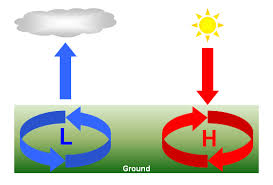
What are the characteristics of a high-pressure system?

1

Wind and rain

2

Humidity and thunder

3

Extremely hot temperatures

4

Clear skies and sun

29

Multiple Choice

Question image

The percentage of water vapor present in the air is called ________________.

1

weather

2

humidity

3

air mass

4

dew point

30

Multiple Choice

What kind of weather is usually associated with a high pressure system?
1
Sunny weather
2
Precipitation (rain, snow, etc.)

31

Multiple Choice

When a high pressure system is approaching, what happens?

1

warm air is pushing under cold air causing humid weather and lower temperatures

2

warm air is pushing under cold air causing humid weather and higher temperatures

3

warm air rises over the cool air, then cools down, and causes heavy rain and thunderstorms

4

cold air is pushed over warm air causing rain and thunderstorms

32

Multiple Choice

Question image
What type of weather usually goes with this symbol?
1
Clear, sunny skies
2
Cloudy skies
3
Hot temperature
4
Thunderstorms

33

Multiple Choice

What type of weather is a low pressure system associated with?

1

lousy (stormy) weather

2

happy (sunny) weather

34

Multiple Choice

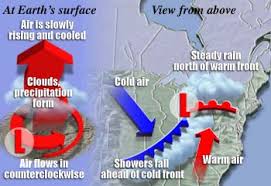
Describe how a cold front works in nature.

1

Cold air pushes a warm air mass out (or displaces) of the area.

2

Warm air pushes a cold air mass out (or displaces) of the area.

3

A warm and a cold air mass come together, but they cannot move each other.

4

Two cold air masses push a warm air mass up and trap the warm air mass from the ground.

35

Multiple Choice

What are the four types of weather fronts?

1

Cold, Warm, Stationary, High

2

Cold, Warm, Occluded, Low

3

Warm, High, Low, Cold

4

Cold, Warm, Stationary, Occluded

36

Multiple Choice

What weather does a cold front (and an occluded front) bring?

1

Dramatic weather with heavy precipitation

2

Calmer weather with light precipitation, if any

37

Multiple Choice

What weather does a warm front bring?

1

Dramatic weather with heavy precipitation

2

Calmer weather with light precipitation, if any

38

Multiple Choice

What weather does a stationary front bring?

1

Dramatic weather with heavy precipitation

2

Calmer weather with light precipitation, if any

3

Long periods of rain

39

Multiple Choice

What tool measures temperature in the atmosphere?

1

Thermometer

2

Anemometer

3

Hygrometer

4

Rain Gauge

40

Multiple Choice

Which tool measures air pressure in the atmosphere?

1

Hygrometer

2

Anemometer

3

Barometer

4

Rain Gauge

41

Multiple Choice

What kind of weather do you predict with a high pressure system?

1

Fair weather, light precipitation (if any), cooler and drier

2

Stormy, heavy precipitation, warmer, more humid

42

Multiple Choice

What kind of weather do you predict with a low pressure system?

1

Fair weather, light precipitation (if any), cooler and drier

2

Stormy, heavy precipitation, warmer, more humid

43

Multiple Choice

If you were predicting the weather, and you noticed that the barometer reading was falling rapidly over a short period of time, what kind of weather could you predict?

1

Stormy weather will come into the area quickly.

2

Stormy weather will come into the area slowly.

3

The weather will not change.

4

The weather will be clear.

44

Multiple Choice

Describe how a warm front works in nature.

1

Cold air pushes a warm air mass out (or displaces) of the area.

2

Warm air pushes a cold air mass out (or displaces) of the area.

3

A warm and a cold air mass come together, but they cannot move each other.

4

Two cold air masses push a warm air mass up and trap the warm air mass from the ground.

45

Multiple Choice

Describe how a stationary front works in nature.

1

Cold air pushes a warm air mass out (or displaces) of the area.

2

Warm air pushes a cold air mass out (or displaces) of the area.

3

A warm and a cold air mass come together, but they cannot move each other.

4

Two cold air masses push a warm air mass up and trap the warm air mass from the ground.

46

Multiple Choice

Describe how an occluded front works in nature.

1

Cold air pushes a warm air mass out (or displaces) of the area.

2

Warm air pushes a cold air mass out (or displaces) of the area.

3

A warm and a cold air mass come together, but they cannot move each other.

4

Two cold air masses push a warm air mass up and trap the warm air mass from the ground.

47

Multiple Choice

You are using your weather tools to predict the weather in the morning. The barometric pressure is rising steadily, the hygrometer is at 30% humidity and dropping, and the anemometer is measuring wind speeds at 5 MPH. If the weather stays the same, what do you predict the weather to be like this afternoon?

1

Clear and fair

2

Stormy and humid

3

Rainy and mild

4

Cold and snowy

48

Multiple Choice

What type of heat transfer causes the wind to blow?

1

Conduction

2

Convection

3

Radiation

49

Multiple Choice

Question image

What type of weather front is moving across Texas?

1

Occluded Front

2

Warm Front

3

Cold Front

4

Stationary Front

50

Multiple Choice

Cumulonimbus clouds often form along cold fronts. Which type of weather is most likely to occur along a cold front?

1

Sunny & Dry

2

Moderate temperature with no precipitation

3

Rain & possible thunderstorms

4

High Temperatures with rain

51

Multiple Choice

Question image

High pressure systems are usually associated with what type of weather?

1

Clouds and precipitation

2

Fair weather and sunny

3

Severe Thunderstorms

4

Jet Streams

52

Multiple Choice

Question image

Low pressure systems are associated with what type of weather?

1

Clouds & precipitation

2

Fair weather & sunny

3

Jet Streams

4

Dry Air

53

Multiple Choice

A weather system brought gentle rain and an increase in air temperature. Which type of front could have caused this?

1

Warm Front

2

Cold Front

3

Occluded Front

54

Multiple Choice

Question image
Which system results in drier, fairer weather?
1
high pressure
2
low pressure
3
hurricane
4
weather system

55

Multiple Choice

Question image
Which system results in rainy or stormy weather?
1
high pressure
2
low pressure
3
hurricane
4
weather system

56

Multiple Choice

Which most likely produces clear, cool weather?
1
zero air pressure
2
stable air pressure
3
a low pressure system
4
a high pressure system

​Tracking Storms Investigation

By Logan Tubb

Show answer

Auto Play

Slide 1 / 56

SLIDE