

Remainder of Chapter 2

Presentation
•
Science
•
9th - 12th Grade
•
Practice Problem
•
Hard
+9
Standards-aligned

Gabriella Dalton
FREE Resource
35 Slides • 27 Questions
1

2
Multiple Choice
Why is it significant that water is denser as a liquid than as a solid?
Because it allows ice to float, which insulates water surfaces and supports aquatic life
Because it makes water freeze faster
Because it causes water to evaporate more quickly
Because it makes water more acidic
3

4
Open Ended
How does the structure of water molecules in ice differ from that in liquid water, and what effect does this have on the density of each state?
5

6

7
Multiple Choice
Which liquid has the highest specific heat according to Table 2.1?
Water (H2O)
Ethanol (C2H6O)
Glycerol (C3H8O3)
Benzene (C6H6)
8

9
Fill in the Blanks
Type answer...
10

11

12
Multiple Choice
What is the chemical equation for the dissociation of water into hydrogen and hydroxide ions?
H2O ⇌ H+ + OH−
H2O ⇌ H3O+ + OH−
2H2O ⇌ H3O+ + OH−
H2O ⇌ H2 + O2
13

14
Multiple Select
Which of the following statements about acids and bases is/are correct?
Acids give up protons and increase hydronium ion concentration.
Bases acquire protons and decrease hydronium ion concentration.
Adding acid to solution decreases proton concentration.
Adding base to solution increases proton concentration.
15

16
Open Ended
Explain how buffers help maintain homeostasis in living organisms.
17
Multiple Choice
Which of the following statements about acids, bases, and buffers is correct?
Acids have a pH greater than 7
Bases have a pH less than 7
Buffers minimize changes in pH
Neutral solutions have a pH less than 7
18

19
Multiple Choice
Based on the pH scale, which substances are considered neutral, and what is their pH value?
Human blood and pure water, pH 7
Lemon juice and milk, pH 5
Household bleach and seawater, pH 10
Stomach acid and tomatoes, pH 2
20

21
Multiple Choice
Which environments are proposed as the origins of chemical evolution, and what gases are associated with each?
Atmosphere and deep-sea hydrothermal vents; CO2, H2, N2
Atmosphere and ocean; O2, CO2, H2
Deep-sea hydrothermal vents and lakes; CO2, O2, N2
Atmosphere and lakes; H2O, CO2, O2
22

23
Fill in the Blanks
24

25

26
Open Ended
Compare and contrast open, closed, and isolated systems in terms of their ability to exchange energy and matter with their surroundings.
27

28

29
Multiple Choice
Which type of energy is associated with the position of shared electrons in covalent bonds?
Kinetic energy
Potential energy
Thermal energy
Mechanical energy
30

31
Open Ended
Explain how the position of shared electrons in covalent bonds affects the potential energy of a molecule.
32

33
Multiple Choice
Which of the following statements about thermal energy is correct?
Thermal energy is stored energy.
Thermal energy is the kinetic energy of molecular motion.
Thermal energy is only present in solid objects.
Thermal energy cannot be transferred between objects.
34

35
Fill in the Blanks
36

37
Open Ended
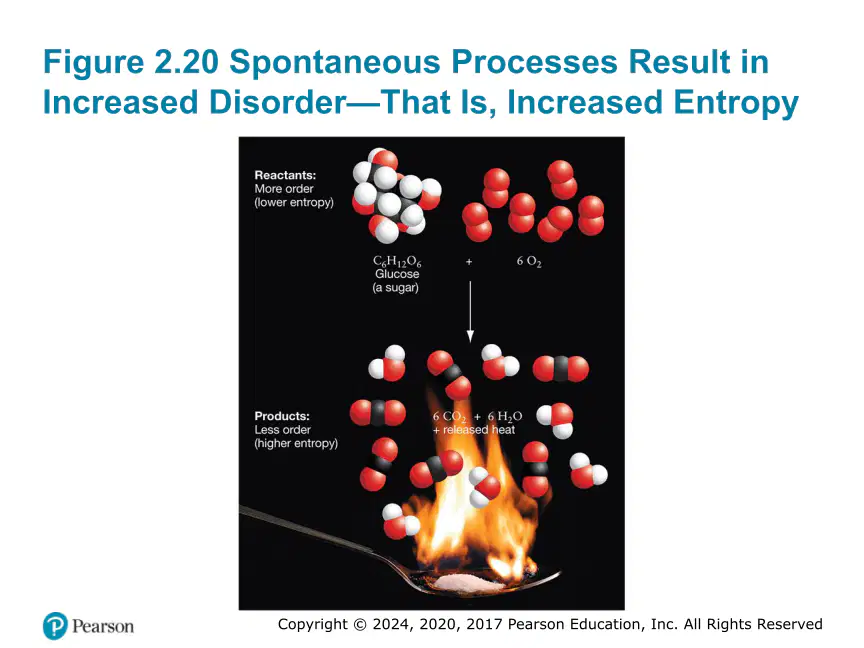
Describe the relationship between entropy and the spontaneity of a chemical reaction.
38
Multiple Select
Select all the factors that determine if a chemical reaction will proceed spontaneously.
Products have lower potential energy than reactants
Products are less ordered than reactants
Reactants have higher entropy than products
Products require added energy
39
40
Multiple Choice
Which process is illustrated by the burning of glucose in the presence of oxygen, resulting in increased disorder and entropy?
Photosynthesis
Cellular respiration
Fermentation
Dehydration synthesis
41

42
Open Ended
Explain how the second law of thermodynamics relates to spontaneous chemical reactions.
43

44
Multiple Choice
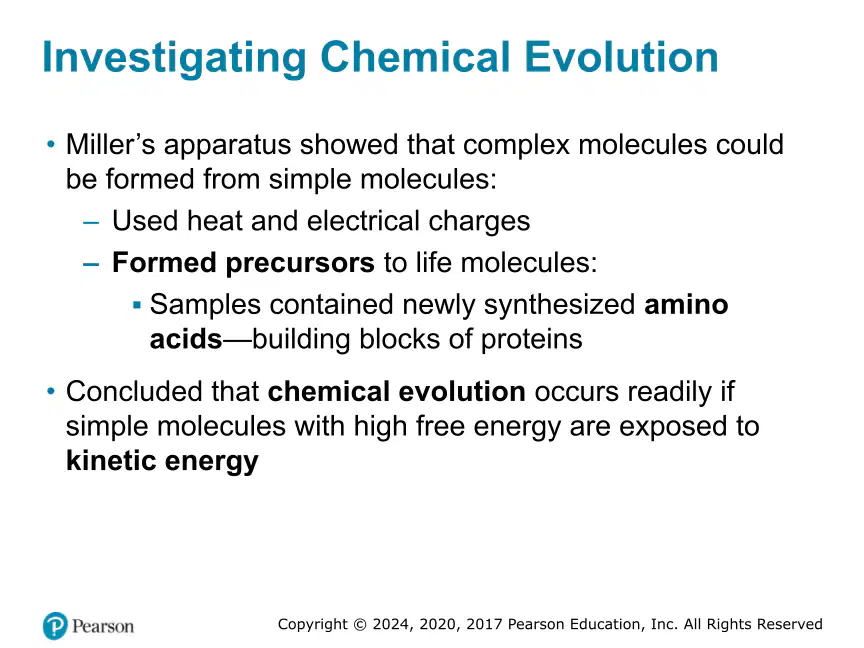
Stanley Miller's experiment aimed to answer which fundamental question about the origin of life?
Can life exist without water?
Can complex organic compounds be synthesized from simple molecules present in Earth's early atmosphere?
Can carbon form double bonds?
Can entropy decrease in a closed system?
45

46
47
Fill in the Blanks
Type answer...
48
Multiple Choice
Which of the following were used in Miller's Spark-Discharge Experiment to simulate early Earth's conditions?
Ultraviolet light and nitrogen
Heat and electrical charges
Radioactive isotopes and oxygen
Magnetic fields and helium
49

50
51

52

53

54
Match
Match the functional group with the correct picture:
Hydroxyl
Carboxyl
Amine
Carbonly
Phosphate
Hydroxyl
Carboxyl
Amine
Carbonly
Phosphate
55

56

57
Multiple Choice
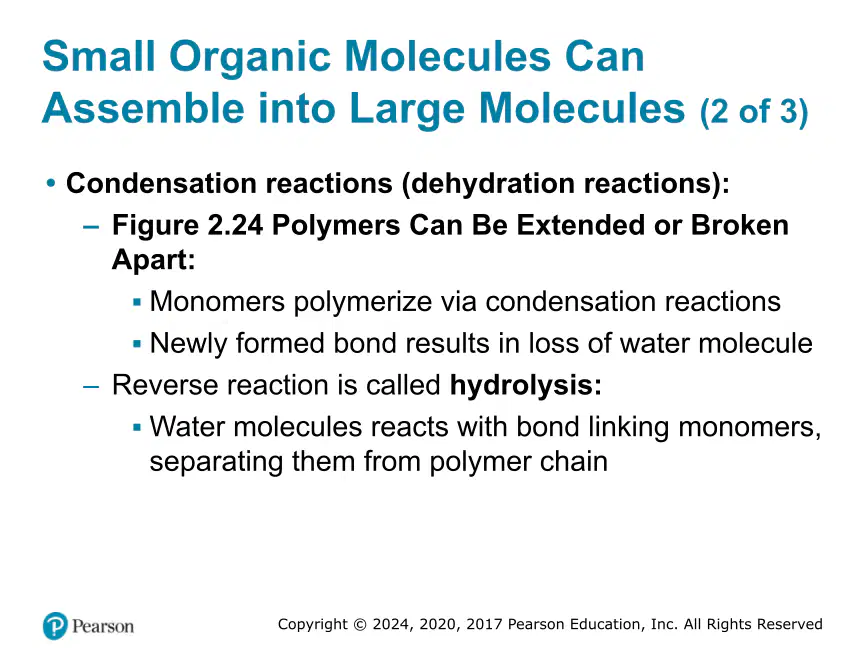
A __________ consists of many monomers bonded together.
monomer
hydrocarbon
peptide
polymer
58
59
Multiple Choice
60

61

62
Multiple Choice
Show answer
Auto Play
Slide 1 / 62
SLIDE
Similar Resources on Wayground

58 questions
Digestive System
Presentation
•
9th - 11th Grade
57 questions
Ecology part 1 review 2025 fall semester final
Presentation
•
9th - 12th Grade
53 questions
Wildlife Conservation
Presentation
•
9th - 12th Grade
58 questions
Speed, Velocity, and Acceleration
Presentation
•
9th - 12th Grade
55 questions
Untitled Presentation
Presentation
•
KG - University
53 questions
Lesson 3: EMS
Presentation
•
9th - 12th Grade
61 questions
Density Review
Presentation
•
9th - 12th Grade
58 questions
African American Migration (Performance)
Presentation
•
9th - 12th Grade
Popular Resources on Wayground
6 questions
Secondary Safety Quiz
Presentation
•
9th - 12th Grade
10 questions
MyPath Diagnostic Overview
Presentation
•
6th - 8th Grade
20 questions
Lab Safety Quiz

Quiz
•
6th Grade
21 questions
Continents and Oceans
Quiz
•
6th Grade
20 questions
Adding and Subtracting Decimals
Quiz
•
5th Grade
20 questions
Parts of Speech
Quiz
•
5th Grade
16 questions
Subject & Predicate
Quiz
•
5th Grade
21 questions
Lab Safety
Quiz
•
10th Grade
Discover more resources for Science
10 questions
Scientific Method (The scientific method)

Interactive video
•
9th Grade
9 questions
Scientific method
Interactive video
•
9th - 12th Grade
10 questions
Lab Safety Essentials
Interactive video
•
6th - 10th Grade
10 questions
Essential Guidelines for Science Lab Safety
Interactive video
•
6th - 10th Grade
35 questions
Flinn Lab Safety
Quiz
•
11th Grade
10 questions
Exploring Scientific Variables and Their Roles
Interactive video
•
6th - 10th Grade
15 questions
counting significant figures
Quiz
•
9th Grade
10 questions
Structure of Water and Hydrogen Bonding
Quiz
•
9th - 12th Grade