

Bài 22

Presentation
•
Science
•
10th Grade
•
Practice Problem
•
Hard

Truong Thi Dao (FE FSCHOOL BTL)
FREE Resource
26 Slides • 24 Questions
1

2
3
Open Ended
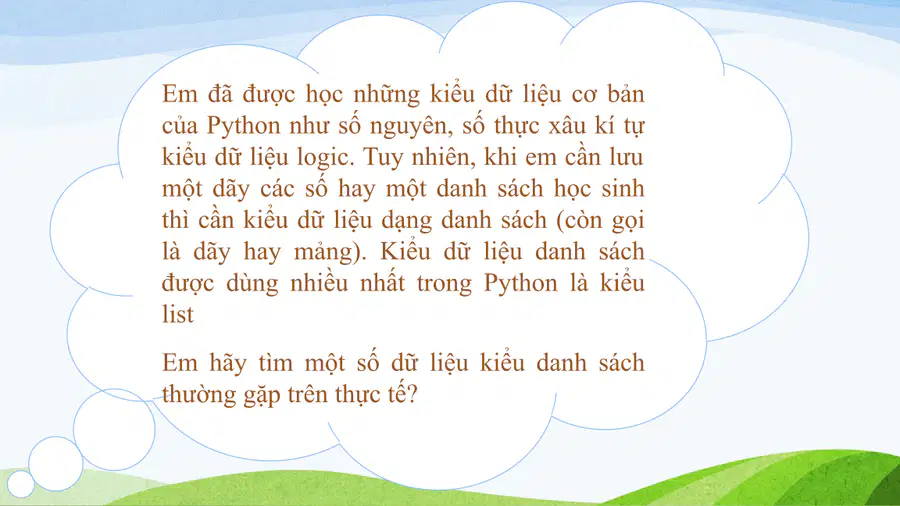
Can you find some examples of list-type data that are commonly encountered in real life?
4
5
Open Ended
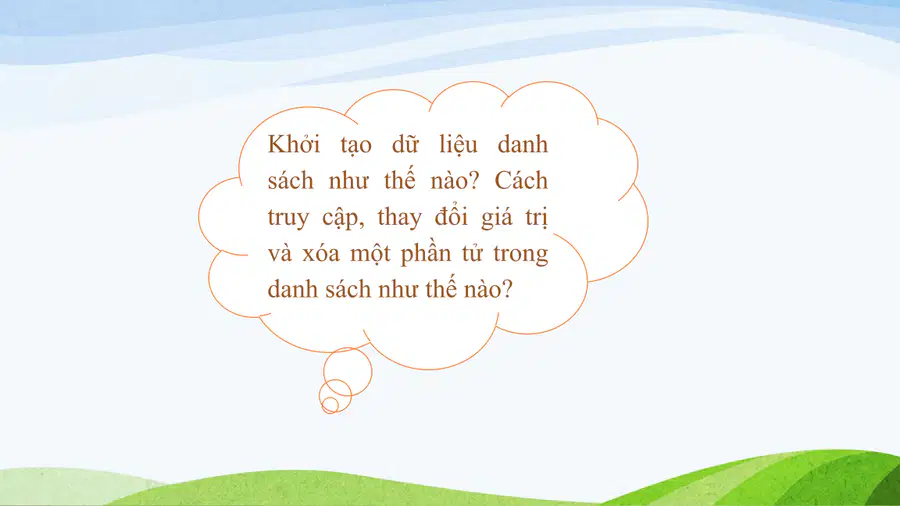
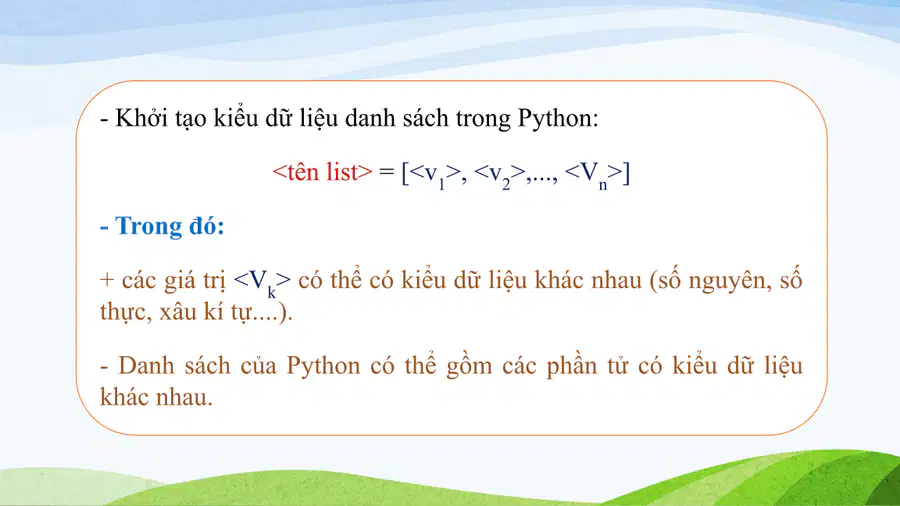
How do you initialize a list in Python? How can you access, modify, and delete an element in a list?
6
7
Multiple Choice
Which of the following statements about Python lists is correct?
All elements in a Python list must be of the same data type.
Python lists can contain elements of different data types.
Python lists cannot be empty.
Python lists are immutable.
8
9
Multiple Select
Select all correct ways to access elements in a Python list.
Using the element's value directly
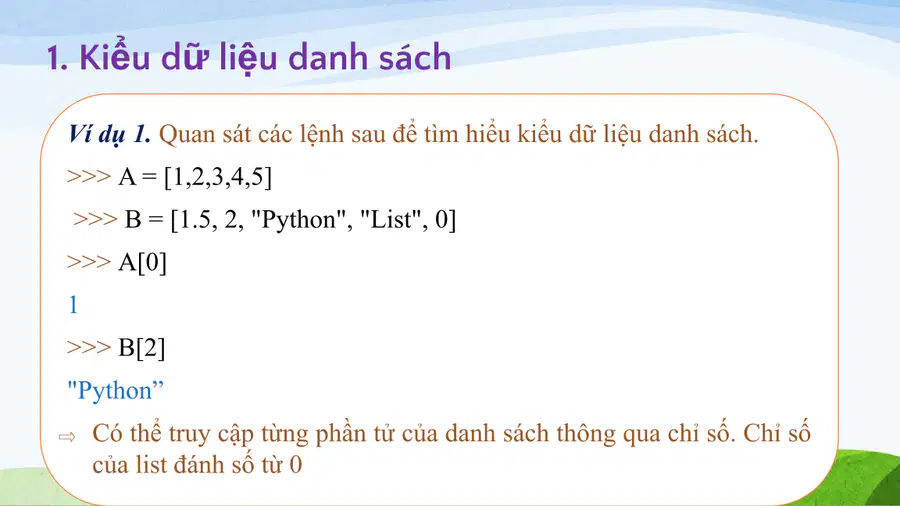
Using the index of the element
Using the length of the list
Using a loop with indices
10
11
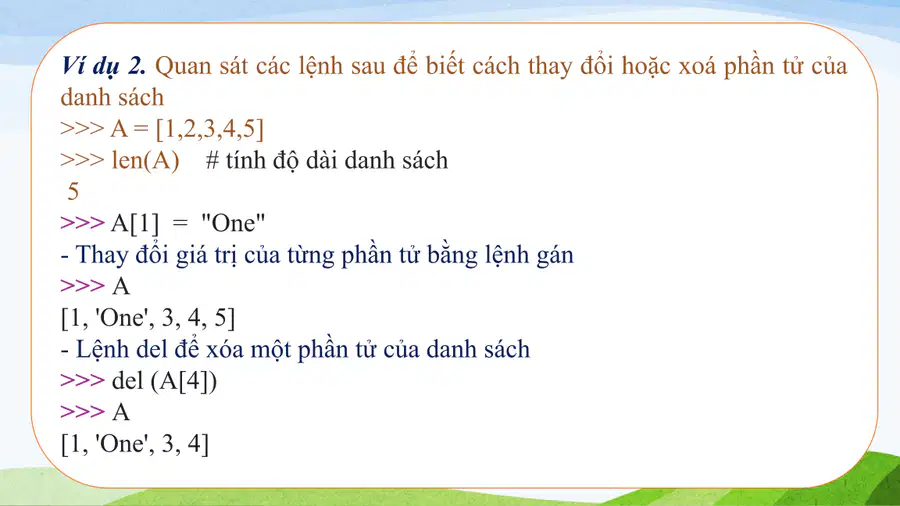
Open Ended
Explain how you can change the value of an element in a Python list and how to remove an element from the list.
12
13
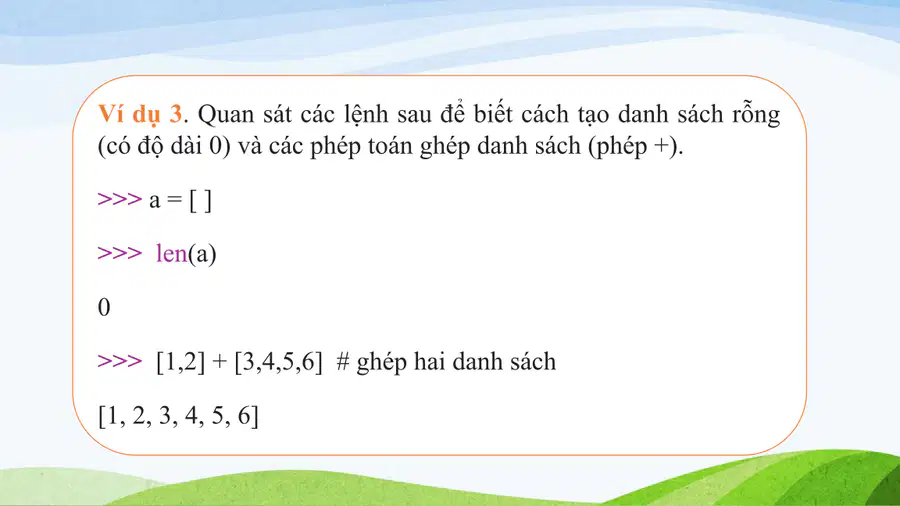
Multiple Choice
What is the result of the operation [1,2] + [3,4,5,6] in Python?
[1,2,3,4,5,6]
[1,2],[3,4,5,6]
[1,2,3,4]
[1,2,6,5,4,3]
14
15
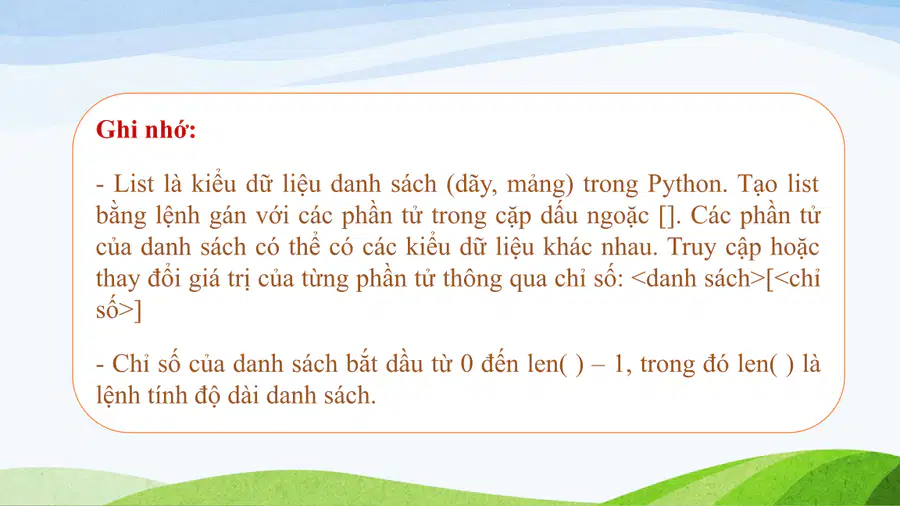
Fill in the Blanks
Fill in the blank: The index of the first element in a Python list is
Type answer...
16
17
Multiple Choice
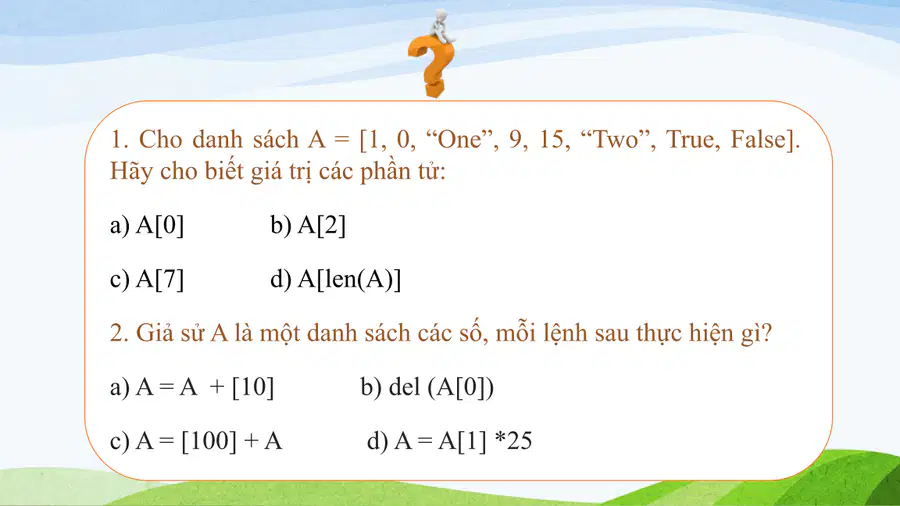
Suppose A is a list of numbers. What does the command del(A[0]) do to the list?
Removes the first element from A
Deletes the entire list A
Removes the last element from A
Adds a new element to A
18
Multiple Choice
Given the list A = [1, 0, "One", 9, 15, "Two", True, False], what is the value of A[2]?
0
"One"
9
True
19
20
21
22
Multiple Select
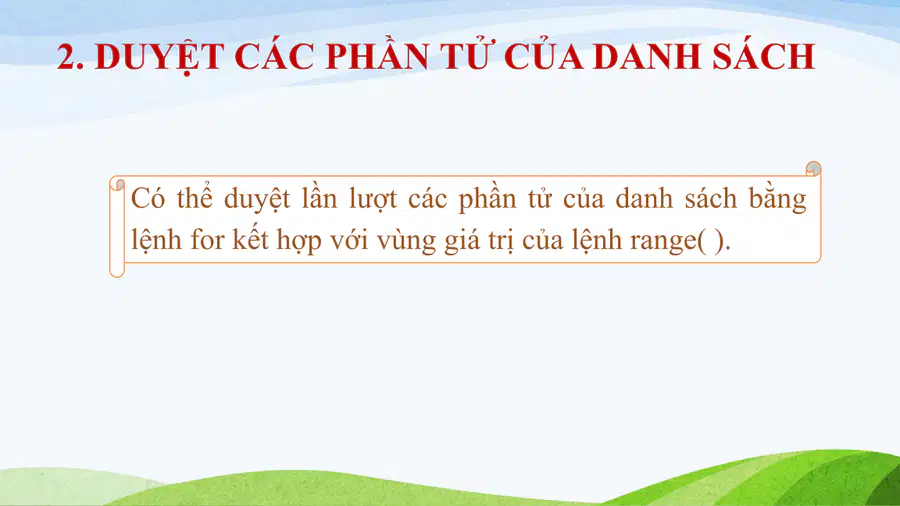
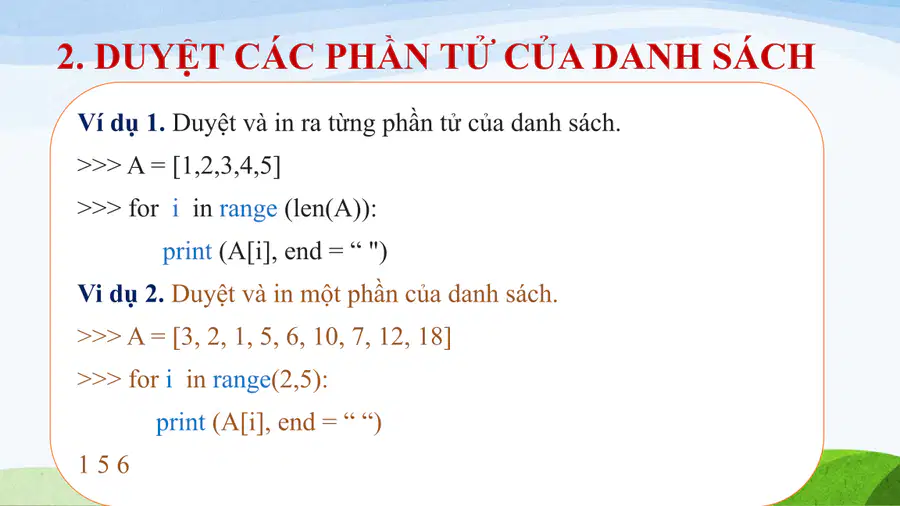
Which of the following statements about iterating over a list in Python are correct?
You can use for i in range(len(A)) to access each element by index.
You can use for element in A to access each element directly.
Using range(2,5) allows you to access a subset of the list.
You cannot use a for loop to iterate over a list.
23
Open Ended
Explain how the for loop combined with the range function can be used to iterate over elements of a list.
24
25
Open Ended
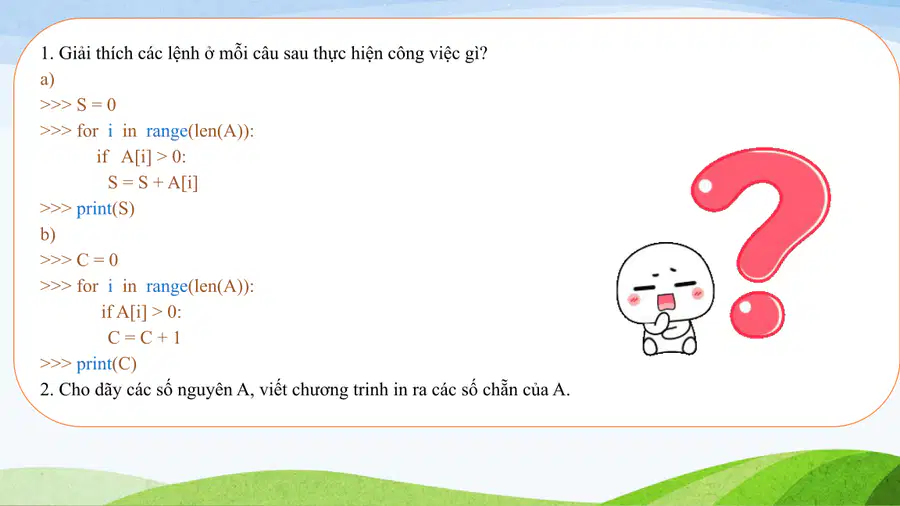
Describe what the following code does: S = 0; for i in range(len(A)): if A[i] > 0: S = S + A[i]; print(S)
26
27
Fill in the Blanks
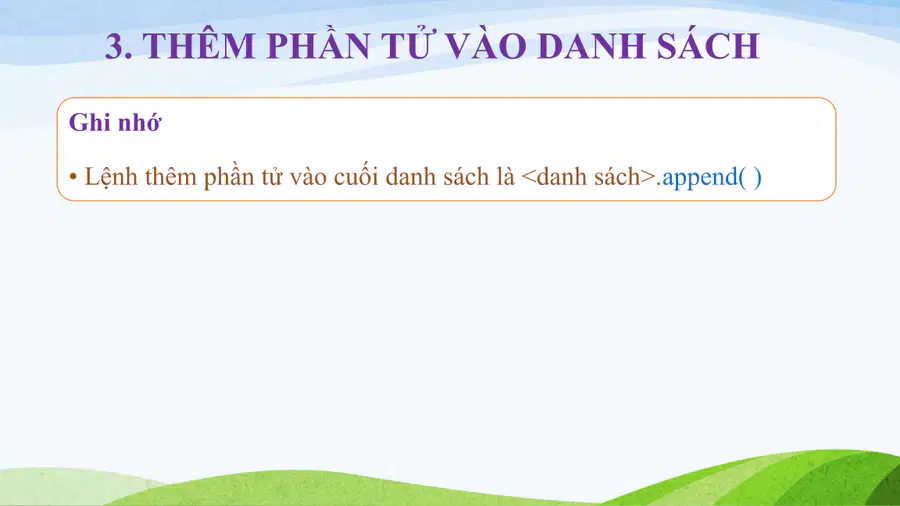
Fill in the blank: To add an element to the end of a list in Python, use the
Type answer...
28
29
Multiple Select
Which of the following statements about the Python list append() method are correct?
It adds an element to the end of the list.
It can add multiple elements at once.
It modifies the original list.
It returns the new list.
30
Open Ended
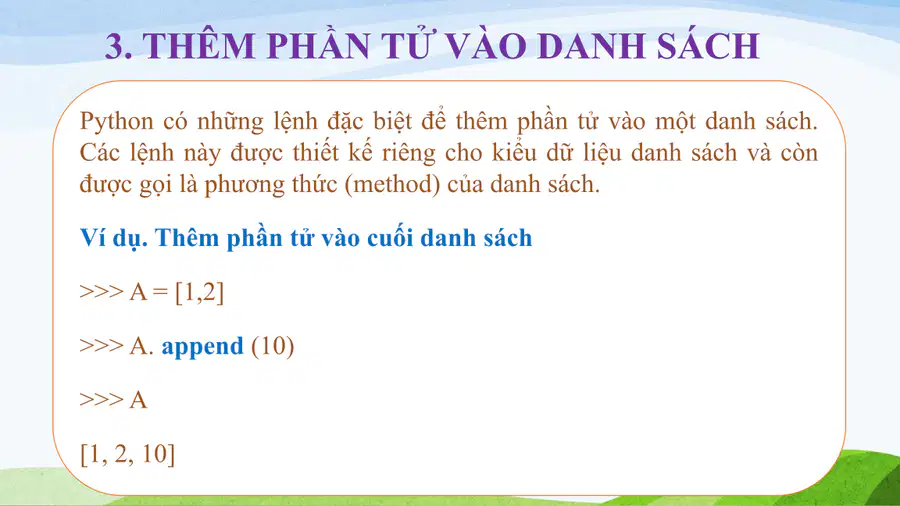
Explain how the append() method works in Python lists. Give an example.
31
Multiple Choice
What is the result of the list A after executing the following code? A = [1,2]; A.append(10); print(A)
[1, 2, 10]
[1, 10, 2]
[10, 1, 2]
[1, 2]
32
33
Multiple Choice
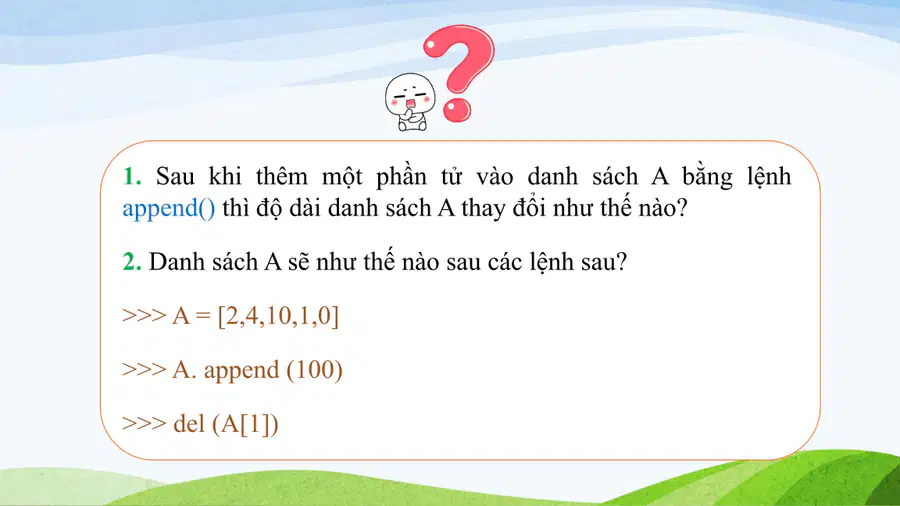
Given a list A = [2,4,10,1,0], what will A look like after executing: A.append(100); del(A[1])?
[2,10,1,0,100]
[2,4,10,1,0,100]
[4,10,1,0,100]
[2,4,1,0,100]
34
Multiple Choice
After using the append() method to add an element to a list in Python, how does the length of the list change?
It increases by 1
It decreases by 1
It stays the same
It doubles
35
36

37
38
39
40
41
Open Ended
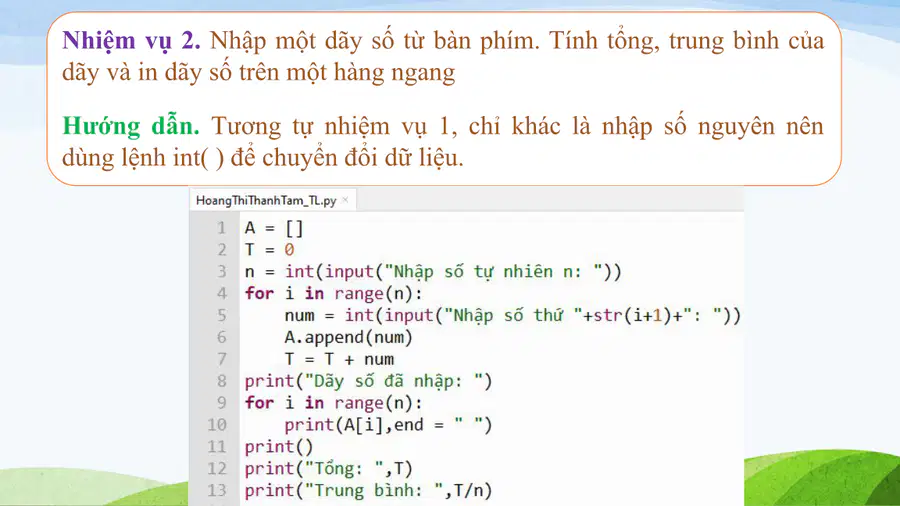
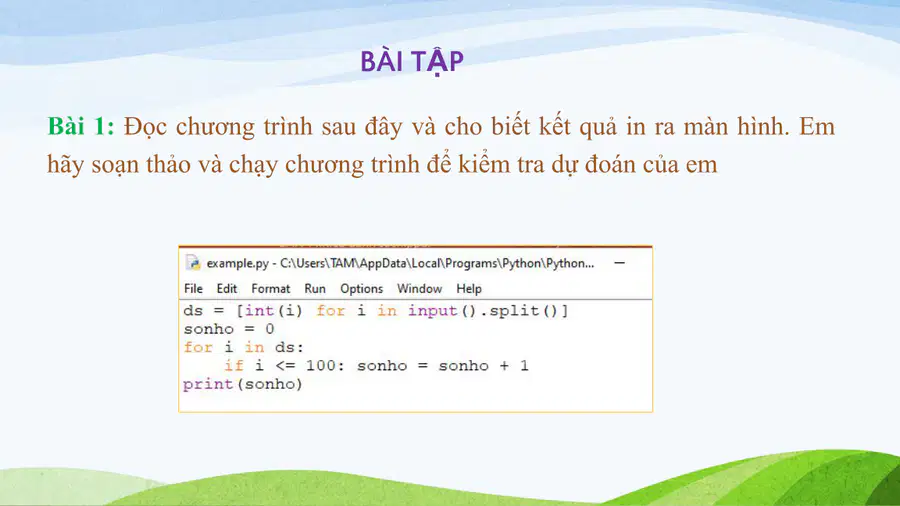
Explain how the program in images 0 and 1 counts the number of integers less than or equal to 100.
42
Multiple Choice
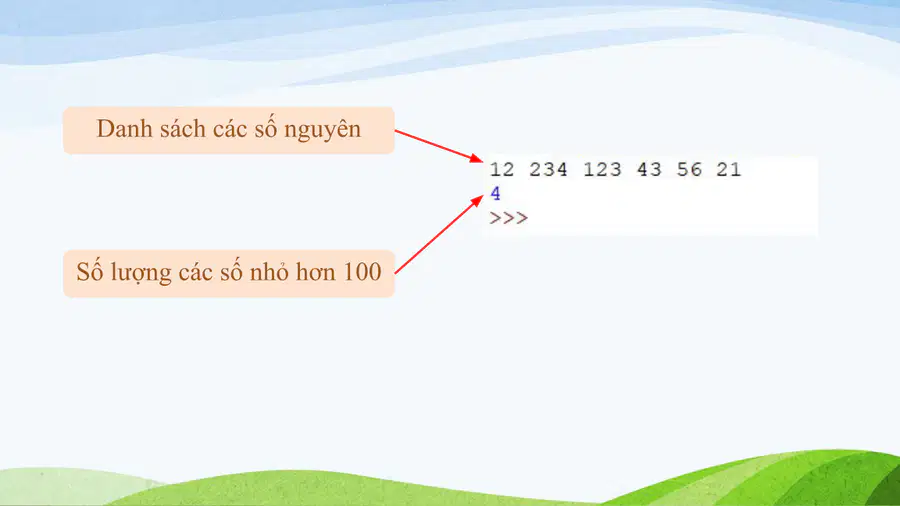
What is the output of the Python program if the input is '12 234 123 43 56 21'?
3
4
5
6
43
44
45
Fill in the Blanks
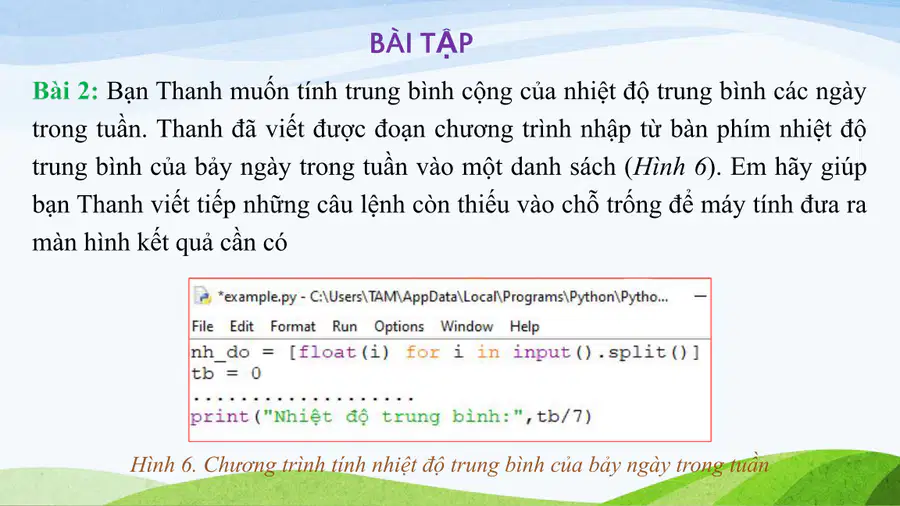
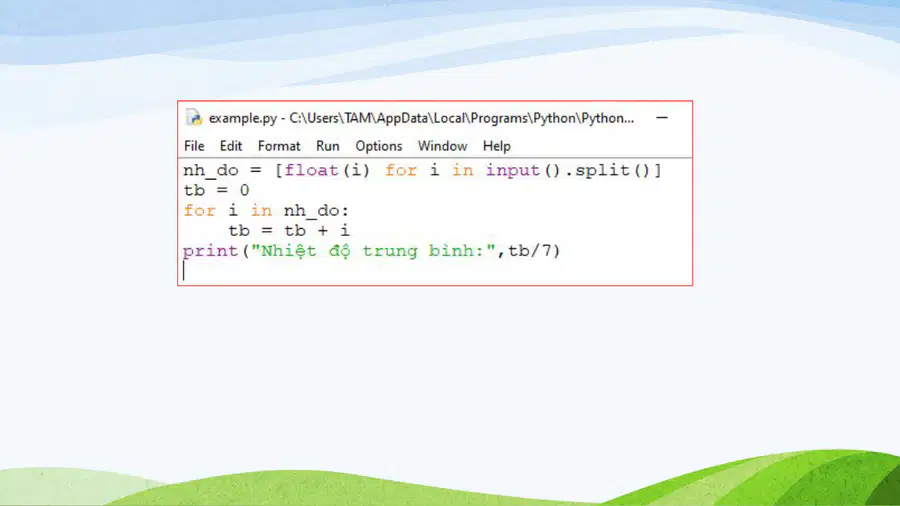
Fill in the blank: To calculate the average temperature for seven days, the program divides the total sum by
Type answer...
46
47
Multiple Choice
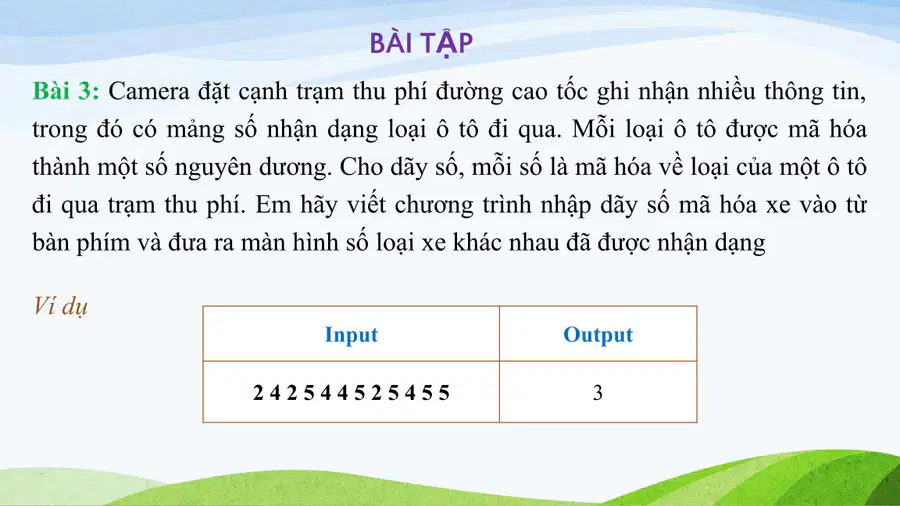
What is the output of the program in image 4 if the input is '2 4 2 5 4 4 5 2 5 4 5 5'?
2
3
4
5
48
49
Multiple Select
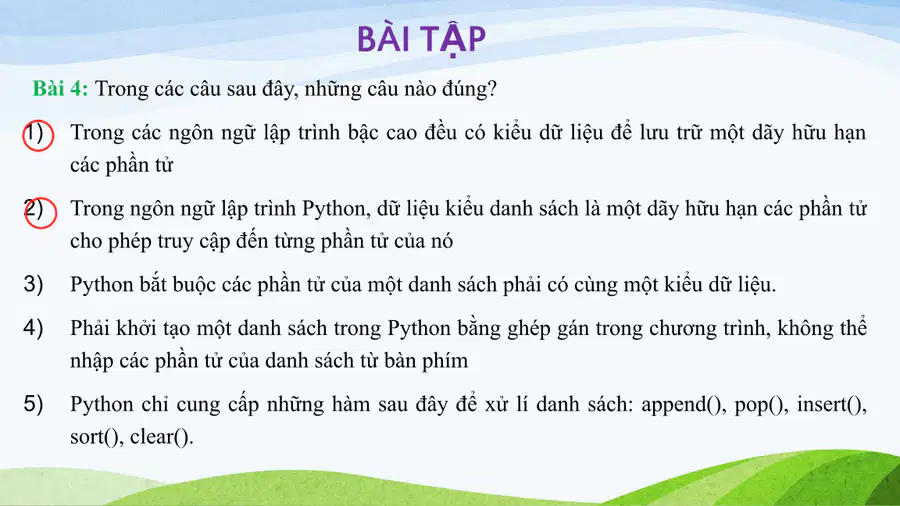
Which of the following are correct statements about lists in Python?
All high-level programming languages have a data type for storing a finite sequence of elements.
In Python, the list data type is a finite sequence of elements that allows access to each element.
Python requires all elements in a list to be of the same data type.
Lists in Python can only be created by assignment in the program, not by input from the keyboard.
50
Open Ended
Can you name some real-life examples of list-type data that you encounter?
Show answer
Auto Play
Slide 1 / 50
SLIDE
Similar Resources on Wayground

42 questions
Animal Science After Break Review 2022
Presentation
•
10th Grade
46 questions
Vocabulary Study Guide Sophomores
Presentation
•
10th Grade
45 questions
Bond Electronegativity
Presentation
•
10th Grade
46 questions
2.3
Presentation
•
10th Grade
43 questions
TERREMOTOS (Procesos Geológicos Internos 4º ESO)
Presentation
•
10th Grade
45 questions
Lab Equipment/Separation Activities #3
Presentation
•
9th - 10th Grade
42 questions
SSWH15 Industrialization and Urbanization
Presentation
•
10th Grade
45 questions
Life Cycle of a Star
Presentation
•
KG - 8th Grade
Popular Resources on Wayground
10 questions
Safety Day 2026 – Student Review

Quiz
•
9th Grade
21 questions
Continents and Oceans
Quiz
•
6th Grade
20 questions
Parts of Speech
Quiz
•
5th Grade
16 questions
Subject & Predicate
Quiz
•
5th Grade
25 questions
Multiplication Facts
Quiz
•
5th Grade
12 questions
Map Skills
Quiz
•
3rd Grade
22 questions
Continents and Oceans
Quiz
•
5th Grade
15 questions
Rounding Decimals
Quiz
•
5th Grade
Discover more resources for Science
10 questions
Exploring Chemical and Physical Changes

Interactive video
•
6th - 10th Grade
10 questions
Exploring the Electromagnetic Spectrum for Middle School Science
Interactive video
•
6th - 10th Grade
10 questions
Exploring Force and Motion Concepts
Interactive video
•
6th - 10th Grade
10 questions
Exploring Air Masses and Weather Fronts
Interactive video
•
6th - 10th Grade
10 questions
Exploring the States of Matter
Interactive video
•
6th - 10th Grade
10 questions
Exploring Forces: Net Force, Normal Force, Gravity, and Friction
Interactive video
•
6th - 10th Grade
10 questions
Differentiating Thermal Energy and Temperature
Interactive video
•
6th - 10th Grade
10 questions
Exploring the States of Matter and Thermal Energy
Interactive video
•
6th - 10th Grade