Search Header Logo
Unit 1: Macromolecules and Enzymes

Unit 1: Macromolecules and Enzymes

Assessment

Presentation

Biology

9th - 12th Grade

Easy

NGSS
HS-LS1-6, HS-PS1-5, HS-PS1-4

+6

Standards-aligned

Created by

Sara Bensink

Used 1+ times

FREE Resource

36 Slides • 51 Questions

1

media

2

Open Ended

Is what you eat important? Why?

3

media

4

Open Ended

What are macromolecules and why are they important to living things?

5

media

6

Open Ended

Differentiate between a monomer and a polymer.

7

media

8

Open Ended

What is the purpose of dehydration synthesis and how does it work?

9

media

10

media

11

Multiple Choice

What role do carbohydrates play in metabolism?

1

They are the primary source of energy

2

They are used for building muscle

3

They are used for storing vitamins

4

They are used for hormone production

12

media

13

Multiple Choice

What are the three types of carbohydrates based on the number of monomers they have?

1

Monosaccharides

2

Disaccharides

3

Polysaccharides

4

All of the above

14

Draw

Draw the structure of a monosaccharide.

15

Multiple Select

Which statement is FALSE?

1

carbohydrates are made up of elements CHO

2

Carbohydrates provide short term energy

3

Polysaccharides are made up of one monosaccharide

4

Common endings for carbohydrates is -ase

16

media

17

Multiple Choice

What type of carbohydrate is represented in the image?

1

monosaccharide

2

disaccharide

3

polysaccharide

4

none of the above

18

media

19

Multiple Choice

Which of the following foods is NOT high in carbohydrates?

1

candy

2

fruits

3

pasta

4

chicken

20

media

21

Multiple Choice

Question image

A hydrocarbon chain that is sometimes considered to be a monomer of lipids.

1

Fatty Acids

2

Nucleic Acids

3

Proteins

4

Lipids

22

media

23

Multiple Choice

What are the two types of fats mentioned in the image?

1

Saturated and Unsaturated

2

Solid and Liquid

3

Triglyceride and Glycerol

4

Butter and Oil

24

media

25

Multiple Choice

What are the two parts of a phospholipid?

1

Hydrophilic head and hydrophobic tail

2

Hydrophobic head and hydrophilic tail

3

Glycerol and fatty acids

4

Phosphate group and fatty acids

26

Draw

Draw a phospholipid

27

media

28

media

29

media

30

media

31

media

32

Categorize

Options (6)

Has Deoxyribose Sugar

Has Ribose Sugar

Double Stranded

Single Stranded

Thymine as a base

Uracil as a base

Sort the properties by whether they apply to DNA or RNA

DNA
RNA

33

media

34

Multiple Choice

What are the three parts of nucleotides?

1

sugar, phosphate group, nitrogenous base

2

sugar, amino acids, phosphate group

3

nitrogenous base, sugar, proteins

4

phosphate group, amino acids, nitrogenous base

35

media

36

Multiple Choice

What are the main structural differences between DNA and RNA?

1

DNA is double-stranded, RNA is single-stranded

2

DNA contains Uracil, RNA contains Thymine

3

DNA is found in the nucleus, RNA is found in the cytoplasm

4

DNA is larger than RNA

37

media

38

media

39

Multiple Choice

What is the relationship between food and nucleic acids?

1

All food contains proteins

2

All food has nucleic acids

3

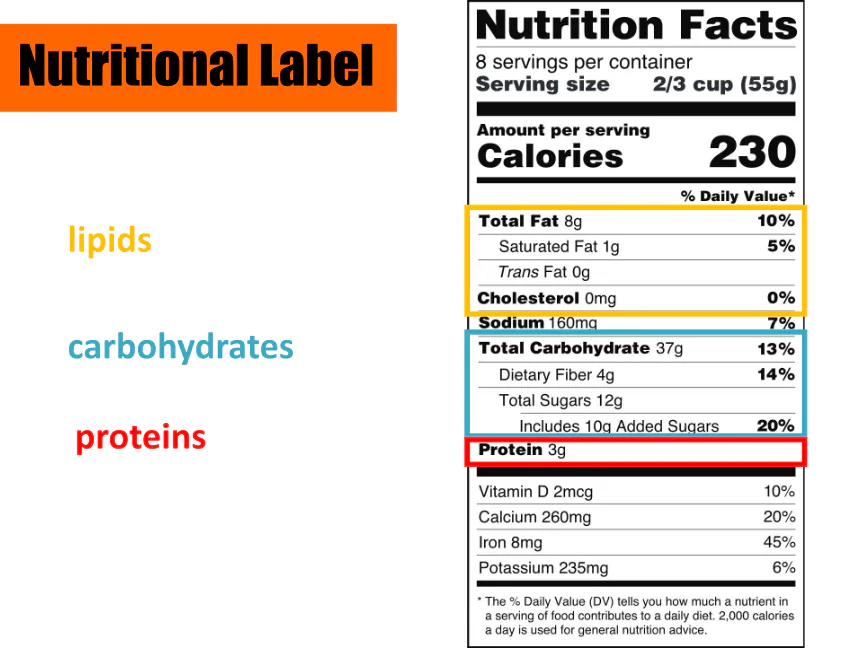
Nucleic acids are included in nutritional labels

4

Only plants have nucleic acids

40

media

41

media

42

Multiple Choice

What is the activation energy?
1
The energy of the products
2
The energy of the reactants
3
The minimum energy needed by the reactants to form the products.
4
The energy lost in the reaction

43

media

44

Multiple Choice

 Enzymes work by lowering activation energy, which is

1

Energy needed to start chemical reaction

2

Energy required to break hydrogen bonds

3

Energy released from chemical reaction

4

Energy conserved during catalytic process

45

media

46

Multiple Choice

++  Which ones are the reactant 2HO ++  Na  ==  H2O2Na

1

2HO

2

Na

3

2HO , Na

4

H2O2Na

47

media

48

media

49

Multiple Choice

Enzymes are specialized __________ that work as __________________.

1

Catalysts, Proteins

2

Lipids, Catalysts

3

Catalysts, Lipids

4

Proteins, Catalysts

50

media

51

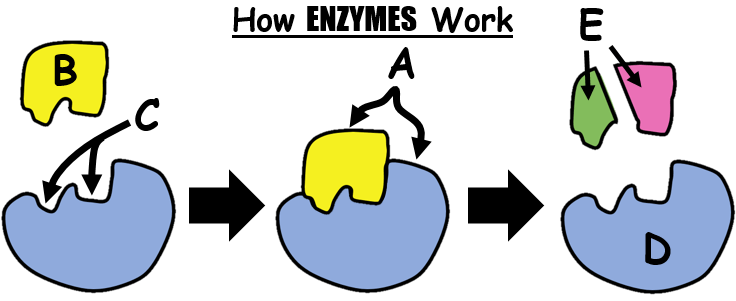
Multiple Choice

Question image
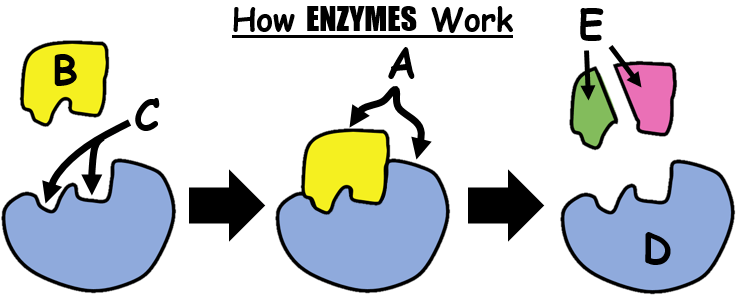
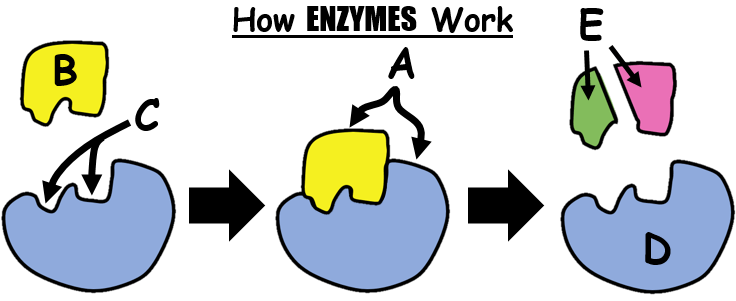
Letter D...
1
active site
2
enzyme
3
substrate
4
products

52

Multiple Choice

Question image
Letter B...
1
active site
2
enzyme
3
substrate
4
products

53

Multiple Choice

Question image
Letter C...
1
active site
2
enzymes
3
substrate
4
products

54

Multiple Choice

Question image
Letter E...
1
active site
2
enzyme
3
substrate
4
products

55

Multiple Choice

Enzymes are _______________ that _____________________ chemical reactions by ____________ the amount of activation energy required to start the reaction.

1

carbohydrates, slow down, lowering

2

proteins, speed up, increasing

3

lipids, speed up, lowering

4

proteins, speed up, lowering

56

media

57

media

58

media

59

media

60

media

61

media

62

media

63

Multiple Choice

Enzymes are proteins that have a three-dimensional shape that is specific to a particular substrate. Environmental conditions can change the shape of the protein. What is the most likely result if the shape of the enzyme changes?

1

the substrate will change its shape to match the enzyme

2

the enzyme will no longer be able to catalyze the reaction with the substrate

3

the products made from the enzyme and the substrate will be changed

4

the enzyme will be able to bind to more diverse substrates than before

64

media

65

Multiple Choice

Question image

The graphs show the reaction rate for an enzyme across a range of temperatures and pH. Based on these data, the enzyme functions best at what temperature and pH?

1

temperature of 27 degrees C and pH of 4

2

temperature of 37 degrees C and pH of 6

3

temperature of 40 degrees C and pH of 8

4

temperature of 50 degrees C and pH of 10

66

Multiple Choice

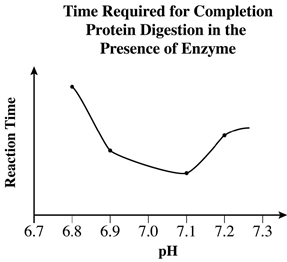
Question image

A student measured the time required for a protein sample to be completely digested in the presence of an enzyme under different pH levels. At which pH is the enzyme most active?

1

7.1

2

6.9

3

6.8

4

7.2

67

Multiple Choice

Question image

If the active site of an enzyme is deformed or damaged, it is said to be:

1

denitrated

2

devalued

3

denatured

4

detritus

68

Multiple Choice

Question image

Enzymes are classified as biological catalysts, which means they...

1

inhibit the enzymatic reaction of an enzyme

2

lower the activation energy of a chemical reaction

3

provide ATP for chemical reactions

4

help organisms repair themselves

69

Multiple Choice

Question image

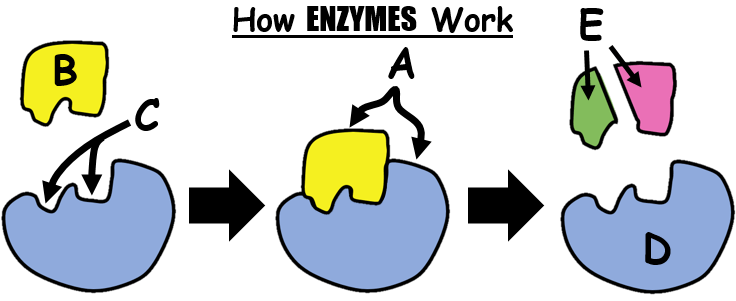
Which letter represents the enzyme?

1

A

2

B

3

C

4

D

70

Multiple Choice

a substance that is formed as the result of a chemical reaction
1
Product 
2
Reactant
3
Starters
4
Enders

71

Multiple Choice

What is the left part of a chemical equation called?
2H2 + O2 --> 2H2O
1
Reactants
2
Products 
3
Yields 
4
Chemical Equation 

72

Multiple Choice

An enzyme has a specific pH that it will work the best in. What happens to an enzyme if it is in an environment that is outside of that range?

1

It will denature but continue to function effectively

2

It will speed up the reaction

3

It will denature and function less effectively

4

It will slow down the reaction

73

Multiple Choice

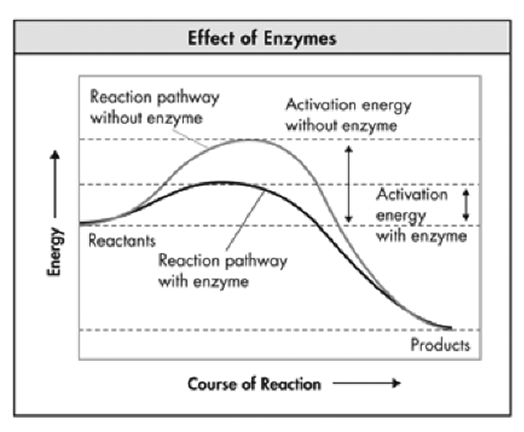
Question image
The graph shows how enzymes affect reactions in cells. Which statement best summarizes the information shown in the graph?
1
Enzymes increase the energy of the reactants.
2
Enzymes decrease the energy level of the products.
3
Enzyme decrease the activation energy of the reaction.
4
Enzymes reverse the direction of the reaction.

74

Multiple Choice

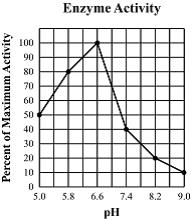
Question image
Which of the following conclusions can be drawn from this graph?
1
The optimum pH of the enzyme is 6.6.
2
The optimum pH of the enzyme is 5.8
3
The enzyme’s activity increases as pH increases 5.0 to 9.0
4
The enzyme’s activity is greater around pH of 8.0 .

75

Multiple Choice

Question image

Which macromolecule is structured in this way?

1

Carbohydrates

2

Lipids

3

Proteins

4

Nucleic acids

76

Multiple Choice

Question image
Which major macromolecule is being represented in this image? 
1
carbohydrate
2
lipid
3
protein
4
nucleic acid

77

Multiple Choice

What are the building blocks of proteins?
1
amino acid
2
fatty acid
3
nucleotide
4
lipid

78

Multiple Choice

Nucleotides are monomers of
1
Carbohydrates
2
Lipids
3
Proteins
4
Nucleic Acids

79

Multiple Choice

Waxes, oils and fats are examples of
1
Carbohydrates
2
Lipids
3
Proteins
4
Nucleic Acids

80

Multiple Choice

Question image

Which macromolecule is shown?

1

lipid

2

protein

3

nucleic acid

4

carbohydrate

81

Multiple Choice

Proteins are made of... 
1
C H O
2
C H O N
3
C H O N P
4
C H O N S

82

Multiple Choice

Which macromolecule stores energy, insulates us, and makes up the cell membrane?
1
lipids
2
proteins
3
carbohydrates
4
nucleic acids

83

Multiple Choice

An enzyme speeds up a chemical reaction in the cell but can only be used once.  True or False? 
1
true
2
false

84

Multiple Choice

Question image
Is found in the cell membrane as a bilayer. 
1
lipids
2
protein
3
nucleic acid
4
carbohydrate

85

Multiple Choice

What is an example of a lipid?

1
2
3
4

86

Multiple Choice

What is an example of a nucleic acid?

1
2
3
4

87

Multiple Choice

What are examples of carbohydrates?

1

triglycerides, waxes, fat, and oils

2

form polypeptides such as antibodies, enzymes, and hormones

3

glucose, fructose, cellulose, and lactose

4

DNA and RNA

media

Show answer

Auto Play

Slide 1 / 87

SLIDE