

SOLUBILITY 1

Presentation
•
Chemistry
•
9th - 12th Grade
•
Practice Problem
•
Easy

Isaiah Onekutu
Used 1+ times
FREE Resource
50 Slides • 28 Questions
1

2
Open Ended
Why is it important to understand the concept of solubility and concentration when making solutions like lemonade?
3

4
Open Ended
How are solutions with different amounts of solute described?
5

6
Multiple Choice
What is the definition of solubility?
The ability of a solvent to dissolve in a solute at any temperature
The maximum amount of a solute that dissolves in a given amount of solvent at a constant temperature
The amount of solvent needed to dissolve any solute
The process of separating solute from solvent
7

8

9

10
Open Ended
Explain how temperature affects the solubility of substances in water, using the examples provided in the tables.
11
Multiple Choice
Which of the following compounds has the highest solubility in water at 20°C?
Table salt (NaCl)
Baking soda (NaHCO3)
Table sugar (C12H22O11)
Calcium carbonate (CaCO3)
12
Open Ended
Compare the solubility of table salt, baking soda, and table sugar in water at 20°C. What does this tell you about their ability to dissolve?
13

14
Fill in the Blanks
A saturated solution contains as much
Type answer...
15

16
Multiple Select
Select all statements that are true about unsaturated solutions.
An unsaturated solution contains less solute than the maximum amount that can be dissolved.
An unsaturated solution will not dissolve any more solute.
An unsaturated solution is always more concentrated than a saturated solution.
As long as the amount of solute is less than the solubility at that temperature, the solution is unsaturated.
17

18
Multiple Choice
Which of the following best describes a supersaturated solution?
A solution that contains less solute than it can hold at a given temperature.
A solution that contains exactly as much solute as it can hold at a given temperature.
A solution that contains more solute than it can normally hold at a given temperature.
A solution that cannot dissolve any solute at any temperature.
19

20
Open Ended
Explain why supersaturated solutions are considered unstable. Use the example of sodium acetate in water to support your answer.
21
22
Multiple Choice
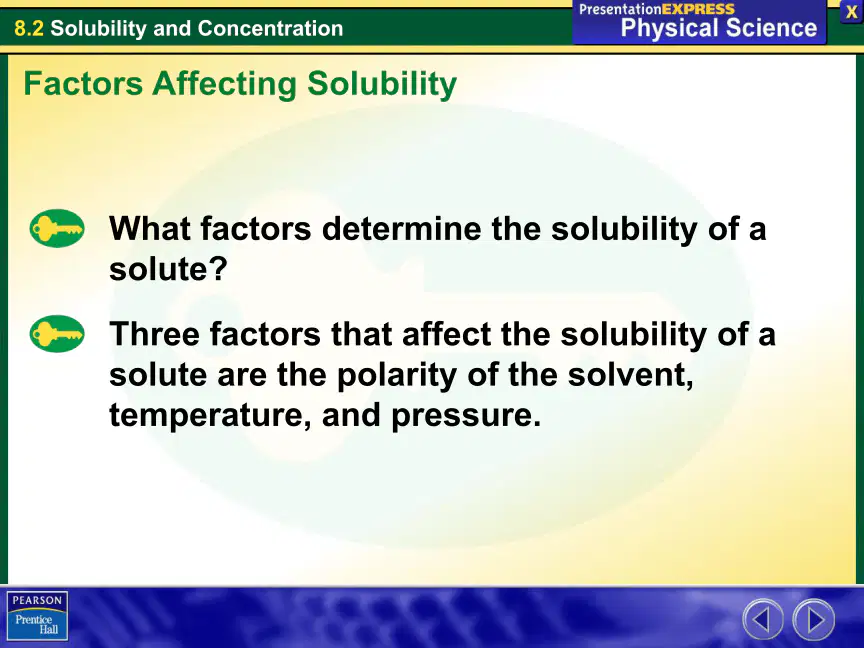
What are the three main factors that affect the solubility of a solute?
Polarity of the solvent, temperature, and pressure
Concentration, color, and taste
Volume, mass, and density
Acidity, alkalinity, and reactivity
23
24
Fill in the Blanks
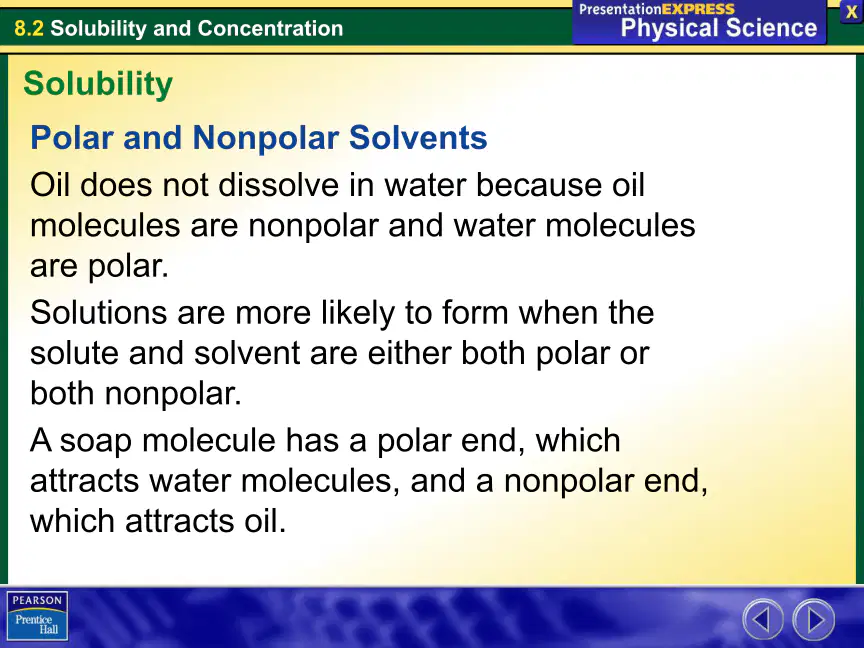
Oil does not dissolve in water because oil molecules are ___ and water molecules are ___.
Type answer...
25

26
Multiple Select
According to the table, which solvent-solute combinations are most likely to form a solution?
Polar solvent and nonpolar solute
Nonpolar solvent and polar solute
Polar solvent and polar solute
Nonpolar solvent and nonpolar solute
27

28
Open Ended
Describe how soaps and detergents help remove grease and oil stains from surfaces.
29

30
Multiple Choice
How does temperature affect the solubility of solids and gases in a solvent?
Solubility of solids increases and gases decrease with temperature increase.
Solubility of both solids and gases increases with temperature increase.
Solubility of both solids and gases decreases with temperature increase.
Solubility of solids decreases and gases increase with temperature increase.
31

32
Open Ended
Explain how pressure influences the solubility of gases in liquids, using an example from everyday life.
33

34
Open Ended
What are three ways to measure the concentration of a solution?
35

36
Multiple Choice
Which of the following is a correct way to measure the concentration of a liquid dissolved in another liquid?
Percent by volume
Percent by mass
Molarity
Density
37

38
Fill in the Blanks
Percent by volume is calculated using the formula: Percent by volume =
Type answer...
39

40
Multiple Choice
In what situation is percent by mass more useful than percent by volume when measuring concentration?
When the solute is a solid
When the solute is a liquid
When the solution is a gas
When the solute is a mixture
41

42
Multiple Choice
What is the formula for calculating molarity in a solution?
Moles of solute divided by liters of solution
Grams of solute divided by liters of solution
Moles of solute divided by grams of solution
Liters of solute divided by moles of solution
43

44
Fill in the Blanks
The molar mass of NaCl is
Type answer...
45
Open Ended
Explain how you would prepare a 1-molar (1M) solution of sodium chloride (NaCl) in water, including the calculations involved.
46

47
Multiple Choice
Which of the following statements is true about a 1M NaCl solution?
It contains 58.5 grams of NaCl per liter of solution.
It contains 1 gram of NaCl per liter of solution.
It contains 100 grams of NaCl per liter of solution.
It contains 58.5 grams of NaCl per 100 mL of solution.
48

49
Multiple Choice
Compound X has a solubility of 20 g in 100 g of water at 20°C. What is the minimum amount of water needed to dissolve 50 g of compound X?
250 g
100 g
500 g
200 g
50

51

52
Multiple Choice
A saturated solution of carbon dioxide in water suddenly experiences an increase in pressure. What happens to the solution?
Bubbles form as the carbon dioxide comes out of the water.
It becomes supersaturated.
It remains saturated.
More carbon dioxide can now be dissolved in the water.
53

54

55

56

57

58

59

60

61

62

63

64

65

66

67

68
69

70

71

72

73

74

75

76

77
Open Ended
How would you describe your understanding of the terms saturated, unsaturated, and supersaturated after this lesson?
78
Multiple Choice
What happens when you keep adding sugar to lemonade and the solution reaches its limit of dissolving sugar?
The solution becomes saturated and no more sugar will dissolve.
The solution becomes unsaturated and more sugar can dissolve.
The solution becomes supersaturated and sugar will dissolve infinitely.
The solution becomes diluted and tastes less sweet.
Show answer
Auto Play
Slide 1 / 78
SLIDE
Similar Resources on Wayground

73 questions
AGRICULTURE
Presentation
•
9th - 12th Grade
72 questions
BRAINBOX 2023
Presentation
•
9th - 12th Grade
70 questions
BL Ch 6 Atomic Structure
Presentation
•
9th - 12th Grade
76 questions
EOC Writing multiple choice 2015
Presentation
•
9th - 12th Grade
77 questions
Holt Ch 5 PPt
Presentation
•
9th - 12th Grade
74 questions
Mastering Collecting, Graphing, and Interpretating Data
Presentation
•
9th - 12th Grade
73 questions
Year 10 Physics Wave Calculations
Presentation
•
9th - 12th Grade
73 questions
G8 T2 C6 S2 - Writing Proofs
Presentation
•
9th - 12th Grade
Popular Resources on Wayground
21 questions
Continents and Oceans

Quiz
•
6th Grade
20 questions
Parts of Speech
Quiz
•
5th Grade
16 questions
Subject & Predicate
Quiz
•
5th Grade
25 questions
Multiplication Facts
Quiz
•
5th Grade
12 questions
Map Skills
Quiz
•
3rd Grade
22 questions
Continents and Oceans
Quiz
•
5th Grade
15 questions
Rounding Decimals
Quiz
•
5th Grade
20 questions
Brand Labels
Quiz
•
5th - 12th Grade
Discover more resources for Chemistry
20 questions
Metric Conversions
Quiz
•
11th Grade
20 questions
electron configurations and orbital notation
Quiz
•
9th - 12th Grade
20 questions
Periodic Table Trends
Quiz
•
11th Grade
20 questions
COUNTING ATOMS
Quiz
•
10th Grade
20 questions
Practice: E-Con, Orbital Notation, Noble Gas Notation
Quiz
•
10th Grade
11 questions
Balancing Chemical Equations
Presentation
•
9th Grade
50 questions
Unit 3: Atomic Assault Summative Review
Quiz
•
11th Grade
15 questions
Heating and Cooling Curves
Quiz
•
9th - 12th Grade