

Evolution Day 1-History of the Theory

Presentation
•
Science
•
9th - 12th Grade
•
Easy
+8
Standards-aligned

Rachael Stark
Used 3+ times
FREE Resource
18 Slides • 23 Questions
1
The History of Evolutionary Theory

2

3
Drag and Drop
A descriptive generalization about how some aspect of the natural world behaves under stated circumstances
A testable statement about the natural world
Obtaining knowledge of the outside world through our senses, or recording information using scientific tools or instruments
A conclusion reached on the basis of evidence and reasoning
4
Multiple Choice
5
Multiple Choice
Isla and Elijah are discussing scientific concepts. Which of the following best describes the difference between a scientific theory and a scientific law?
A theory explains why phenomena occur, while a law describes how phenomena occur.
A law explains why phenomena occur, while a theory describes how phenomena occur.
Both theory and law explain why phenomena occur.
Both theory and law describe how phenomena occur.
6
Multiple Choice
During a science class, Arjun and Maya were discussing scientific theories. Which of the following statements is true about scientific theories?
They are guesses that have not been tested.
They are well-substantiated explanations of why we observe some phenomenon in the natural world.
They are laws that have been proven.
They are hypotheses that have been disproven.
They are well-substantiated descriptions of what we see occur of the natural world.
7
Categorize
A hypothesis can only become a theory once there is enough experimental data to support it
A theory has not been proven yet
Once a theory is proven it will become a law
A theory is widely accepted
Evidence can be added to a theory
Theories are based on a guess
Is a theory just a guess
Theories Explain, Laws Describe
Laws Explain, Theories Describe
Pick true or false for each of the scenarios
8
Scientific Theory vs Scientific Law
Scientific Theory | Scientific Law | Both |
|---|---|---|
Explains natural phenomena we observe/ Explains how nature works Non- mathematical | Can be reduced to a mathematical equation | Supported by a large body of scientific evidence |
9
Multiple Choice
Inheritance in relation to animals is...
How animals behave in an environment.
What animals do to survive in an environment.
What animals like to eat.
Certain things that animals get from their parents.
10
Hotspot
Which part of the sandwich was probably put on the plate last/mot recently?
11
Hotspot
Which part of the sandwich was probably put on the plate first?
12
Hotspot
Which rock layer was the first?
13
What even is Evolution?
By pure definition alone, Evolution MEANS change over time
AKA: The process by which living things have undergone continuous change since they first appeared on Earth
AKA “ Descent with modification”
This process is a central and unifying theme in biology.
All life shares a common ancestor and gave rise to the diversity we see documented in the fossil record and all around us today.

14
What is the fossil record? How does it work?
Let's start with rocks:
The Law of Superposition states that rock on top are usually younger than those deposited below (kind of like a stack of books, a sandwich, or a layered cake). By understanding the Law of Superposition we can make general statements about the ages of these rock units, and their contents.

15
Multiple Choice
Evolution in relation to animals is...
The different things animals eat
How animals have evolved over time into different species
How to classify different animals
How animals have learnt to eat other animals
16
What is the fossil record? How does it work?
Now onto Fossils.
The fossil record is a history recorded by preserved fossils. Fossils are the remains or imprints of organisms from earlier geological periods preserved in sedimentary rock. In most cases, the original components have been replaced by minerals deposited from water seeping through the rock, however in some rare cases some of the organic material (usually skin, feathers, and scales) from the organism is preserved.

17
What is the fossil record? How does it work?
By combining our knowledge of the Law of Superposition with the fossil record, we can create a Geologic Timescale!

18
19
Just go give context, your test will not cover the ages :)
Geologic Time Song!
20
How Did Darwin Do It?
He had great minds giving him ideas...
1. Hutton & Lyell ( 1785-1830): Geologists - Concluded that Earth is extremely old and that the processes that changed Earth in the past are the processes that operate in the present (uniformitarianism)
Ex: Ancient volcanoes release lava & gases just as volcanoes do now


21
How Did Darwin Do It?
He had great minds giving him ideas...
2. Thomas Malthus ( 1798): British Economist
- Inferred that if the human population grew unchecked, there would not be enough living space and food for everyone.


22
How Did Darwin Do It?
He had great minds giving him ideas...
3. Jean-Baptiste Lamarck ( 1801): Early Evolutionary Biologist
- Hypothesized that species evolve through the use and disuse of acquired traits
- Acquired Traits are characteristics organisms could change during their life time by using or not using various parts of their bodies.
- Thought these “acquired traits” could be passed on to offspring


His Hypothesis was REFUTED
23
Multiple Choice
Contrary to the beliefs of Lamarck, this trait will not be inherited
Eye color
Fin Shape
24
Who's Darwin?
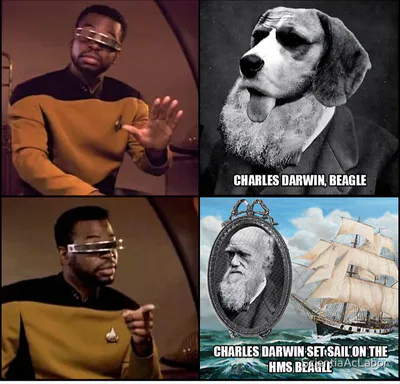
He was a English naturalist/scientist ( 1809-1882). He was only 22 and a fresh graduate of Cambridge University when he made his claim to fame aboard the HMS Beagle, during a 5 year survey trip of shipping routes around the world.
During the voyage, Darwin read Lyell's book Principles of Geology and agreed with Lyell's conclusion; that the geology of the world changes over time.
Darwin Questioned: If Earth can change over time, could life change too?


25
The Galapagos Changed EVERYTHING
On his visit to the Galapagos Islands he observed many unique organisms & they had traits to help them survive in their specific environments. Some organisms also showed variations between the islands and their different habitats


Tortoise


Marine Iguana

Blue Footed Boobies
26
The Galapagos Changed EVERYTHING
He observed many species of finches- each of them unique and were distinguishable by different shaped beaks. Later Darwin suggested these were adaptations to particular diet.
The tortoise, island by island carried different shaped shells


27
The Galapagos Changed EVERYTHING

28
The Galapagos Changed EVERYTHING
Once, back in England, Darwin thought that the mechanism of evolution was like the process of artificial selection (selective breeding) practiced by breeders of plants and animals.
- Artificial Selection (Selective Breeding): Organisms with specific traits are selected and breed to make more organisms with those favorable characteristics

29
The Galapagos Changed EVERYTHING
On November 24, 1859: Darwin’s book The Origin of Species was published. It completely sold out (1250 copies!!!) in just one day.
In his book, he hypothesized natural selection as the mechanism for evolution He used the term natural selection to indicate that evolution was controlled by “nature” or the environment rather than by people!
Natural Selection=Survival of the Fittest

30
Multiple Choice
Black and brown bears have dark fur. They live in wooded areas. Polar bears have
white fur. They live in Arctic areas. How does the color of each bear’s fur help it
survive?
The color helps each type of bear blend into its environment.
The color of each matches its food source so hunting is easier.
The color absorbs the right amount of sun each needs for warmth.
The color is a signal to the enemies of each to keep them from attacking.
31
Multiple Choice
The environment of a particular species of rabbit is becoming colder over time. Rabbits with which of the following traits will best be able to survive and reproduce?
Shorter legs
Thicker fur
Longer ears
Longer whiskers
32
Multiple Choice
If a species is unable to adapt within a changing environment what can happen to that species?
Extinction
Genetic variation
Adaptation
Competition
33
Multiple Choice

During his trip to the Galapagos Islands, Charles Darwin observed that finches on different islands had different features. Ultimately, how did this observation contribute to Darwin’s theory of natural selection?
A.He concluded that every instance of species variation results in a beneficial mutation.
B.He concluded that mutation inhibits the chance that an organism will adapt to its environment.
C. He concluded that species develop mutations exclusively because of electromagnetic radiation.
D. He concluded that traits well suited to an organism’s environment are more likely to be passed on to successive generations.
34
Multiple Choice
3. Scientists have discovered bacteria that can survive in the hot temperatures found in the lava of volcanoes. Which statement best explains how bacteria could survive in this environment?
A.Bacteria are small enough not to be killed by heat.
B.Bacteria are simple organisms and can live in any conditions.
C.Bacteria have mutated and those suited to the environment survive there.
D. Bacteria grow faster in hot conditions and so are suited to the environment.
35
Multiple Choice
Why is adaptation important for animals?
So they can live in a range of different habitats
So they can have more young
So they don't get scared by humans
so they can live in groups
36
Multiple Choice
37
Multiple Choice
38
Multiple Choice
39
Multiple Choice
40
Multiple Choice
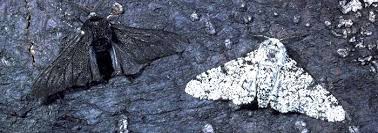
Predict which moth would increase in population as a result of natural selection
41
Multiple Choice
The History of Evolutionary Theory
Show answer
Auto Play
Slide 1 / 41
SLIDE
Similar Resources on Wayground

35 questions
Osmosis
Presentation
•
9th - 12th Grade
38 questions
The Carbon Cycle
Presentation
•
9th - 12th Grade
35 questions
Motion: Speed & Velocity
Presentation
•
8th - 11th Grade
38 questions
Work & Power
Presentation
•
8th - 11th Grade
36 questions
SAVOIR vs Connaitre
Presentation
•
9th - 12th Grade
37 questions
East Asia History & Culture
Presentation
•
9th - 12th Grade
35 questions
Balancing Chemical Equations
Presentation
•
9th - 12th Grade
37 questions
Inducción Familias Seguras
Presentation
•
KG
Popular Resources on Wayground
10 questions
How much do you know about our Portrait of an Eagle?

Quiz
•
10th Grade
10 questions
Fast Food Slogans
Quiz
•
6th - 8th Grade
21 questions
Continents and Oceans
Quiz
•
6th Grade
20 questions
Parts of Speech
Quiz
•
5th Grade
16 questions
Subject & Predicate
Quiz
•
5th Grade
25 questions
Multiplication Facts
Quiz
•
5th Grade
12 questions
Map Skills
Quiz
•
3rd Grade
22 questions
Continents and Oceans
Quiz
•
5th Grade
Discover more resources for Science
10 questions
Exploring Chemical and Physical Changes

Interactive video
•
6th - 10th Grade
20 questions
Atomic Structure
Quiz
•
9th Grade
10 questions
Decoding the Periodic Table of Elements
Interactive video
•
6th - 10th Grade
10 questions
Exploring the Periodic Table
Interactive video
•
6th - 10th Grade
14 questions
Physical and Chemical Changes
Quiz
•
10th Grade
22 questions
Periodic Table Review
Quiz
•
9th - 12th Grade
20 questions
Observation vs. Inference
Quiz
•
7th - 9th Grade
14 questions
Periodic Trends
Interactive video
•
11th Grade