

8.3 - Challenges to Monarchs

Presentation
•
Social Studies
•
9th - 12th Grade
•
Practice Problem
•
Hard

Cole Ferguson
Used 1+ times
FREE Resource
21 Slides • 0 Questions
1
Challenges to Monarchs

2
On This day in History! (2/9)
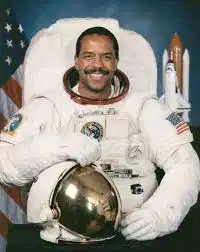
On this day in 1995, NASA astronaut Bernard Harris becomes the first Black man to walk in space.
1995- First Black man to walk in space
On this day in 1775, British Parliament declares Massachusetts to be in rebellion.
1775- Massachusetts Colony rebellion

3
Today!
Today we will:
contrast the unifications of Germany and Italy
identify causes of conflict between the Ottoman Empire and other states in the nineteenth century
sequentially arrange events that shaped Russian government and society from 1856 to 1905
explain how nationalism and imperialism impacted Europe in the nineteenth and early twentieth centuries
Riddle! - What has a face, but never gets tired of seeing the stars?
4
Mount Rushmore!

5
Vocabulary
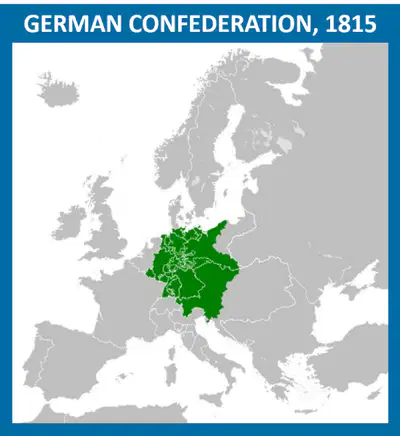
German Confederation - a political group that included 38 independent German states loosely linked together
Otto von Bismarck - Prime Minister of Prussia appointed by King Wilhelm I in 1862
Second Reich - empire of King Wilhelm I, referring to the Holy Roman Empire as the First Reich. Reich means “realm” and refers to a German empire.
genocide - mass killing of a specific group with the intent of wiping out that group
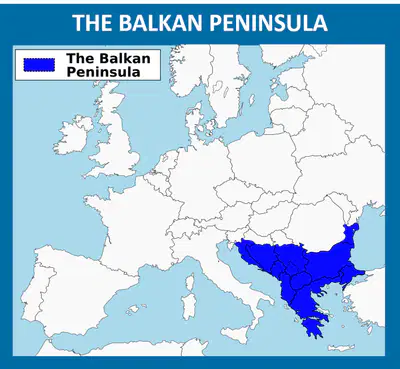
Balkan Peninsula - also called the Balkans, a geographic region of Eastern Europe along the Mediterranean and Black Seas
Austro-Hungarian Empire - aka Austria-Hungary
Revolution of 1905 - the events of Bloody Sunday led to this event, where urban workers, rural peasants, and terrorist groups pushed the government to reform
6
The German Confederation
Until the nineteenth century, Germany was not a unified country as it is today. In 1814, when the Congress of Vienna drew national borders in Europe, it recognized 38 independent German states loosely linked together as the German Confederation. The map shows the German Confederation on a map of Europe.
7
German Rebellion in 1848 and 1849
Citizens of the German states, inspired by nationalism and liberalism, began leading small campaigns against their monarchies. France’s rebellion against Louis Phillipe in 1848, which you learned about previously, inspired a German rebellion that began the same year and lasted until the following year. German revolutionaries opposed the monarchs’ autocratic rule and aimed to form a unified Germany with a constitution and representation for the people. The image shows revolutionaries in Berlin in 1848.

8
The Frankfurt National Assembly
German nationalists' and liberals' efforts were sporadic and unorganized compared to the movements elsewhere in Europe. They were divided by class and political ideals; some rebels wanted a republic, while others desired a constitutional monarchy.
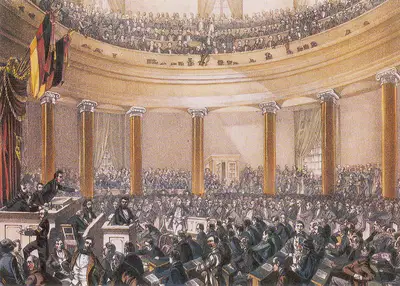
A group called the Frankfurt National Assembly tried to form a unified Germany with a constitutional monarchy. The image shows a meeting of the Assembly. However, the monarchs of Prussia and Austria—the two greatest powers of the German Confederation—blocked the Frankfurt National Assembly’s efforts.
9
Otto von Bismarck
In 1862, King Wilhelm I of Prussia appointed Otto von Bismarck (pictured) as his prime minister. Bismarck expanded Prussia’s military power, and he launched military campaigns without approval from the Prussian Parliament. Liberals opposed Bismarck’s militarism and violation of Prussia’s constitution, but Bismarck’s policies continued. In 1870, Bismarck provoked the Franco-Prussian War, a war against France. He used this war to inspire German patriotism and create a union of German states fighting against France.

10
The Second Reich
Prussia and its coalition of German states won the Franco-Prussian War. The victors captured the French leader Napoleon III, annexed the French territory of Alsace-Lorraine (AH-slahs lor-RAIN), and forced France to pay a large sum of money. French anger at the German states created international tension into the twentieth century.
The German coalition against France unified Germany under Prussian rule. In 1871, Bismarck declared King Wilhelm I the emperor of the German Empire. He called the empire the Second Reich, referring to the Holy Roman Empire as the First Reich. Reich means “realm” and refers to a German empire. The image shows the declaration of Wilhelm I as Emperor. Wilhelm stands on the stage, and Bismarck stands near the middle of the picture, wearing a white uniform.

11
12
Key Figures in Italy's Unification

13
The Ottomans
The Ottoman Empire was founded in 1299 and they conquered the Byzantine Empire in 1453.
The Sultan is the political and religious leader of the Ottoman Empire.
In 1804, the Serbs revolted against Ottoman rule. In 1807 Russia decided to join the revolt and support the Serbs.
The Serbs and Russians share ethnic and religious heritage.
Serbians gained self-rule in 1817, and international recognition as an independent country in 1878.

14
Greece
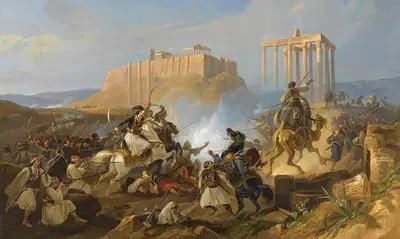
In 1821 the Greeks were under Ottoman control and revolted against them.
Britain, France, and Russia supported the Greeks.
Greece gained independence in 1832, and European allies placed a German prince in charge of Greece. The Greeks resented this.
15
Young Turks
The Ottoman Empire weakened as ethnic groups continued to rebel against the Turkic rulers. In 1908, a group of Turkic nationalists called the Young Turks attempted to save the failing empire.
They overthrew the sultan and created a new government. They restricted the rights of other ethnic groups.
The Young Turks discriminated against groups who were not part of their nation.
Beginning during WWI Turkic military leaders targeted Armenians. An estimated 1–1.5 million died in a genocide attempt.
Armenians were Christian and the Ottoman Turks were Muslim.

16
The Balkans
The Ottoman Empire also faced challenges from the Balkan Peninsula.
Competition for Balkan influence came from multiple powers.
Russia wanted influence in order to get access to the Mediterranean Sea.
Britain and France competed for the Balkan because they wanted to limit Russia's power.
A rival power called Austria-Hungary already controlled part of the Balkans and wanted the rest of the peninsula.
17
Austria Hungary
Austria was defeated by Prussia removing it from the German confederation.
Austria was a multinational empire ruled by the Hapsburg family.
Austria had nationalist uprising and Austria was weak and unable to defeat Prussia. As a result they had to make concessions with Hungarians.
The new empire was known as the Austro-Hungarian Empire, also called Austria-Hungary.
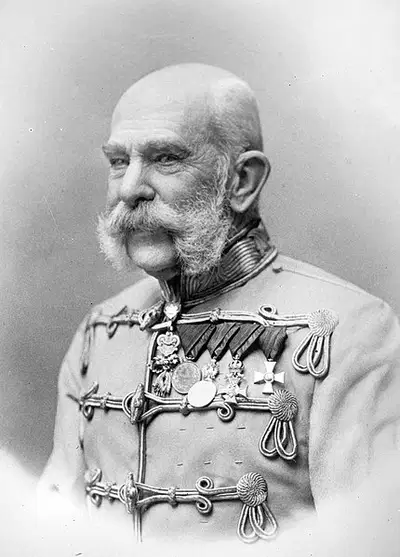
Austrian Emperor Franz Joseph was also the king of Hungary.
18
The Spark
Hungary's success in gaining self-rule inspired nationalist efforts seeking independence from Austria.
Conflict within the empire continued into the twentieth century.
In 1914, Gavrilo Princip, a Serbian nationalist, assassinated Archduke Franz Ferdinand, who was the nephew of Franz Joseph and heir to the Austro‑Hungarian monarch.
This event sparked World War I.

19
Russia
In 1800s industrialization was occurring within Western Europe. This change occurred more slowly in Russia.
Feudalism remained the dominant economic system. Serfs farmed for landowners, had little freedom, and often lived in poverty.
Russia’s tsars (rulers) reigned with absolute power without a parliament or congress to represent the populace.
Watch video in Edio.

20
Bloody Sunday
In 1894 Nicholas II succeeded Alexander II as tsar.
During the reign of Nicholas II the Russian government massacred a group of protesters pushing for workers' rights.
This event is known as Bloody Sunday, led to an uprising called the Revolution of 1905.
Urban workers, rural peasants, and terrorist groups pushed the government for reforms.
In response Nicholas II ordered reforms that included Russia's first constitution and the creation of an elected assembly. The tsar and elected assembly shared power.

21
Tomorrow!
Tomorrow we will learn about Japan's Meiji Restoration
If you have any questions please ask!
Have a great rest of your day!
Challenges to Monarchs
Show answer
Auto Play
Slide 1 / 21
SLIDE
Similar Resources on Wayground

16 questions
FOIL Method
Presentation
•
9th - 12th Grade
16 questions
Buddhism
Presentation
•
9th - 12th Grade
16 questions
Intro to Deaf Culture
Presentation
•
9th - 12th Grade
17 questions
Confucius
Presentation
•
9th - 12th Grade
15 questions
AP World History Vocabulary and Terms
Presentation
•
9th - 12th Grade
18 questions
Muckrakers
Presentation
•
8th - 12th Grade
17 questions
Mongols
Presentation
•
9th - 12th Grade
16 questions
Empirical and Molecular Formulas
Presentation
•
9th - 12th Grade
Popular Resources on Wayground
20 questions
Math Review

Quiz
•
3rd Grade
15 questions
Fast food
Quiz
•
7th Grade
20 questions
Context Clues
Quiz
•
6th Grade
20 questions
Inferences
Quiz
•
4th Grade
19 questions
Classifying Quadrilaterals
Quiz
•
3rd Grade
20 questions
Figurative Language Review
Quiz
•
6th Grade
20 questions
Equivalent Fractions
Quiz
•
3rd Grade
10 questions
Identify Fractions, Mixed Numbers & Improper Fractions
Quiz
•
3rd - 4th Grade
Discover more resources for Social Studies
53 questions
Semester 2 Final Review Game
Quiz
•
9th Grade
36 questions
World History Semester Exam
Quiz
•
10th Grade
30 questions
Memorial day trivia
Quiz
•
10th Grade
92 questions
Spring World Geography Year Review
Quiz
•
9th Grade
30 questions
Spring Semester 2
Quiz
•
9th Grade
37 questions
World History 2nd Semester Final Exam
Quiz
•
9th Grade