

8.11 - Imperialism in Southeast Asia & the Pacific

Presentation
•
Social Studies
•
9th - 12th Grade
•
Practice Problem
•
Hard

Cole Ferguson
Used 2+ times
FREE Resource
17 Slides • 0 Questions
1

2
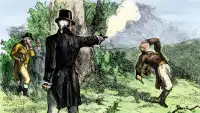
On this day in 1839, congress bans to outlaw dueling after Maine rep. Johnathan Cilley was killed in a duel against Kentucky rep. William Graves.
1839 - Duels are outlawed in Washington D.C.
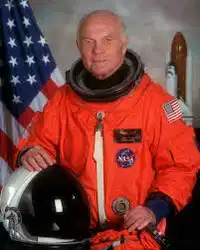
On this day in 1963, John Glenn becomes the first American to orbit Earth.
1962 - First American Orbits Earth
3
Today!
Today we will:
identify motivations for imperialism in Southeast Asia and the Pacific
sequentially order events of imperialism in the Philippines
Riddle! - Though my ears look like wings, I can't even jump. What am I?
4
An Elephant!

5
Vocabulary
annex - to make an area, or territory part of a existing country
Bayonet Constitution - the constitution signed by the monarch of Hawaii, it was signed under the threat of violence
Emilio Aguinaldo - leader of Filipino nationalists, who fought against American troops in an attempt to free his country
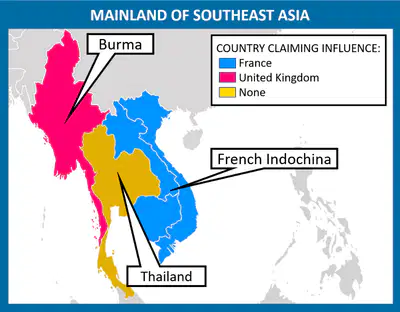
Indochina - mainland of Southeast Asia, including the present-day countries of Cambodia, Laos, Myanmar, Thailand, and Vietnam
6
Vocabulary
Philippine-American War - fought between the US and the Philippines lasting for 3 years, at the end, the American government granted greater self-government to the Philippines and agreed to eventually grant independence
provisional government - a new government that is intended to be temporary and governs until a permanent government is established
Republic of Hawaii - a period of time when the provisional government was replaced, placing Dole as it’s president. Eventually Hawaii would become a state in the USA
7
Resources in Southeast Asia
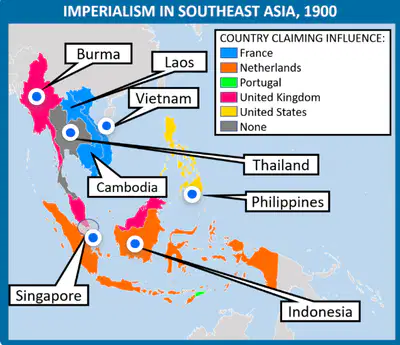
During the Age of Imperialism, different western powers took control of different parts of Southeast Asia.
The mainland was rich in wood, rubber, and tin.
The islands had spice, sugar, coffee, and tea.
The western businesses set up plantations in this region and exported products to their home countries.
Plantation workers were usually local people who accepted jobs, but got paid low wages.
8
Resistance
Local populations in Southeast Asia fought back against western imperialism.
Peasant revolts occurred on plantations.
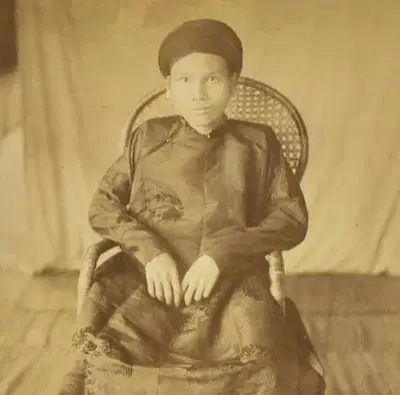
In the 1880s the Vietnamese government began a movement which sought to expel the French and create an independent Vietnam.
The Vietnamese would attack French troops. The movement for independence would not gain much traction as Vietnam did not have as much national unity to achieve long-lasting results.
9
Western Ideals
In the early 1900s, western intellectual influence in Southeast Asia gave rise to a new middle class in the region.
Asians who had been educated at Western‑style schools or had jobs connected with Western authorities began to adopt values of liberalism and nationalism.
They advocated for local economic interests and defended their religious traditions.
Thailand remained independent throughout this time. They enacted western beliefs. They believed that Britain or France would be less likely to colonize a nation that Europeans saw as similar to themselves.
10
Filipino Resistance to Spain
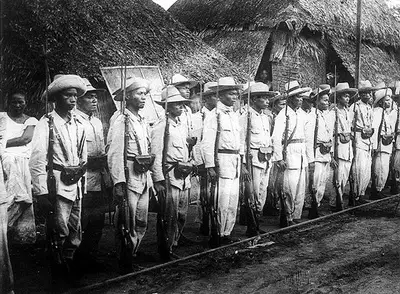
In the 1890s, Filipino resistance to Spain resulted in Spain’s execution of about 4,000 rebels for their involvement in uprisings. Some Americans wanted the U.S. government to protect the locals from this treatment. The image shows Filipino rebel soldiers in 1899.
Meanwhile, members of the U.S. government sought to expand American interests in the Pacific Ocean. They wanted to secure naval bases to protect their trade interests in China against European colonial powers. Many also wanted to spread democracy.
11
The Philippines Change Hands
During the Spanish-American War, many Filipinos welcomed and aided American forces in the war, believing the Philippines would become an independent country afterward. However, after the United States won the war, it kept the Philippines as a colony rather than helping the country gain independence. The United States valued the islands as a strategic naval base and wanted to prevent other imperial powers, including Japan, from conquering the islands.
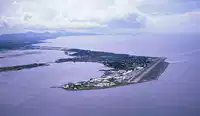
The image shows a United States naval station in the Philippines around 1964. U.S. presence in the Philippines continued even after the Philippines gained independence in 1946.
12
Resistance to American Rule
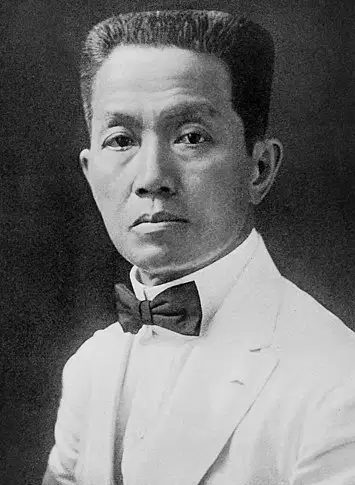
In 1899, Filipino nationalists, led by Emilio Aguinaldo (pictured), fought against American troops to free their country. The ensuing Philippine-American War lasted three years. To end the fighting, the American government granted greater self-government to the Philippines and agreed to eventually grant independence. The Philippines remained a U.S. colony until 1946, after the end of World War II.
13
Hawaii
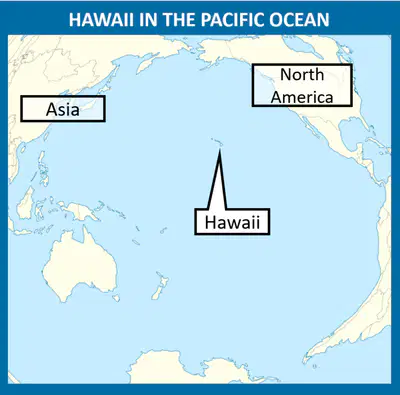
Prior to Hawaii becoming a state, it was an independent kingdom.
Hawaii had long traded with foreign countries, as the islands are well‑situated as supply stops for those sailing the Pacific.
The U.S. sought to expand its influence in Hawaii because of trade. The production of sugar also grew in Hawaii, and many of the largest sugar farms were owned by Americans.
In 1887 the U.S. and European powers sought to decrease the power of the Hawaiian monarchy to increase their own control and ability to trade within the region.
They used military intimidation to force Hawaiian King Kalākaua to sign the Bayonet Constitution.
14
Dole!
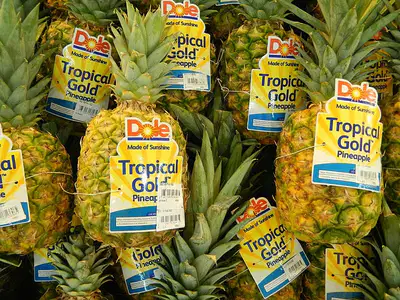
In 1891 after King Kalākaua's death his sister became queen of Hawaii and proposed a new constitution that would replace the Bayonet Constitution.
American plantation owners became alarmed by this and this threatened American trade interests.
Sanford B. Dole led a group of Americans to overthrow the queen. Sanford B. Dole then established a new government where he was the leader.
15
Hawaiian Statehood
Dole asked the United States to make Hawaii part of the country, but the U.S. government concluded that Dole's takeover was illegal and that this could not be done.
In 1896 William McKinley became President and during his presidency the Spanish-American War occurred, resulting in the U.S. acquisition of the Philippines and increased interest in the Pacific.
The U.S. had established the naval base of Pearl Harbor in 1899 to repair and refuel ships. McKinley believed the annexation of Hawaii would be a strategic advantage to the United States.
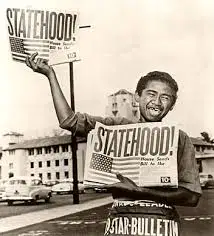
The U.S. officially claimed Hawaii as its territory in 1900 and in 1959 Hawaii had become a U.S. State.
16
17
Monday!
Monday we will have our Imperialism Cartoon Project Preview
If you have any questions please ask!
Have a great weekend!
Show answer
Auto Play
Slide 1 / 17
SLIDE
Similar Resources on Wayground

14 questions
Factors of Production
Presentation
•
9th - 12th Grade
11 questions
Civil Rights/Civil Liberties
Presentation
•
9th - 12th Grade
11 questions
Statistical Evaluation
Presentation
•
9th - 12th Grade
12 questions
Molar Conversions
Presentation
•
9th - 12th Grade
12 questions
Graphing Linear Inequalities Review
Presentation
•
9th - 12th Grade
12 questions
Standard Deviation
Presentation
•
9th - 12th Grade
12 questions
Living Things
Presentation
•
KG
12 questions
Linear Equations/ One Step
Presentation
•
9th - 12th Grade
Popular Resources on Wayground
10 questions
Safety Day 2026 – Student Review

Quiz
•
9th Grade
21 questions
Continents and Oceans
Quiz
•
6th Grade
20 questions
Parts of Speech
Quiz
•
5th Grade
16 questions
Subject & Predicate
Quiz
•
5th Grade
25 questions
Multiplication Facts
Quiz
•
5th Grade
12 questions
Map Skills
Quiz
•
3rd Grade
22 questions
Continents and Oceans
Quiz
•
5th Grade
15 questions
Rounding Decimals
Quiz
•
5th Grade
Discover more resources for Social Studies
10 questions
Exploring the Age of Exploration: Key Events and Figures

Interactive video
•
6th - 10th Grade
9 questions
Exploring Ancient Mesopotamia and Its Civilizations
Interactive video
•
10th Grade
20 questions
Chapter 8 Test "Types of Business Organizations"
Quiz
•
12th Grade
39 questions
Unit 7 Key Terms
Quiz
•
11th Grade - University
10 questions
Debating the Legacy of Christopher Columbus
Interactive video
•
6th - 10th Grade
38 questions
Unit 6 Key Terms
Quiz
•
11th Grade - University
27 questions
World Geography - Q1 9week Test
Quiz
•
9th Grade
22 questions
U3T2 Vocab FAC: Domestic Policy
Quiz
•
10th Grade