
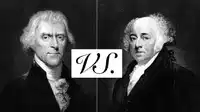
The Birth of Modern Politics

Presentation
•
Social Studies
•
7th Grade
•
Practice Problem
•
Easy

Laura Morris
Used 14+ times
FREE Resource
15 Slides • 17 Questions
1

2
Multiple Choice
How did the 1828 election differ from prior elections?
A majority of the popular vote, not the electoral college, decided the outcome.
Candidates built excitement through slogans, parades, speeches, and mudslinging.
All the candidates came from Washington, D.C.
All the candidates came from western states.
3

4
Multiple Choice

An agreement between Henry Clay and John Quincy Adams that resulted in a Presidential victory for Adams and Secretary of State for Clay.
5

6
Multiple Choice
What are the differences of Andrew Jackson/John Quincy Adams?
War hero/Incumbent
Son of a President/The Statesman
An orphan/The Outsider
Diplomat/The Statesman
7

8
Multiple Choice
What is the narrative associated with Old Hickory?
A story of wealth
A story of rising from poverty
A story of betrayal
A story of war
9

10
Multiple Choice
What does the Oak Tree symbolize in the context of John Quincy Adams?
Stability and tradition
Weakness and instability
Change and innovation
Popularity and fame
11

12
Multiple Select
What new tactics were introduced in political campaigning during the shift to mass mobilization in 1828?
Mass Rallies
Parades
Merchandise
Music
13

14
Multiple Select
What were the main slogans used by Jackson and Adams during their political campaigns?
Let the People Rule!
Experience Over Popularity!
Order and Progress!
Down with the Corrupt Bargain!
15

16
Multiple Choice
What was the strategy behind the 1828 campaign?
It was the first truly negative campaign in US history.
It focused on positive messaging.
It aimed to unite the parties.
It was based on economic policies.
17
Multiple Choice
Which of the following is an example of mudslinging?
questioning an opponent's loyalty to the United States
attacking a candidate's approach to foreign policy
focusing on failed campaign promises
discussing a nominee's lack of experience
18

19
Multiple Choice
What was the key change in state voting laws leading up to 1828?
Removal of property ownership requirements
Introduction of literacy tests
Establishment of voting age at 21
Mandatory voter registration
20

21
Multiple Choice

22

23
Multiple Choice
What was the popular vote percentage for Andrew Jackson in the election?
44%
56%
50%
60%
24

25
Multiple Choice
What were the groups excluded from the democratic process according to the image?
Women
Enslaved People
Native Americans
All of the above
26

27
Multiple Choice
What were the key factors that contributed to Jackson's victory according to the image?
The 'Corrupt Bargain' Factor
The Outsider Appeal
The Verdict
All of the above
28

29
Multiple Choice
What are the main differences between campaign strategies in the 1828 era and the modern era?
Campaign Songs & Buttons
Viral Videos & Merch
Corrupt Bargain Claims
Character Assassination
30

31
Multiple Choice
What significant political change did the Election of 1828 bring about in the United States?
It ended the two-party system
It established the Electoral College
It proved the common voter was powerful
It initiated the Civil War
32
Poll
How confident do you feel about this topic now?
Show answer
Auto Play
Slide 1 / 32
SLIDE
Similar Resources on Wayground

25 questions
empresario system
Presentation
•
7th Grade
26 questions
Japan's Golden Age (Heian Period)
Presentation
•
7th Grade
28 questions
Rise of West African Empires: Ghana
Presentation
•
7th Grade
21 questions
Mesopotamia 1.2: The Sumerians
Presentation
•
7th Grade
21 questions
Mexican Nationals
Presentation
•
7th Grade
25 questions
Lesson #18 Introduction to Neolithic Revolution
Presentation
•
6th Grade
25 questions
US Constitution
Presentation
•
8th Grade
26 questions
Italian Renaissance
Presentation
•
7th Grade
Popular Resources on Wayground
20 questions
Math Review

Quiz
•
3rd Grade
15 questions
Fast food
Quiz
•
7th Grade
20 questions
Context Clues
Quiz
•
6th Grade
20 questions
Inferences
Quiz
•
4th Grade
19 questions
Classifying Quadrilaterals
Quiz
•
3rd Grade
20 questions
Figurative Language Review
Quiz
•
6th Grade
20 questions
Equivalent Fractions
Quiz
•
3rd Grade
10 questions
Identify Fractions, Mixed Numbers & Improper Fractions
Quiz
•
3rd - 4th Grade
Discover more resources for Social Studies
56 questions
Civics & Econ Practice SOL #1
Quiz
•
6th - 8th Grade
35 questions
7th ELA 4th 9wks Final
Quiz
•
7th Grade
35 questions
Civics EOC Review: Category 1
Quiz
•
7th Grade
50 questions
TCI 7 Semester 2 Exam Quiz
Quiz
•
7th Grade
56 questions
Civics & Econ Practice SOL #1
Quiz
•
6th - 8th Grade
29 questions
7th Grade: Spring Semester Final Exam Review
Quiz
•
7th Grade
20 questions
The United States 1800s-1900s
Quiz
•
6th - 8th Grade
6 questions
Texas History Timeline Questions

Interactive video
•
7th Grade