

Plate Tectonics

Presentation
•
English
•
9th Grade
•
Hard

Christina Nokes
FREE Resource
35 Slides • 18 Questions
1

2

3
Multiple Choice
Which of the following statements best describes the process shown in the 'Breakup of Pangaea' diagram?
The continents have always been in their current positions.
Pangaea broke apart gradually over millions of years, forming the continents we know today.
All continents moved to the North Pole.
The breakup of Pangaea happened suddenly in a single event.
4

5

6
Multiple Choice
Which types of evidence support the theory of continental drift?
Fossil evidence and rock types
Ancient climates and ocean currents
Plate tectonics and volcanoes
Earthquakes and tsunamis
7

8
Multiple Choice
Which continents show evidence of matching mountain ranges according to the diagrams?
North America and South America
North America and Europe
Africa and Australia
Asia and Antarctica
9

10
Fill in the Blanks
Glacier evidence for continental drift can be observed in the distribution of
Type answer...
11

12

13
Fill in the Blanks
According to the plate tectonics theory, the uppermost mantle and crust together form the
Type answer...
14

15

16

17
Multiple Select
Select all features that are associated with divergent plate boundaries.
Oceanic ridges
Rift valleys
Mountain ranges
Seafloor spreading
18
Multiple Choice
Which type of plate boundary is responsible for the formation of oceanic ridges and seafloor spreading?
Divergent boundary
Convergent boundary
Transform fault boundary
Subduction boundary
19

20
Multiple Choice
What is the sequence of geological events that leads from upwarping to the formation of an oceanic ridge at a spreading center?
Upwarping → Rift valley → Linear sea → Oceanic ridge
Rift valley → Upwarping → Oceanic ridge → Linear sea
Linear sea → Upwarping → Rift valley → Oceanic ridge
Upwarping → Linear sea → Rift valley → Oceanic ridge
21

22

23
Fill in the Blanks
The East African
Type answer...
24

25

26
Multiple Choice
Which type of plate boundary is responsible for the formation of continental volcanic arcs such as the Andes and Cascades?
Oceanic-Continental Convergent Boundary
Oceanic-Oceanic Convergent Boundary
Continental-Continental Convergent Boundary
Transform Boundary
27

28
Fill in the Blanks
Volcanic island arcs form as volcanoes emerge from the
Type answer...
29

30
Multiple Select
Which of the following are features formed at oceanic-oceanic convergent boundaries?
Volcanic island arcs
Trenches
Mountain ranges
Mid-ocean ridges
31

32
Fill in the Blanks
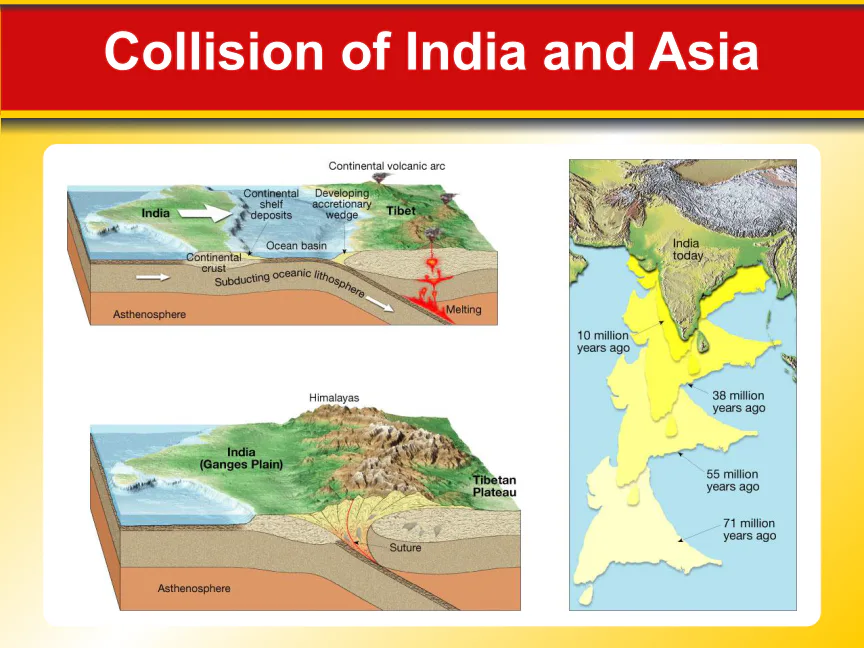
When subducting plates contain continental material, two continents collide and produce new
Type answer...
33

34
35
Multiple Choice
Which geological feature was formed as a result of the collision between the Indian and Asian plates?
The Andes Mountains
The Himalayas
The Rocky Mountains
The Alps
36

37
Fill in the Blanks
At a transform fault boundary, plates grind past each other without destroying the
Type answer...
38

39
Multiple Choice
Which of the following statements about transform fault boundaries is correct?
They destroy the lithosphere.
They create new oceanic crust.
Plates grind past each other without destroying the lithosphere.
They form volcanic arcs.
40

41

42

43
Fill in the Blanks
The discovery of strips of alternating polarity across ocean ridges is strong evidence for
Type answer...
44

45

46

47

48

49

50

51

52

53
Multiple Choice
What is the name of the supercontinent that Alfred Wegener proposed began to break apart 200 million years ago to form the present landmasses?
Laurasia
Gondwana
Pangaea
Eurasia
Show answer
Auto Play
Slide 1 / 53
SLIDE
Similar Resources on Wayground

49 questions
A2 - B1 Summer Camps
Presentation
•
9th Grade
46 questions
Present Perfect 23.02
Presentation
•
9th Grade
47 questions
The Body's Support and Control Systems
Presentation
•
10th Grade
44 questions
Conditionals
Presentation
•
9th Grade
49 questions
ÔN TẬP 5.1.2022
Presentation
•
9th Grade
44 questions
Assignment: Argumentative Writing Review 1
Presentation
•
9th Grade
49 questions
Topic and Main Ideas
Presentation
•
9th Grade
48 questions
body parts
Presentation
•
KG
Popular Resources on Wayground
10 questions
Safety Day 2026 – Student Review

Quiz
•
9th Grade
21 questions
Continents and Oceans
Quiz
•
6th Grade
20 questions
Parts of Speech
Quiz
•
5th Grade
16 questions
Subject & Predicate
Quiz
•
5th Grade
25 questions
Multiplication Facts
Quiz
•
5th Grade
12 questions
Map Skills
Quiz
•
3rd Grade
22 questions
Continents and Oceans
Quiz
•
5th Grade
15 questions
Rounding Decimals
Quiz
•
5th Grade
Discover more resources for English
10 questions
Test Your Knowledge on Bullying
Quiz
•
9th Grade
16 questions
Ethos, Pathos, Logos Practice
Quiz
•
9th Grade
10 questions
Exploring the Role of Setting in Storytelling

Interactive video
•
6th - 10th Grade
10 questions
Differentiating the 3 Types of Irony
Interactive video
•
6th - 10th Grade
15 questions
Poetry Terms
Quiz
•
6th - 9th Grade
10 questions
Unlocking English Vocabulary through Latin and Greek Roots
Interactive video
•
6th - 10th Grade
16 questions
Complete Sentences vs Fragments and Run-Ons
Presentation
•
5th - 12th Grade
18 questions
Interview with John Lewis
Quiz
•
9th Grade