

Chromosomal Abnormalities

Presentation
•
Biology
•
12th Grade
•
Hard
+1
Standards-aligned

Ashley Chassard
FREE Resource
17 Slides • 19 Questions
1
2
3
Multiple Choice
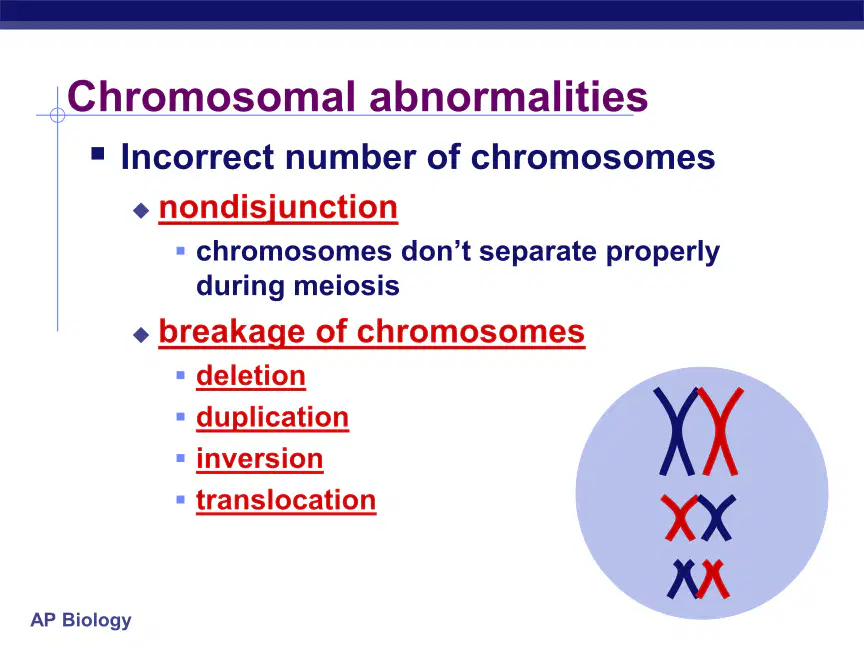
Which of the following is NOT a type of chromosomal abnormality caused by breakage of chromosomes?
Deletion
Duplication
Nondisjunction
Translocation
4
5
Multiple Choice
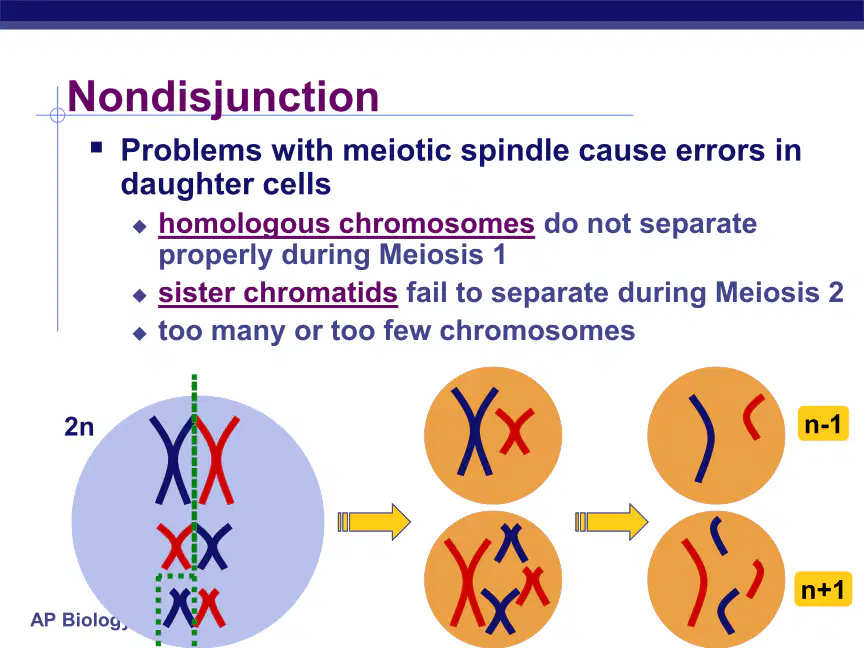
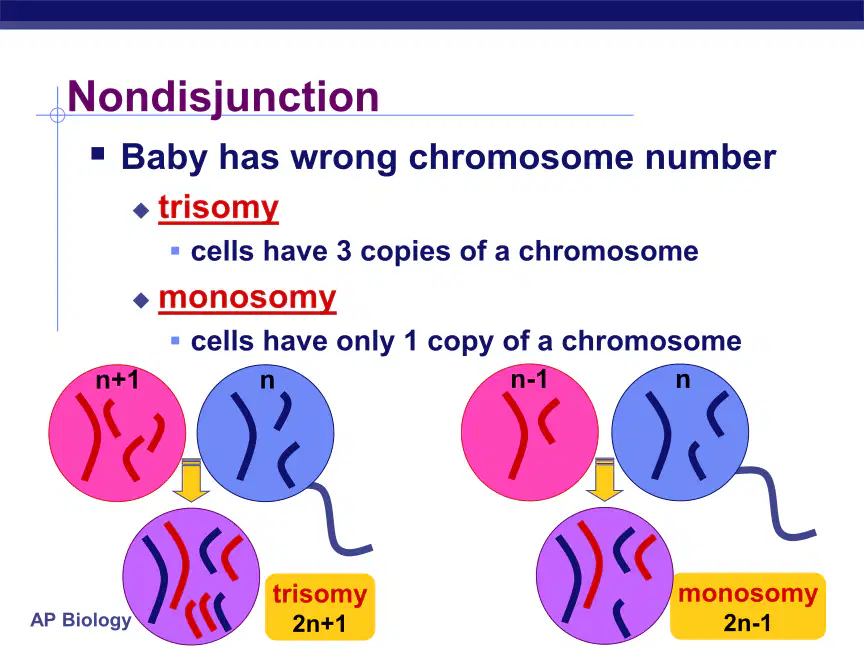
What is nondisjunction and how does it affect chromosome number in daughter cells during meiosis?
Nondisjunction is the failure of chromosomes to separate properly during mitosis, leading to identical daughter cells.
Nondisjunction is the failure of homologous chromosomes or sister chromatids to separate during meiosis, resulting in daughter cells with too many or too few chromosomes.
Nondisjunction is the process by which chromosomes replicate twice during meiosis, causing extra chromosomes in daughter cells.
Nondisjunction is the separation of chromosomes during mitosis, resulting in cells with half the chromosome number.
6
7
Multiple Choice
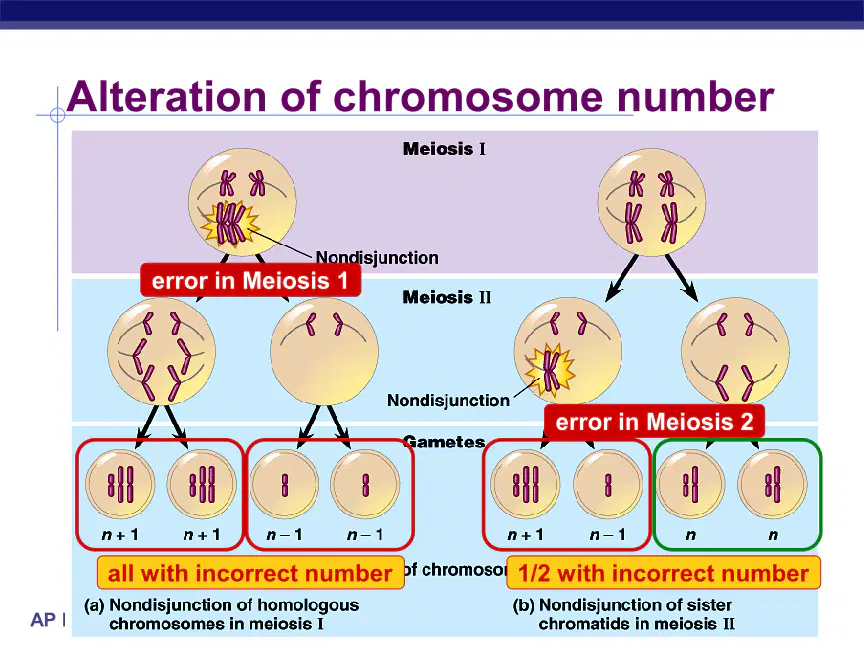
Compare the effects of nondisjunction in Meiosis I and Meiosis II on the chromosome number of resulting gametes.
Nondisjunction in Meiosis I results in all gametes having the correct chromosome number, while Meiosis II results in all gametes having incorrect numbers.
Nondisjunction in Meiosis I results in half of the gametes having incorrect chromosome numbers, while Meiosis II results in all gametes having incorrect numbers.
Nondisjunction in Meiosis I results in all gametes having incorrect chromosome numbers, while nondisjunction in Meiosis II results in half of the gametes having incorrect numbers.
Both Meiosis I and Meiosis II nondisjunction result in the same number of incorrect gametes.
8
9
Open Ended
Explain the difference between trisomy and monosomy and how each condition arises from nondisjunction.
10
Hotspot
Select the abnormal set of chromosomes in the picture provided.
11
12
Multiple Select
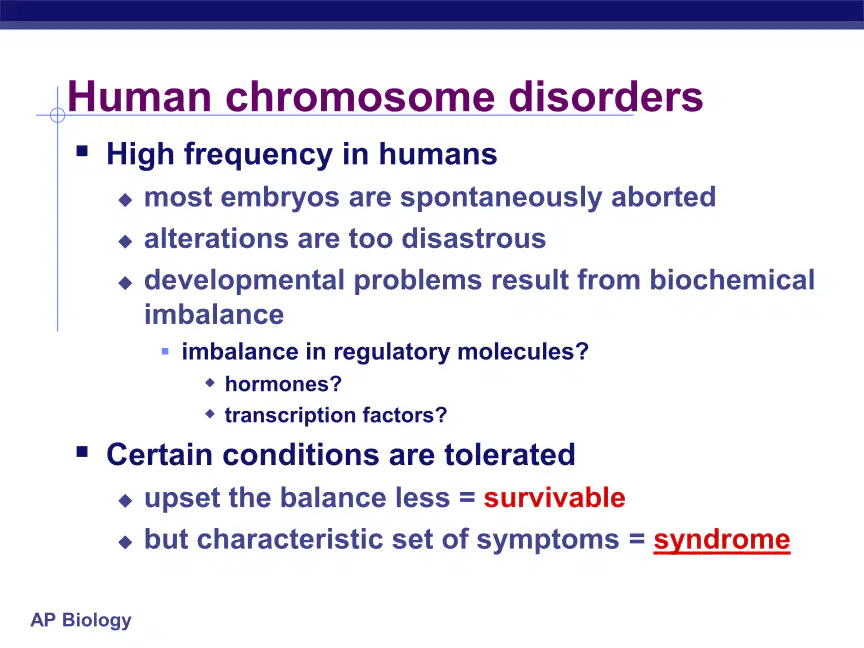
Human chromosome disorders often result from biochemical imbalance. List two possible regulatory molecules that may be affected and describe their role in development.
hormones
transcritpion factors
low cAMP
improper ligand binding
13
14
Fill in the Blanks
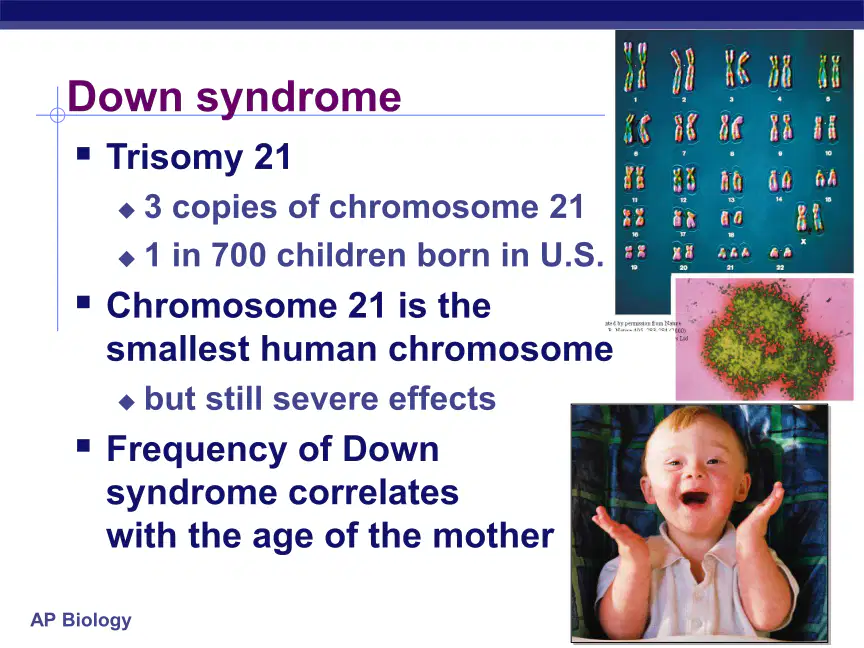
Down syndrome is caused by
15
16
Multiple Choice
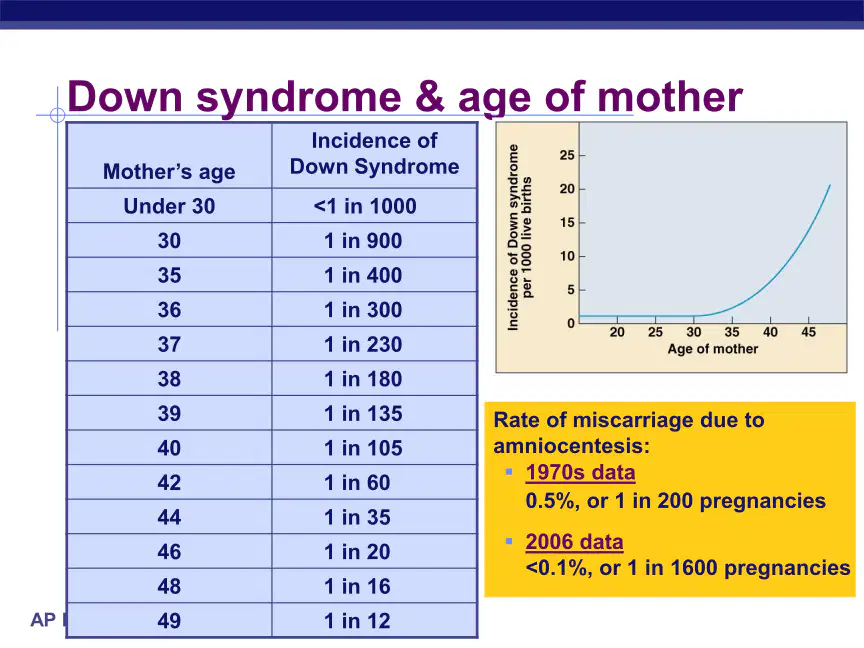
Which of the following statements about the relationship between maternal age and the incidence of Down syndrome is correct?
The incidence of Down syndrome decreases as maternal age increases.
The incidence of Down syndrome remains constant regardless of maternal age.
The incidence of Down syndrome increases as maternal age increases.
Maternal age has no effect on the incidence of Down syndrome.
17

18
Multiple Choice
Which genetic testing procedure is used in the 2nd trimester to analyze the karyotype of an embryo?
Amniocentesis
Ultrasound
Blood test
MRI
19
20
Open Ended
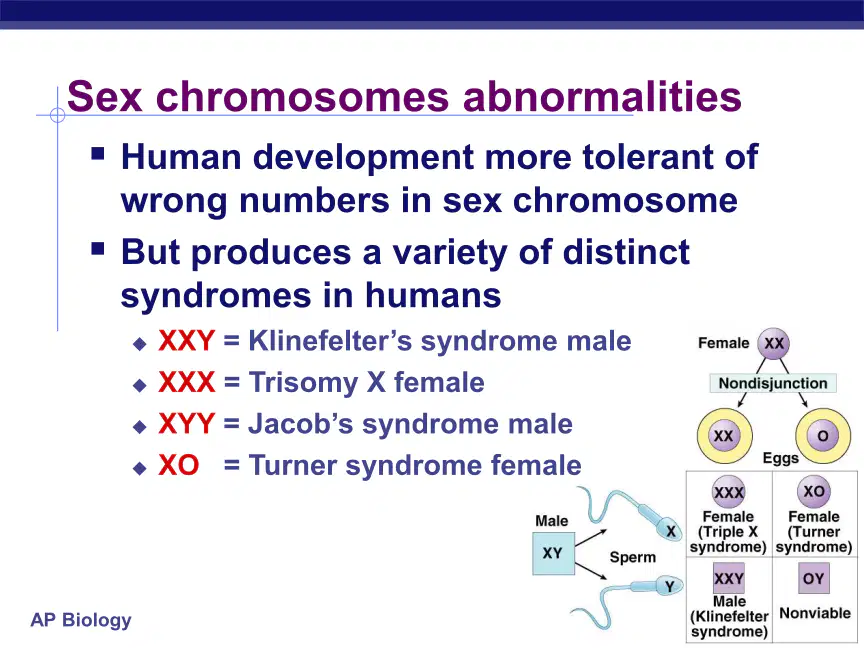
Explain how abnormalities in sex chromosomes can lead to distinct syndromes in humans. Use examples from the slides.
21
22
Multiple Select
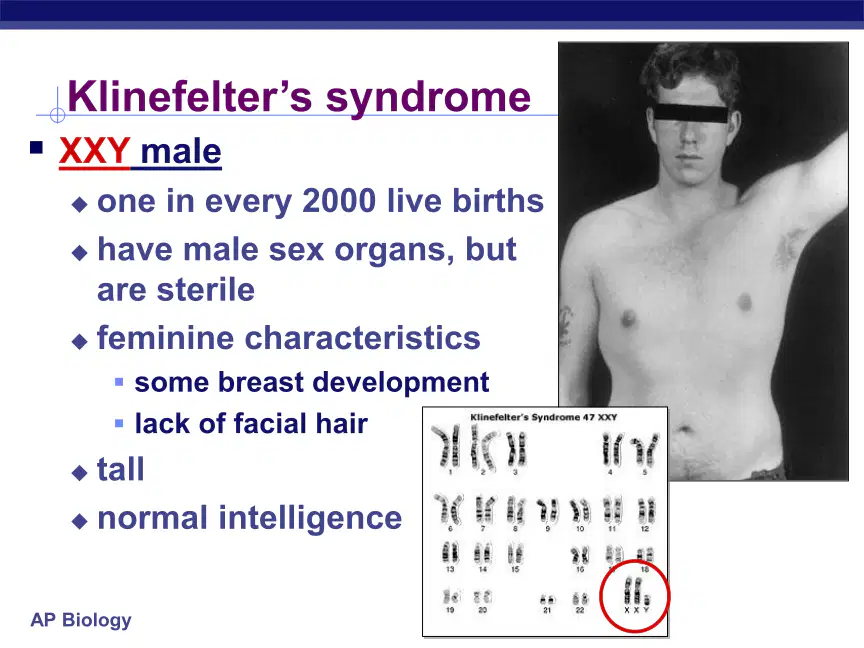
Which of the following are characteristics of Klinefelter’s syndrome (XXY male)?
Sterile
Tall
Normal intelligence
Delayed emotional maturity
23
24
Fill in the Blanks
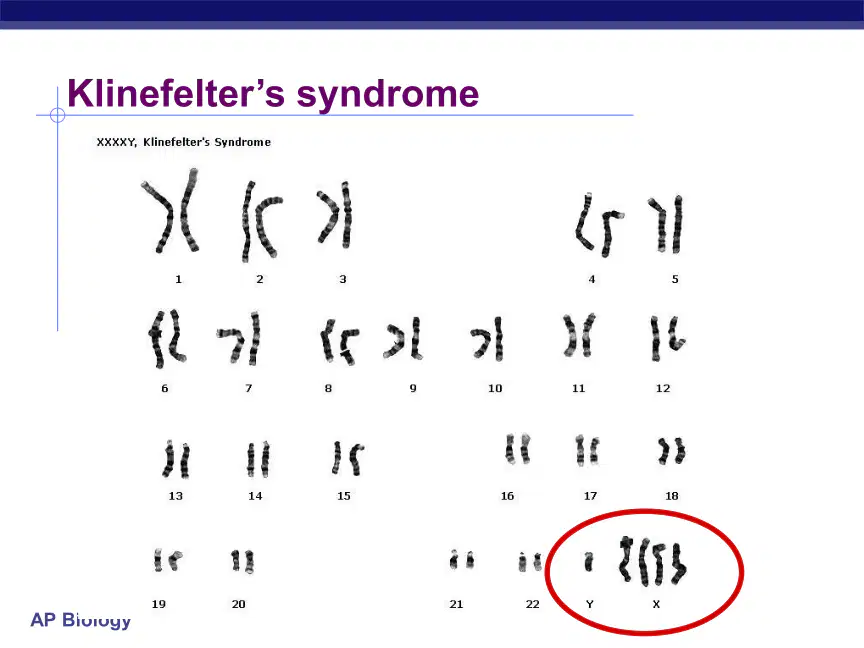
Klinefelter’s syndrome is caused by the presence of an extra
25
26
Open Ended
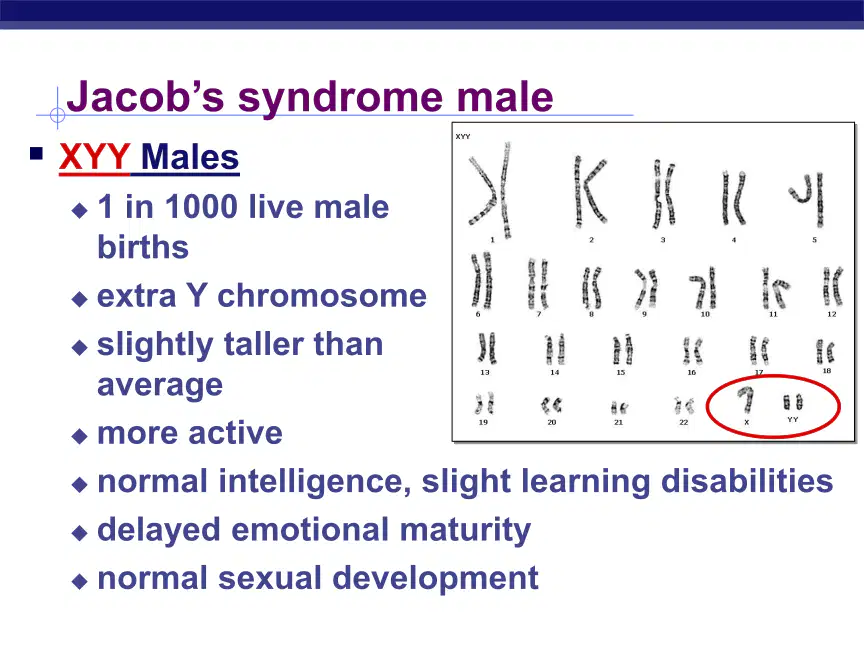
Compare the karyotypes shown for Klinefelter’s syndrome and Jacob’s syndrome. What is the key chromosomal difference between these two conditions?
27
28
Multiple Choice
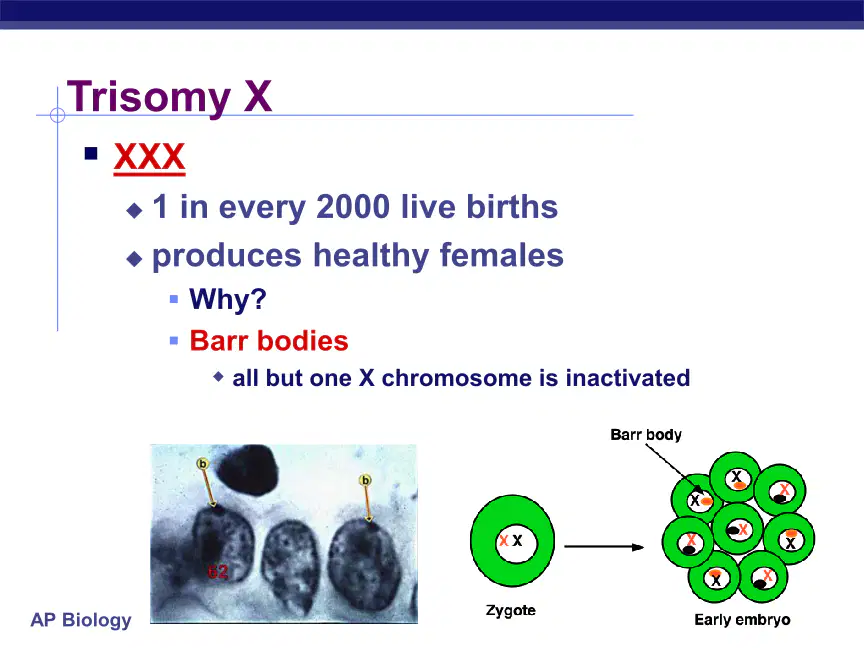
What is the biological reason that females with Trisomy X (XXX) are generally healthy?
All but one X chromosome is inactivated
The extra X chromosome is deleted
The extra X chromosome is duplicated
The extra X chromosome is converted to a Y chromosome
29
30
Fill in the Blanks
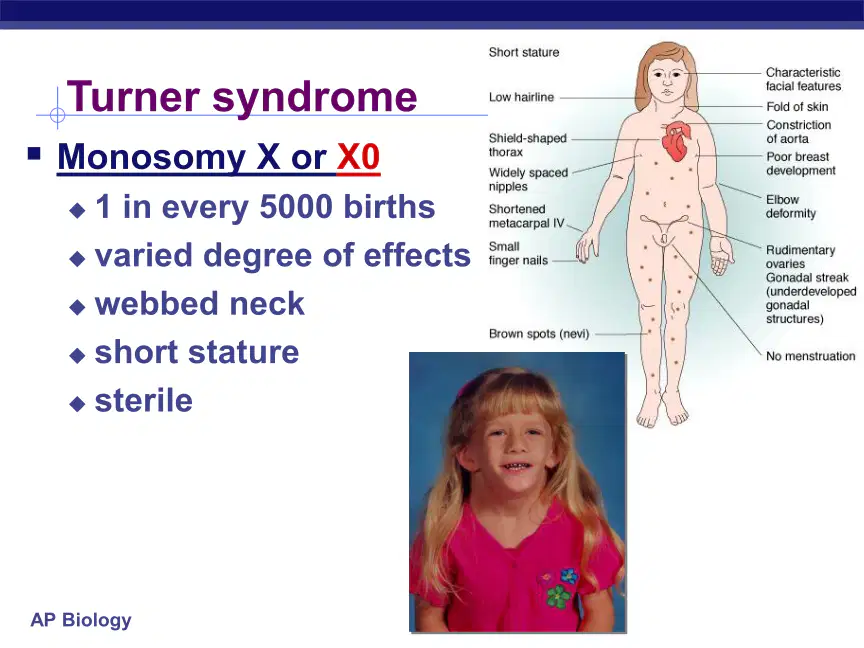
A person with Turner syndrome has
31
Multiple Choice
Which of the following is NOT a typical symptom or characteristic of Turner syndrome?
Webbed neck
Short stature
Sterile
Excessive height
32
33
Open Ended
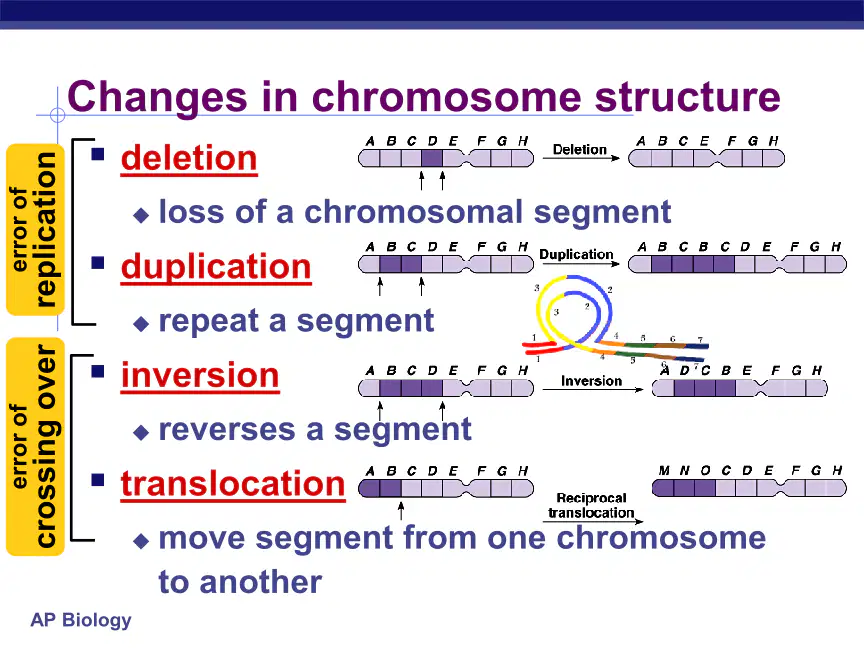
Explain how changes in chromosome structure such as deletion, duplication, inversion, and translocation can impact genetic disorders. Use examples from the images.
34
35
Multiple Choice
Which of the following is NOT a type of chromosomal breakage abnormality?
Deletion
Duplication
Nondisjunction
Inversion
36
Open Ended
What are some possible consequences of errors during meiosis, and how might they affect an individual?
Show answer
Auto Play
Slide 1 / 36
SLIDE
Similar Resources on Wayground

27 questions
K10MS W10 LAC OPERON TUTORIAL
Presentation
•
12th Grade
34 questions
The Federal Reserve
Presentation
•
12th Grade
31 questions
Unit 3: Federalist System - Test Review
Presentation
•
11th - 12th Grade
31 questions
The Human Person in their Environment
Presentation
•
11th - 12th Grade
33 questions
Chapter 6 Integumentary System
Presentation
•
11th - 12th Grade
28 questions
5.3 Trigonometric Ratios
Presentation
•
12th Grade
29 questions
Translocation
Presentation
•
12th Grade
Popular Resources on Wayground
10 questions
Safety Day 2026 – Student Review

Quiz
•
9th Grade
21 questions
Continents and Oceans
Quiz
•
6th Grade
20 questions
Parts of Speech
Quiz
•
5th Grade
16 questions
Subject & Predicate
Quiz
•
5th Grade
25 questions
Multiplication Facts
Quiz
•
5th Grade
12 questions
Map Skills
Quiz
•
3rd Grade
22 questions
Continents and Oceans
Quiz
•
5th Grade
15 questions
Rounding Decimals
Quiz
•
5th Grade
Discover more resources for Biology
20 questions
Cell Transport
Quiz
•
9th - 12th Grade
8 questions
DNA vs. RNA
Presentation
•
9th - 12th Grade
16 questions
Epithelial tissues
Quiz
•
11th - 12th Grade
15 questions
DNA Structure and Replication
Quiz
•
9th - 12th Grade
20 questions
Ecological Succession Review
Quiz
•
9th - 12th Grade
3 questions
Enzymes & Energy
Quiz
•
9th - 12th Grade
38 questions
Mitosis & Meiosis
Quiz
•
9th - 12th Grade
37 questions
DNA/RNA practice part 2
Quiz
•
9th - 12th Grade