

division

Presentation
•
Mathematics
•
6th - 8th Grade
•
Practice Problem
•
Easy

Luke Pencheon
Used 1+ times
FREE Resource
18 Slides • 1 Question
1
division
By Luke Pencheon
2
today you will learn about division, including dividing into equal groups, long division, dividing with remainder and decimals
By Luke Pencheon
3
Open Ended
research:
What is division?
4
What is division?
Division is the process of sharing a number into equal parts or groups.
Division is one of the four basic operations (arithmetic operations) and it is the inverse or opposite of multiplication.
To write a division equation, you write the number being divided, the dividend, then a division sign,
By Luke Pencheon
5
For example,
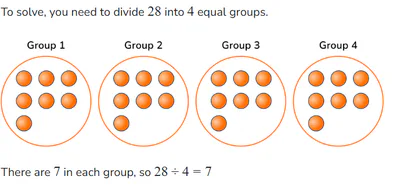
Annie wants to split her 28 marbles into equal groups of 4. How many marbles will be in each group?
You would write this as
28÷4=?
By Luke Pencheon
6
By Luke Pencheon
7
By Luke Pencheon
There are many different ways to solve division problems.
Today, we’re going to look at a visual method called the grid method.
This method helps us break numbers into smaller, easier parts. If you feel confident with understanding the value of numbers, you can replace the pictures or visual models with mental maths—the same thinking still applies.
The grid method is especially useful because:
It shows each step clearly
It helps you see how many groups you are making
It builds a strong understanding of place value
By the end of today’s lesson, you should be able to use the grid method to solve division questions and explain how it works.
8
By Luke Pencheon
96 ÷ 3
9
By Luke Pencheon
24 ÷4
10
By Luke Pencheon
745 ÷ 6
11
By Luke Pencheon
A baker makes 155 cupcakes. Boxes hold 5 cupcakes each.
12
By Luke Pencheon
A water tank holds 80 litres. Ben has a 3 litres jug, how many full jug could ben have, and how many litres will be left over
13
By Luke Pencheon
A water tank holds 80 litres. Ben has a 3 litres jug, how many full jug could ben have, and how many litres will be left over
14
By Luke Pencheon
When a divisor becomes too large to draw using pictures or grids, we can move on to using inverse operations to help us divide.
Instead of drawing groups, we can write out the times table of the divisor. This helps us see how many times the divisor fits into the larger number.
245 ÷ 15
15
By Luke Pencheon
When a divisor becomes too large to draw using pictures or grids, we can move on to using inverse operations to help us divide.
Instead of drawing groups, we can write out the times table of the divisor. This helps us see how many times the divisor fits into the larger number.
84 ÷ 24
16
By Luke Pencheon
When a divisor becomes too large to draw using pictures or grids, we can move on to using inverse operations to help us divide.
Instead of drawing groups, we can write out the times table of the divisor. This helps us see how many times the divisor fits into the larger number.
1520 ÷ 25
17
By Luke Pencheon
Using Fractions and Simplifying to Help with Division
We can also use our understanding of fractions to help us with division. As you already know, fractions and division are basically the same thing:
This gives us the power to make many division problems smaller and easier.
If we rewrite a division question so that it looks like a fraction, we can then use simplifying to reduce the numbers. This often makes the divisor smaller and the calculation much easier.
18
By Luke Pencheon
example
19
By Luke Pencheon
example
division
By Luke Pencheon
Show answer
Auto Play
Slide 1 / 19
SLIDE
Popular Resources on Wayground

15 questions
Grade 3 Simulation Assessment 1

Quiz
•
3rd Grade
22 questions
HCS Grade 4 Simulation Assessment_1 2526sy
Quiz
•
4th Grade
16 questions
Grade 3 Simulation Assessment 2
Quiz
•
3rd Grade
19 questions
HCS Grade 5 Simulation Assessment_1 2526sy
Quiz
•
5th Grade
17 questions
HCS Grade 4 Simulation Assessment_2 2526sy
Quiz
•
4th Grade
20 questions
Equivalent Fractions
Quiz
•
3rd Grade
24 questions
HCS Grade 5 Simulation Assessment_2 2526sy
Quiz
•
5th Grade
20 questions
Math Review
Quiz
•
3rd Grade
Discover more resources for Mathematics
36 questions
6th Grade Math STAAR Review
Quiz
•
6th Grade
14 questions
Volume of rectangular prisms
Quiz
•
7th Grade
20 questions
Math Review
Quiz
•
6th Grade
15 questions
Pythagorean Theorem Word Problems Quizizz
Quiz
•
8th Grade
22 questions
6TH GRADE MATH STAAR REVIEW
Quiz
•
6th Grade
22 questions
Simple Probability
Quiz
•
7th Grade
21 questions
6th Grade Math CAASPP Practice
Quiz
•
6th Grade
20 questions
Graphing Inequalities on a Number Line
Quiz
•
6th - 9th Grade