
Earth science for 8th Grade
Authored by Nadine Head
Other
8th Grade
Used 7+ times


AI Actions
Add similar questions
Adjust reading levels
Convert to real-world scenario
Translate activity
More...
Content View
Student View
60 questions
Show all answers
1.
MULTIPLE CHOICE QUESTION
2 mins • 1 pt
The fossil record can reveal changes in the environment over time. Scientists have found fossils of marine animals on the tops of mountains in Canada. What does this tell us about the history of the environment in that area?
2.
MULTIPLE CHOICE QUESTION
2 mins • 1 pt
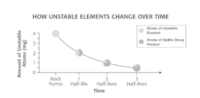
The graph shows how radioactive decay occurs in a 4-milligram (mg) rock sample that contains fossils. The unstable atoms in the sample have a half-life of 1.3 billion years. When the rock forms, the atoms are all unstable. After one half-life, the atoms of 2 mg of the sample are unstable. How much time will have passed after three half-lives?
3.
MULTIPLE CHOICE QUESTION
2 mins • 1 pt
A paleontologist is studying fossils of ferns from the Cenozoic era. Species A Is abundant in older rock layers. In younger rock layers, however, Species A disappears and other species of ferns become abundant. Which is the best hypothesis for why Species A disappeared?
4.
MULTIPLE CHOICE QUESTION
2 mins • 1 pt
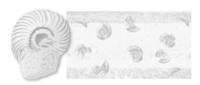
The illustration above shows Tropites marine mollosks similar to squids that had called shells and that lived between 230 and 208 million years ago. Fossils of these mollusks are now found in rock layers throughout the world. Why are Tropites particularly useful to geologists and paleontologists?
5.
MULTIPLE CHOICE QUESTION
30 sec • 1 pt
Which of the following organisms will most likely become a fossil?
6.
MULTIPLE CHOICE QUESTION
1 min • 1 pt
A scientist is trying to determine the age of a fossil. If the scientist wants to find the fossil's age in years, which method should she use?
7.
MULTIPLE CHOICE QUESTION
30 sec • 1 pt
Which of the following is not a trace fossil?
Access all questions and much more by creating a free account
Create resources
Host any resource
Get auto-graded reports

Continue with Google

Continue with Email

Continue with Classlink

Continue with Clever
or continue with

Microsoft
%20(1).png)
Apple

Others
Already have an account?
Popular Resources on Wayground

8 questions
Spartan Way - Classroom Responsible

Quiz
•
9th - 12th Grade
15 questions
Fractions on a Number Line
Quiz
•
3rd Grade
14 questions
Boundaries & Healthy Relationships

Lesson
•
6th - 8th Grade
20 questions
Equivalent Fractions
Quiz
•
3rd Grade
3 questions
Integrity and Your Health
Lesson
•
6th - 8th Grade
25 questions
Multiplication Facts
Quiz
•
5th Grade
9 questions
FOREST Perception
Lesson
•
KG
20 questions
Main Idea and Details
Quiz
•
5th Grade
Discover more resources for Other
14 questions
Boundaries & Healthy Relationships
Lesson
•
6th - 8th Grade
3 questions
Integrity and Your Health
Lesson
•
6th - 8th Grade
7 questions
SMS Playground Expectations Quiz
Quiz
•
6th - 8th Grade
16 questions
Mario Trivia Challenge
Quiz
•
6th - 8th Grade
14 questions
SMS Car & Bus Expectations Quiz
Quiz
•
6th - 8th Grade
20 questions
Scatter Plots and Line of Best Fit
Quiz
•
8th Grade
12 questions
8th U6 L4 - Fitting a Line to Data
Quiz
•
8th Grade
22 questions
Phases of the moon
Quiz
•
8th Grade