
Bio 3.4.1
Biology
9th - 11th Grade
NGSS covered
Used 322+ times


AI Actions
Add similar questions
Adjust reading levels
Convert to real-world scenario
Translate activity
More...
Content View
Student View
18 questions
Show all answers
1.
MULTIPLE CHOICE QUESTION
2 mins • 1 pt
Which best describes the first organisms to live on Earth?
Tags
NGSS.HS-LS2-3
2.
MULTIPLE CHOICE QUESTION
2 mins • 1 pt

The similarities in these homologous structures imply which of the following?
Tags
NGSS.MS-LS4-2
NGSS.MS-LS4-3
3.
MULTIPLE CHOICE QUESTION
2 mins • 1 pt
A paleontologist is comparing the fossilized remains of two primates. Both animals had a prehensile tail. What can be concluded from this evidence?
Tags
NGSS.MS-LS4-2
NGSS.MS-LS4-1
4.
MULTIPLE CHOICE QUESTION
2 mins • 1 pt
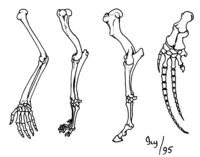
Structures with the same parts have different functions; suggests that organisms share a common ancestry
Tags
NGSS.MS-LS4-2
NGSS.MS-LS4-1
5.
MULTIPLE CHOICE QUESTION
2 mins • 1 pt
The process by which populations slowly change over time is called__________
Tags
NGSS.MS-LS4-2
NGSS.MS-LS4-4
6.
MULTIPLE CHOICE QUESTION
2 mins • 1 pt
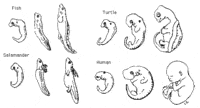
Study of embryos of various organisms to show a common ancestor because of similarities in development
Tags
NGSS.MS-LS4-3
7.
MULTIPLE CHOICE QUESTION
2 mins • 1 pt
Structures that have the same function but different structures are...
Tags
NGSS.MS-LS4-2


Access all questions and much more by creating a free account
Create resources
Host any resource
Get auto-graded reports

Continue with Google

Continue with Email

Continue with Microsoft
or continue with

%20(1).png)
Apple

Others
By signing up, you agree to our Terms of Service & Privacy Policy
Already have an account?


