
Conservation of Mass
Authored by Mrs. Sarigumba
Chemistry
7th Grade
NGSS covered
Used 22+ times


AI Actions
Add similar questions
Adjust reading levels
Convert to real-world scenario
Translate activity
More...
Content View
Student View
23 questions
Show all answers
1.
MULTIPLE CHOICE QUESTION
30 sec • 1 pt
In a chemical reaction, the mass of the reactants was 15g. The mass of the products was 12g. Did this chemical reaction follow the law of conservation of mass?
Tags
NGSS.MS-PS1-5
2.
MULTIPLE CHOICE QUESTION
30 sec • 1 pt
There are two reactants in a chemical equation, and one product. The mass of the product is 30g. The mass of the first reactant is 17g. What must the mass of the second reactant be, if the equation is to follow the law of conservation of mass?
Tags
NGSS.MS-PS1-5
3.
MULTIPLE CHOICE QUESTION
30 sec • 1 pt
Which of the following is a chemical change?
Tags
NGSS.MS-PS1-5
NGSS.MS-PS1-2
4.
MULTIPLE CHOICE QUESTION
1 min • 1 pt
The substances listed to the left of the arrow in a chemical reaction are called the _______________.
5.
MULTIPLE CHOICE QUESTION
30 sec • 1 pt
Which of the following is true of the law of conservation of mass?
Tags
NGSS.MS-PS1-5
6.
MULTIPLE CHOICE QUESTION
30 sec • 1 pt
Students react baking soda & vinegar.
Which of the following would provide the evidence that the number of atoms present before a chemical reaction is equal to the number of atoms present after the chemical reaction?
Tags
NGSS.MS-PS1-5
NGSS.MS-PS1-2
7.
MULTIPLE CHOICE QUESTION
20 sec • 1 pt

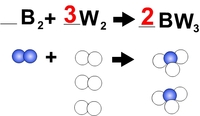
Is this equation balanced?
Tags
NGSS.MS-PS1-5

Access all questions and much more by creating a free account
Create resources
Host any resource
Get auto-graded reports

Continue with Google

Continue with Email

Continue with Classlink

Continue with Clever
or continue with

Microsoft
%20(1).png)
Apple

Others
Already have an account?


