
Physics First Review - Newton's Laws
Authored by Myronna Pryor
Physics
9th - 10th Grade
NGSS covered
Used 78+ times


AI Actions
Add similar questions
Adjust reading levels
Convert to real-world scenario
Translate activity
More...
Content View
Student View
40 questions
Show all answers
1.
MULTIPLE CHOICE QUESTION
1 min • 12 pts
What is Newton's First Law known as? The Law of
2.
MULTIPLE CHOICE QUESTION
1 min • 1 pt
What is Newton's First Law of Motion?
3.
MULTIPLE CHOICE QUESTION
1 min • 1 pt
The unit of force is
m/s
m/s2
Newton
kg
4.
MULTIPLE CHOICE QUESTION
1 min • 1 pt
A force of 250 N is applied to an object that accelerates at a rate of 5 m/sec2. What is the mass of the object?
Tags
NGSS.MS-PS2-2
5.
MULTIPLE CHOICE QUESTION
1 min • 1 pt
F=ma
1st
Law of Motion
2nd
Law of Motion
3rd
Law of Motion
Tags
NGSS.MS-PS2-2
6.
MULTIPLE CHOICE QUESTION
1 min • 1 pt

Which best explains why we are able to accelerate forward when starting to run?
Tags
NGSS.MS-PS2-1
7.
MULTIPLE CHOICE QUESTION
1 min • 1 pt
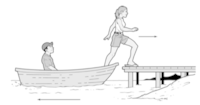
A person steps out of the boat and onto the dock. As the person moves forward onto the dock, the boat moves backward. Which statement best describes the backward motion of the boat as the person steps forward?
Tags
NGSS.MS-PS2-1
Access all questions and much more by creating a free account
Create resources
Host any resource
Get auto-graded reports

Continue with Google

Continue with Email

Continue with Classlink

Continue with Clever
or continue with

Microsoft
%20(1).png)
Apple

Others
Already have an account?
Similar Resources on Wayground

40 questions
Semester 2 - Energy Review

Quiz
•
9th Grade
45 questions
Physics, Motion in One Dimension Review
Quiz
•
9th Grade - University
40 questions
Unit 6 Test Review
Quiz
•
5th - 9th Grade
35 questions
Mechanical Waves
Quiz
•
9th - 12th Grade
45 questions
PS M9 Test Review Introduction to Waves
Quiz
•
9th - 12th Grade
45 questions
Year 10 Motion Topic Test Revision
Quiz
•
10th Grade
35 questions
Science Form 2_Chap 7.3 Magnetism
Quiz
•
8th - 11th Grade
35 questions
Goal 1 Astronomy Test
Quiz
•
9th - 12th Grade
Popular Resources on Wayground
8 questions
Spartan Way - Classroom Responsible
Quiz
•
9th - 12th Grade
15 questions
Fractions on a Number Line
Quiz
•
3rd Grade
14 questions
Boundaries & Healthy Relationships

Lesson
•
6th - 8th Grade
20 questions
Equivalent Fractions
Quiz
•
3rd Grade
3 questions
Integrity and Your Health
Lesson
•
6th - 8th Grade
25 questions
Multiplication Facts
Quiz
•
5th Grade
9 questions
FOREST Perception
Lesson
•
KG
20 questions
Main Idea and Details
Quiz
•
5th Grade
Discover more resources for Physics
10 questions
Exit Check 4.5 - Impulse
Quiz
•
9th Grade
20 questions
Simple Machines and Mechanical Advantage Quiz
Quiz
•
9th Grade
20 questions
Electricity/Magnets
Quiz
•
9th Grade
20 questions
Light Vs. Sound Waves
Quiz
•
9th - 12th Grade
14 questions
Bill Nye Waves

Interactive video
•
9th - 12th Grade
37 questions
CIA #3 Study Guide: ACPS
Quiz
•
10th Grade
20 questions
Waves
Quiz
•
9th - 12th Grade
10 questions
Exploring the Properties of Waves
Interactive video
•
9th - 12th Grade