
AP Statistics Linear Regression Review
Authored by Mike Trejo
Mathematics
12th Grade
CCSS covered
Used 70+ times


AI Actions
Add similar questions
Adjust reading levels
Convert to real-world scenario
Translate activity
More...
About
This AP Statistics quiz focuses comprehensively on linear regression analysis, targeting Grade 12 students enrolled in Advanced Placement Statistics. The questions assess critical understanding of correlation coefficients, least squares regression lines, residual analysis, coefficient of determination (r²), data transformations for exponential relationships, and the identification of influential points and outliers. Students must demonstrate mastery of interpreting regression output, calculating residuals using the formula (observed - predicted), distinguishing between interpolation and extrapolation, understanding the properties of correlation (including unit invariance), and analyzing scatter plots and residual plots to evaluate model fit. The quiz requires students to work with real-world contexts involving biological measurements, nutritional data, and environmental science, demanding both computational skills and conceptual understanding of when linear models are appropriate and how various data points affect regression analysis. Created by Mike Trejo, a Mathematics teacher in US who teaches grade 12. This comprehensive review quiz serves multiple instructional purposes in AP Statistics classrooms, functioning effectively as a summative review before major assessments, targeted practice for students struggling with regression concepts, or structured homework to reinforce classroom learning. The quiz excellently supports formative assessment by revealing specific gaps in student understanding of regression analysis through its diverse question formats and real-world applications. Teachers can use individual questions as warm-up problems or discussion starters, while the complete quiz provides comprehensive preparation for AP Statistics exam regression questions. This assessment aligns with Common Core Standards S-ID.6 (representing data on two quantitative variables and summarizing relationships), S-ID.7 (interpreting slope and intercept of linear fits), and S-ID.8 (computing and interpreting correlation coefficients for linear fits), while directly supporting AP Statistics Learning Objectives related to exploring bivariate data and performing statistical inference.
Content View
Student View
22 questions
Show all answers
1.
MULTIPLE CHOICE QUESTION
15 mins • 1 pt
Which of the following statements is not true of the correlation r between the lengths in inches and weights in pounds of a sample of brook trout?
r must take a value between -1 and 1.
r is measured in inches.
If longer trout tend to also be heavier, then r>0.
r would not change if we measured the lengths of the trout in centimeters instead of inches.
Tags
CCSS.HSS.ID.B.6
CCSS.HSS.ID.C.8
2.
MULTIPLE CHOICE QUESTION
1 min • 1 pt

Write the linear regression equation for the data set foot length (x) and height (y).
Tags
CCSS.HSF.LE.B.5
3.
MULTIPLE CHOICE QUESTION
30 sec • 1 pt
In order to linearize data that is growing exponentially, you must take:
Log of x
Log of y
Log of y-hat
Log of x and y
Tags
CCSS.HSF.BF.B.5
CCSS.HSF.LE.A.4
4.
MULTIPLE CHOICE QUESTION
30 sec • 1 pt
What does r2 stand for?
Tags
CCSS.HSS.ID.B.6
CCSS.HSS.ID.C.8
5.
MULTIPLE CHOICE QUESTION
1 min • 1 pt
Which is TRUE?
I. Random scatter in the residuals indicates a linear model.
II. If two variables are very strongly associated, then the correlation between them will be near 1 or -1.
III. Changing the units of measurement for x or y changes the correlation coefficient.
Tags
CCSS.HSS.ID.B.6
CCSS.HSS.ID.C.8
CCSS.HSS.ID.C.9
6.
MULTIPLE CHOICE QUESTION
30 sec • 1 pt
How do you calculate a residual?
7.
MULTIPLE CHOICE QUESTION
1 min • 1 pt
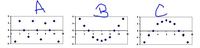
After performing analyses on a set of data, Mr. Trejo examined the scatter plot of the residual values for each analysis. Which scatter plot indicated the best linear fit for the data?
A
B
C
Tags
CCSS.HSS.ID.B.6
CCSS.HSS.ID.C.8


Access all questions and much more by creating a free account
Create resources
Host any resource
Get auto-graded reports

Continue with Google

Continue with Email

Continue with Classlink

Continue with Clever
or continue with

Microsoft
%20(1).png)
Apple

Others
Already have an account?

