
AP Biology: Cellular Energetics
Authored by Katie Starke
Biology
11th - 12th Grade
NGSS covered
Used 116+ times


AI Actions
Add similar questions
Adjust reading levels
Convert to real-world scenario
Translate activity
More...
Content View
Student View
30 questions
Show all answers
1.
MULTIPLE CHOICE QUESTION
30 sec • 1 pt
A researcher proposes a model of an enzyme-catalyzed reaction in which a reactant is converted to a product. The model is based on the idea that the reactant passes through a transition state within the enzyme-substrate complex before the reactant is converted to the product.
Which of the following statements best helps explain how the enzyme speeds up the reaction?
The enzyme’s active site binds to and stabilizes the reactant, which decreases the free-energy change of the reaction.
The enzyme’s active site binds to and stabilizes the transition state, which decreases the activation energy of the reaction.
The enzyme’s active site binds to and stabilizes the product, which increases the amount of energy released by the reaction.
The enzyme’s active site binds to and stabilizes both the reactant and the product at the same time, which increases the reaction’s equilibrium constant.
2.
MULTIPLE CHOICE QUESTION
30 sec • 1 pt
Enzymes are made up of these repeating monomers.
Tags
NGSS.HS-LS1-6
3.
MULTIPLE CHOICE QUESTION
30 sec • 1 pt
The part of the enzyme that the substrate bonds to is called the _____.
4.
MULTIPLE CHOICE QUESTION
30 sec • 1 pt
If a mutation occurs in a DNA sequence that codes for an enzyme, what is the most likely result?
There will likely be no change in the shape and function of the enzyme.
The enzyme will most likely fold in a way that makes its shape incompatible with the substrate and the enzyme will not function correctly.
The enzyme will not be produced at all.
The enzyme will have an enhanced ability to bind with the substrate.
Tags
NGSS.HS-LS1-1
NGSS.HS-LS3-2
5.
MULTIPLE CHOICE QUESTION
30 sec • 12 pts
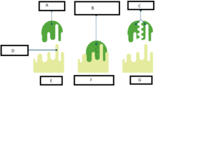
What is structure A?
Tags
NGSS.MS-LS1-7
6.
MULTIPLE CHOICE QUESTION
30 sec • 12 pts
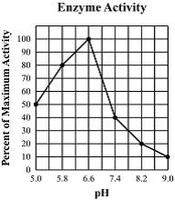
Which of the following conclusions can be drawn from this graph?
7.
MULTIPLE CHOICE QUESTION
30 sec • 1 pt
Which of these is NOT true?
Tags
NGSS.HS-PS1-5

Access all questions and much more by creating a free account
Create resources
Host any resource
Get auto-graded reports

Continue with Google

Continue with Email

Continue with Microsoft
or continue with

%20(1).png)
Apple

Others
Already have an account?



