
08 Chapter 14.1 History of life and fossils Bio IB
Authored by Wendel Landes
Biology
9th Grade
NGSS covered
Used 364+ times


AI Actions
Add similar questions
Adjust reading levels
Convert to real-world scenario
Translate activity
More...
Content View
Student View
25 questions
Show all answers
1.
MULTIPLE CHOICE QUESTION
1 min • 1 pt

Analyze the seashell found in the white layer. Which statement is true of the rock layer that contains this fossil?
It is older than the layers above it.
It is older than the layers below it.
It is younger than the layers above it.
Tags
NGSS.MS-ESS1-4
2.
MULTIPLE CHOICE QUESTION
1 min • 1 pt
Relative dating of rock layers tells us that the deeper we dig, _______.
Tags
NGSS.MS-ESS1-4
3.
MULTIPLE CHOICE QUESTION
1 min • 1 pt
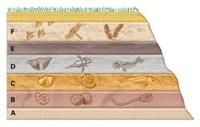
Which rock layer in the diagram seems to be the oldest?
Tags
NGSS.MS-ESS1-4
4.
MULTIPLE CHOICE QUESTION
1 min • 1 pt
According to scientific measurements, approximately how old is the Earth?
4,600 years
4.6 million years
4.6 billion years
Tags
NGSS.HS-ESS1-6
5.
MULTIPLE CHOICE QUESTION
1 min • 1 pt
If you were examining sedimentary rock and saw fossils of many types of organisms in lower layers of rock and found almost no species in areas above a certain point, what would you conclude? Choose the best answer.
There was a major change on Earth that caused a mass extinction
All of the species moved to a new habitat
The dinosaurs caused all of the other species to go extinct
Tags
NGSS.MS-LS4-1
6.
MULTIPLE CHOICE QUESTION
1 min • 1 pt
Put these species in order according to the order in which they appear in the fossil record.
prokaryotic cells, eukaryotic cells, sponges, fish, amphibians, reptiles
eukaryotic cells, prokaryotic cells, sponges, amphibians, fish, reptiles
prokaryotic cells, eukaryotic cells, fish, reptiles, amphibians, sponges
Tags
NGSS.MS-LS4-1
7.
MULTIPLE CHOICE QUESTION
30 sec • 1 pt
What is a half life?
The time it takes for 1/2 of the atoms of a radioactive element to change into another element.
About 50 years since humans can live to 100 years
1000 years
The time is takes for all of the carbon-14 atoms to disappear
Tags
NGSS.HS-PS1-8

Access all questions and much more by creating a free account
Create resources
Host any resource
Get auto-graded reports

Continue with Google

Continue with Email

Continue with Microsoft
or continue with

%20(1).png)
Apple

Others
Already have an account?



