Natural Selection

Quiz
•
Science
•
7th Grade
•
Practice Problem
•
Hard
+3
Standards-aligned

A. Ransom
Used 359+ times
FREE Resource
Student preview

15 questions
Show all answers
1.
MULTIPLE CHOICE QUESTION
2 mins • 1 pt
What is evolution?
a group of organisms that can mate to produce fertile offspring
the process in which inherited traits of a population change over many generations
the process by which individuals that are better adapted to their environment are more likely to survive and reproduce
a trait that allows organisms in a population to better survive and reproduce in their environment
Tags
NGSS.MS-LS4-2
NGSS.MS-LS4-4
2.
MULTIPLE CHOICE QUESTION
2 mins • 1 pt
What is natural selection?
the process by which humans breed a species for certain traits
the process in which inherited traits of a population change over many generations
the process by which Charles Darwin noted the differences in finches while visiting the Galápagos Islands
the process by which individuals that are better adapted to their environment are more likely to survive and reproduce
3.
MULTIPLE CHOICE QUESTION
2 mins • 1 pt
What is an adaptation?
a group of organisms that can mate to produce fertile offspring
a process by which inherited traits in a population change over generations
a process by which individuals that are better adapted to their environment are more likely to survive and reproduce
a trait that improves chances of survival and reproduction for a group of individuals in a population
Tags
NGSS.MS-LS1-4
4.
MULTIPLE CHOICE QUESTION
2 mins • 1 pt
Which of the following is an example of a species?
birds
birds of prey
owls
spotted owl- bubo eublopharius
5.
MULTIPLE CHOICE QUESTION
2 mins • 1 pt
What did Charles Darwin observe on the Galápagos Islands?
different rock layers on different islands
the extinction of finches on different islands
physical differences in finches that lived on different islands
the fossil record of finches that once lived on different islands
Tags
NGSS.MS-LS4-2
6.
MULTIPLE CHOICE QUESTION
2 mins • 1 pt

The figure shows two spotted salamanders. They are the same species of salamander, but they live in different areas.
Which of these terms is used to describe the difference between them?
overpopulation
population
extinction
variation
Tags
NGSS.MS-LS4-4
7.
MULTIPLE CHOICE QUESTION
2 mins • 1 pt
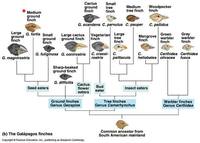
When Charles Darwin observed finches on the Galápagos Islands, he noted differences in the shapes of the birds’ beaks. He observed that finches that ate insects had longer, narrower beaks than finches that crushed and ate seeds. Crushing seeds requires a larger, powerful beak. Based on this information, which finch shown below would most likely have an advantage for survival in an environment where seeds are the main source of food?


Tags
NGSS.MS-LS4-2
NGSS.MS-LS4-4

Access all questions and much more by creating a free account
Create resources
Host any resource
Get auto-graded reports

Continue with Google

Continue with Email

Continue with Classlink

Continue with Clever
or continue with

Microsoft
%20(1).png)
Apple

Others
Already have an account?
Popular Resources on Wayground

15 questions
Fractions on a Number Line
Quiz
•
3rd Grade
20 questions
Equivalent Fractions
Quiz
•
3rd Grade
25 questions
Multiplication Facts
Quiz
•
5th Grade
54 questions
Analyzing Line Graphs & Tables
Quiz
•
4th Grade
22 questions
fractions
Quiz
•
3rd Grade
20 questions
Main Idea and Details
Quiz
•
5th Grade
20 questions
Context Clues
Quiz
•
6th Grade
15 questions
Equivalent Fractions
Quiz
•
4th Grade
Discover more resources for Science
20 questions
Cell Organelles and Functions
Quiz
•
6th - 8th Grade
33 questions
Grade 6 Quarter 3 PMA 5 Review
Quiz
•
6th - 8th Grade
12 questions
Ecological Succession
Quiz
•
7th Grade
10 questions
Exploring the Rock Cycle: Types and Formation

Interactive video
•
6th - 8th Grade
10 questions
Exploring the Layers of the Earth
Interactive video
•
6th - 10th Grade
10 questions
Exploring the Rock Cycle
Interactive video
•
6th - 8th Grade
12 questions
Photosynthesis
Quiz
•
7th Grade
10 questions
Exploring Weathering, Erosion, and Deposition Processes
Interactive video
•
6th - 10th Grade