
Evolution Test Honors Biology
Biology
9th - 10th Grade
NGSS covered
Used 1K+ times


AI Actions
Add similar questions
Adjust reading levels
Convert to real-world scenario
Translate activity
More...
About
This quiz comprehensively covers evolutionary biology at the high school level, specifically designed for grades 9-10 honors biology students. The assessment evaluates student understanding of fundamental evolutionary concepts including natural selection, speciation mechanisms, evidence for evolution, and the historical development of evolutionary theory. Students need to demonstrate mastery of key principles such as how geographic and reproductive isolation lead to speciation, the difference between homologous and analogous structures, and the role of fossil evidence in understanding evolutionary relationships. The quiz requires students to analyze Darwin's observations of Galápagos finches, distinguish between natural and artificial selection, interpret cladograms and phylogenetic relationships, and understand how molecular evidence supports evolutionary theory. Advanced concepts include types of natural selection (directional, disruptive, and stabilizing), vestigial structures as evidence of common ancestry, and the relationship between genetic similarity and evolutionary relatedness. Created by a biology teacher in the US who teaches grades 9 and 10. This assessment serves as an excellent comprehensive evaluation tool for an evolution unit in honors biology, allowing teachers to gauge student comprehension across multiple learning objectives simultaneously. The quiz works effectively as a summative assessment following instruction on evolutionary theory, or can be adapted for formative assessment by using individual questions as warm-up activities or exit tickets. Teachers can assign this as homework to reinforce classroom learning or use it for test preparation to help students identify areas needing additional review. The varied question formats, from basic recall to higher-order analysis of cladograms and comparative anatomy, make this quiz particularly valuable for differentiating instruction and supporting students at multiple learning levels. This assessment aligns with NGSS standards HS-LS4-1 (communicating scientific information about common ancestry using evidence), HS-LS4-2 (constructing explanations for similarities and differences among organisms), and HS-LS4-3 (applying mathematical concepts to support explanations of factors affecting populations over time).
Content View
Student View
34 questions
Show all answers
1.
MULTIPLE CHOICE QUESTION
45 sec • 1 pt

what did Charles Darwin observe in finch populations of the Galapagos Islands off the coast of South America?
Tags
NGSS.HS-LS4-1
NGSS.HS-LS4-4
NGSS.HS-LS4-2
NGSS.HS-LS4-5
2.
MULTIPLE CHOICE QUESTION
1 min • 1 pt
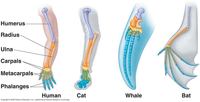
If an organism has a vestigial structure, that structure likely once had a function in a(n)
Tags
NGSS.HS-LS4-1
NGSS.HS-LS4-4
3.
MULTIPLE CHOICE QUESTION
30 sec • 1 pt
What is speciation?
combining of two species to form one with different traits
isolation that affects mating behaviors
timing of mating that prevents normal sexual selection
divergence of two or more species from an existing one
Tags
NGSS.HS-LS4-4
NGSS.HS-LS4-5
4.
MULTIPLE CHOICE QUESTION
30 sec • 1 pt

An earthquake causes an ocean channel top open and separate an island into two. The species on each section are now in
geographic isolation
behavioral isolation
disruptive selection
temporal isolation
Tags
NGSS.HS-LS4-2
NGSS.HS-LS4-5
5.
MULTIPLE CHOICE QUESTION
20 sec • 1 pt
What is the process in which humans breed organisms for certain traits?
Tags
NGSS.MS-LS4-5
6.
MULTIPLE CHOICE QUESTION
45 sec • 1 pt
Why are advantageous traits more likely to be passed onto offspring?
Tags
NGSS.HS-LS4-4
NGSS.HS-LS4-2
NGSS.HS-LS4-3
7.
MULTIPLE CHOICE QUESTION
1 min • 1 pt
Which of the following ideas proposed by Lamarck was later found to be incorrect?
Tags
NGSS.HS-LS3-2

Access all questions and much more by creating a free account
Create resources
Host any resource
Get auto-graded reports

Continue with Google

Continue with Email

Continue with Classlink

Continue with Clever
or continue with

Microsoft
%20(1).png)
Apple

Others
Already have an account?


