
5.2 Limits to Growth
9th Grade
•25 Qs

Similar activities
Gaseous Exchange
9th - 11th Grade
•20 Qs
Food webs and energy flows
9th - 10th Grade
•20 Qs
Characteristics of Cells & Functions
KG - University
•20 Qs
CH 30 DIGESTION
9th - 10th Grade
•25 Qs
Lesson 7 - Ecology Vocabulary
9th - 12th Grade
•20 Qs
Ch.2 Cells and Heredity
6th - 9th Grade
•21 Qs
Cell Cycle and Stem Cells and Cellular Differentiation
9th Grade
•20 Qs
9.2 - Global Climate Change
9th - 12th Grade
•20 Qs

5.2 Limits to Growth

Quiz
•
Biology
•
9th Grade
•
Practice Problem
•
Easy
+5
Standards-aligned

Chris Larson
Used 373+ times
FREE Resource

Enhance your content in a minute
25 questions
Show all answers
1.
MULTIPLE CHOICE QUESTION
45 sec • 1 pt

When a specific population grows past the ecosystem's carrying capacity, what happens to the population?
Density Independent limiting factors start to occur resulting in the population going farther above carrying capacity.
Density Dependent limiting factors start to occur resulting in the population going back below carrying capacity.
The population will go extinct due to lack of resources
The population grows then finds a new carrying capacity
Answer explanation
When a specific population grows past the ecosystem's carrying capacity, Density Dependent limiting factors start to occur resulting in the population going back below carrying capacity. This means that the population size will decrease as the limiting factors, such as competition for resources or predation, become more intense. The population will adjust to a lower carrying capacity to maintain a sustainable balance with the available resources. This process helps to prevent the population from exceeding the ecosystem's capacity and ensures the survival of the species.
Tags
NGSS.MS-LS2-1
NGSS.MS-LS2-4
2.
MULTIPLE CHOICE QUESTION
1 min • 1 pt
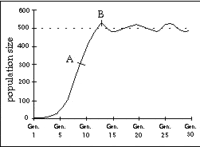
What is the carrying capacity of the graph?
around 500
more than 500
less than 500
around 600
Answer explanation
The question asks about the carrying capacity of the graph. The correct answer is 'around 500'. This means that the graph can hold approximately 500 units. The other options are not correct as they mention different values. The explanation is limited to 75 words and does not include the option number or mention the word 'query'.
Tags
NGSS.MS-LS2-1
NGSS.MS-LS2-4
3.
MULTIPLE CHOICE QUESTION
30 sec • 1 pt
Natural disasters can be considered limiting factors.
true: density independent limiting factors
false; natural disasters are not limiting factors
true: density dependent limiting factors
false: because Mrs. Schaffer said
Answer explanation
Natural disasters can be considered limiting factors because they can significantly impact population size and distribution. They are density independent limiting factors, meaning they affect populations regardless of their size or density. In contrast, density dependent limiting factors are influenced by population size and can include factors like competition for resources. The correct choice is 'true: density independent limiting factors'.
Tags
NGSS.MS-ESS3-2
NGSS.MS-LS2-4
4.
MULTIPLE CHOICE QUESTION
30 sec • 1 pt
Limiting factors which impact the size of a population no matter how large that population is.
Density Independent Limiting Factors
Density Dependent Limiting Factors
Carrying Capacity
Exponential Growth
Answer explanation
The question asks about the limiting factors that affect population size regardless of its magnitude. The correct choice is 'Density Independent Limiting Factors.' These factors, such as natural disasters or climate change, can impact population size without regard to population density. The explanation should not exceed 75 words and should not mention the option number or use the term 'query' but instead refer to it as a question.
Tags
NGSS.MS-LS2-1
NGSS.MS-LS2-4
5.
MULTIPLE CHOICE QUESTION
1 min • 1 pt
An environmental factor such as storms and extreme heat or cold that decrease a population are considered to be.
density- dependent factor
population density
dispersion
density- independent factor
Answer explanation
An environmental factor such as storms and extreme heat or cold that decreases a population is known as a density-independent factor. These factors are not influenced by the population density or dispersion. They can affect a population regardless of its size or distribution. In this question, the correct choice is 'density-independent factor' as it accurately describes the given scenario. The term 'density-dependent factor' refers to environmental factors that are influenced by population density. The other options, 'population density' and 'dispersion', are not relevant to the given context.
Tags
NGSS.MS-LS2-1
NGSS.MS-LS2-4
6.
MULTIPLE CHOICE QUESTION
30 sec • 1 pt
A lion and a cheetah attempt to occupy the same niche. The more aggressive lion survives; the cheetah does not.
Density-Dependent: Competition
Density-Independent: Competition
Density-Dependent: Predator-Prey
Density-Independent: Predator-Prey
Answer explanation
The lion and cheetah are competing for the same niche. The more aggressive lion survives, while the cheetah does not. This scenario represents density-dependent competition, where the population density affects the competition outcome. The correct choice is 'Density-Dependent: Competition', as it accurately describes the relationship between the lion and cheetah. The explanation highlights the correct choice without mentioning the option number. The given question states that a lion and cheetah attempt to occupy the same niche, emphasizing the competition aspect rather than the query itself.
Tags
NGSS.MS-LS2-2
7.
MULTIPLE CHOICE QUESTION
30 sec • 1 pt
Coyotes cross the winter pack ice and enter Newfoundland. The moose population starts to decline.
Density-Dependent: Competition
Density-Independent: Competition
Density-Dependent: Predator-Prey
Density-Independent: Predator-Prey
Answer explanation
The question states that coyotes cross the winter pack ice and enter Newfoundland, causing the moose population to decline. This scenario represents a density-dependent relationship between the coyotes (predator) and the moose (prey). The explanation highlights the correct choice, which is 'Density-Dependent: Predator-Prey'. It is important to note that the explanation should not exceed 75 words and should not mention the option number. Additionally, instead of using the term 'query', it should be referred to as 'question'.
Tags
NGSS.MS-LS2-1
NGSS.MS-LS2-2
NGSS.MS-LS2-4
Access all questions and much more by creating a free account
Create resources
Host any resource
Get auto-graded reports

Continue with Google

Continue with Email

Continue with Classlink

Continue with Clever
or continue with

Microsoft
%20(1).png)
Apple

Others
Already have an account?
Similar Resources on Wayground
21 questions
Biomolecules: Function
Quiz
•
9th - 11th Grade
20 questions
Cellular Processes for Energy
Quiz
•
9th - 10th Grade
24 questions
Biological Molecules
Quiz
•
8th - 10th Grade
20 questions
Organic Molecules Structure
Quiz
•
9th - 12th Grade
20 questions
ECOLOGY: Renewable and Non Renewable Resources - Review
Quiz
•
9th - 12th Grade
20 questions
Cell as the Basic Unit of Life
Quiz
•
7th - 11th Grade
27 questions
Steele HS Biology Blitz Category 2
Quiz
•
9th Grade
20 questions
EOC Exam Review 2
Quiz
•
9th - 12th Grade
Popular Resources on Wayground
8 questions
2 Step Word Problems
Quiz
•
KG - University
20 questions
Comparing Fractions
Quiz
•
4th Grade
15 questions
Fractions on a Number Line
Quiz
•
3rd Grade
20 questions
Equivalent Fractions
Quiz
•
3rd Grade
25 questions
Multiplication Facts
Quiz
•
5th Grade
10 questions
Latin Bases claus(clois,clos, clud, clus) and ped
Quiz
•
6th - 8th Grade
22 questions
fractions
Quiz
•
3rd Grade
7 questions
The Story of Books
Quiz
•
6th - 8th Grade
Discover more resources for Biology
20 questions
Cell Organelles
Quiz
•
9th Grade
20 questions
DNA & Protein Synthesis
Quiz
•
9th Grade
14 questions
Ecological Succession: Primary and Secondary
Quiz
•
9th Grade
51 questions
Weather, Climate Change, Cycles
Quiz
•
9th Grade
7 questions
Amoeba Sisters Dihybrid Cross Punnett Square

Interactive video
•
9th - 12th Grade
10 questions
Sex-Linked Traits
Quiz
•
9th - 12th Grade
14 questions
Unit 07.2 Vocabulary
Quiz
•
9th Grade
15 questions
Dihybrid Cross Practice
Quiz
•
9th Grade