
PS2.5 Choice Board
Authored by DAVID WILBURN
Science
8th Grade
NGSS covered
Used 12+ times


AI Actions
Add similar questions
Adjust reading levels
Convert to real-world scenario
Translate activity
More...
Content View
Student View
10 questions
Show all answers
1.
MULTIPLE CHOICE QUESTION
30 sec • 1 pt
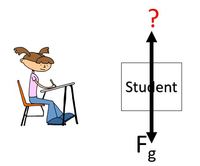
Name the missing force....
Tags
NGSS.MS-PS2-2
NGSS.MS-PS2-4
2.
MULTIPLE CHOICE QUESTION
30 sec • 1 pt
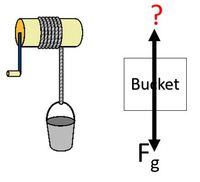
Name the missing force...
Tags
NGSS.3-PS2-1
3.
MULTIPLE CHOICE QUESTION
30 sec • 1 pt

When a cannon fires a cannonball we observe Newton's third law. Which force is the reaction force?
Tags
NGSS.MS-PS2-1
4.
MULTIPLE CHOICE QUESTION
30 sec • 1 pt

An archer pulls the bowstring back, then releases the string and the arrow flies forward. Pulling the string back is the...
Tags
NGSS.MS-PS2-1
5.
MULTIPLE CHOICE QUESTION
2 mins • 1 pt
When gravity pulls a skydiver towards the Earth, the reaction force is...
The skydiver pulling the Earth.
Air resistance
kinetic energy
Tags
NGSS.MS-PS2-4
6.
MULTIPLE CHOICE QUESTION
30 sec • 1 pt

A person pushes against a wall with 15N of force. The wall doesn't move. The wall exerts how much force on the student?
15N
greater than 15N
less than 15N
0N
Tags
NGSS.MS-PS2-1
7.
MULTIPLE CHOICE QUESTION
30 sec • 1 pt

Angela blows air into a balloon and holds the end of it closed with her fingers. When she lets go of the end of the balloon, Angela observes that the release of the air propels the balloon. The propelling of the balloon from the release of the air is an example of which of Newton’s laws?
Tags
NGSS.MS-PS2-1


Access all questions and much more by creating a free account
Create resources
Host any resource
Get auto-graded reports

Continue with Google

Continue with Email

Continue with Classlink

Continue with Clever
or continue with

Microsoft
%20(1).png)
Apple

Others
Already have an account?
Similar Resources on Wayground

10 questions
Fibres

Quiz
•
7th - 9th Grade
10 questions
7.1 The Erosion-Deposition Process
Quiz
•
8th Grade
10 questions
Measuring in cm
Quiz
•
6th - 8th Grade
14 questions
Day and Night 1
Quiz
•
6th - 9th Grade
14 questions
UNIT 1 REVIEW
Quiz
•
8th Grade
10 questions
Rocks revision
Quiz
•
8th Grade
10 questions
Atom, Elements and Compound
Quiz
•
6th - 9th Grade
10 questions
Food Chain-Web
Quiz
•
7th - 8th Grade
Popular Resources on Wayground
15 questions
Fractions on a Number Line
Quiz
•
3rd Grade
10 questions
Probability Practice
Quiz
•
4th Grade
15 questions
Probability on Number LIne
Quiz
•
4th Grade
20 questions
Equivalent Fractions
Quiz
•
3rd Grade
25 questions
Multiplication Facts
Quiz
•
5th Grade
22 questions
fractions
Quiz
•
3rd Grade
6 questions
Appropriate Chromebook Usage

Lesson
•
7th Grade
10 questions
Greek Bases tele and phon
Quiz
•
6th - 8th Grade
Discover more resources for Science
10 questions
Exploring the Rock Cycle

Interactive video
•
6th - 8th Grade
8 questions
Newton's Second Law
Lesson
•
6th - 8th Grade
8 questions
Amoeba Sister Asexual vs Sexual Reproduction
Interactive video
•
8th Grade
10 questions
Exploring the Rock Cycle: Types and Formation
Interactive video
•
6th - 8th Grade
20 questions
Plate Tectonics
Quiz
•
8th Grade
25 questions
Evolution and Natural Selection Review
Quiz
•
6th - 8th Grade
10 questions
Exploring Weathering, Erosion, and Deposition Processes
Interactive video
•
6th - 10th Grade
20 questions
Rock Cycle
Quiz
•
8th Grade