
Bio Test 1 Review
Authored by Karen Chang
Biology
9th - 10th Grade
NGSS covered
Used 7+ times


AI Actions
Add similar questions
Adjust reading levels
Convert to real-world scenario
Translate activity
More...
Content View
Student View
30 questions
Show all answers
1.
MULTIPLE CHOICE QUESTION
45 sec • 1 pt

A sea otter's diet consists mainly of slow-moving fishes and marine invertebrates including crabs, sea urchins, abalones, clams, mussels, and snails. What should happen to the crab and sea urchin population at Tom's Lagoon from 1940 to 2000?
The population should increase and then decrease.
The population should increase.
The population should decrease.
The population should stay the same.
Tags
NGSS.MS-LS2-4
NGSS.MS-LS2-1
2.
MULTIPLE CHOICE QUESTION
45 sec • 1 pt

Which of the following statements account for the change in population seen between years 7 and 8?
The birth rate of the pigeons increased.
The emigration rate of the pigeons decreased.
The death rate of the pigeons exceeded the birth rate.
The neighborhood reached its carrying capacity for the pigeon population
Tags
NGSS.MS-LS2-4
NGSS.MS-LS2-1
3.
MULTIPLE CHOICE QUESTION
30 sec • 1 pt
The five levels of organization in the environment, from the first to the fifth level are
Organism, population, biosphere, ecosystem, community
Organism, population, biotic elements, abiotic elements, community
Organism, population, community, ecosystem, biosphere
Organism, population, biosphere, abiotic elements, ecology
4.
MULTIPLE CHOICE QUESTION
30 sec • 1 pt
Ecologists study different levels of organization within the biosphere. Identify which level corresponds to a group of individuals that belong to the same species and live in the same area.
A: Community
B. Biome
C. Ecosystem
D. Population
5.
MULTIPLE CHOICE QUESTION
30 sec • 1 pt
What growth pattern describes a population whose growth rate slows or stops following a period of exponential growth?
Tags
NGSS.HS-LS2-6
6.
MULTIPLE CHOICE QUESTION
45 sec • 1 pt
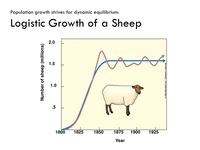
What is the carrying capacity for this sheep population?
Tags
NGSS.MS-LS2-4
NGSS.MS-LS2-1
7.
MULTIPLE CHOICE QUESTION
30 sec • 1 pt

Human population has grown exponentially for several centuries. Which graph best depicts this type of exponential growth?
A
B
C
D
Tags
NGSS.MS-ESS3-4

Access all questions and much more by creating a free account
Create resources
Host any resource
Get auto-graded reports

Continue with Google

Continue with Email

Continue with Classlink

Continue with Clever
or continue with

Microsoft
%20(1).png)
Apple

Others
Already have an account?
Similar Resources on Wayground

30 questions
Central Dogma

Quiz
•
9th - 12th Grade
26 questions
Chemistry of Water
Quiz
•
10th Grade
25 questions
NYS Making Connections
Quiz
•
9th - 12th Grade
25 questions
Enzyme Practice
Quiz
•
9th - 12th Grade
25 questions
Zoologi og conservation - Test
Quiz
•
9th - 12th Grade
25 questions
Seeds Roots Stems
Quiz
•
9th Grade
25 questions
Vitamins and Minerals
Quiz
•
9th - 12th Grade
27 questions
Nervous System/Vitamins
Quiz
•
10th - 12th Grade
Popular Resources on Wayground
8 questions
Spartan Way - Classroom Responsible
Quiz
•
9th - 12th Grade
15 questions
Fractions on a Number Line
Quiz
•
3rd Grade
14 questions
Boundaries & Healthy Relationships

Lesson
•
6th - 8th Grade
20 questions
Equivalent Fractions
Quiz
•
3rd Grade
3 questions
Integrity and Your Health
Lesson
•
6th - 8th Grade
25 questions
Multiplication Facts
Quiz
•
5th Grade
9 questions
FOREST Perception
Lesson
•
KG
20 questions
Main Idea and Details
Quiz
•
5th Grade
Discover more resources for Biology
18 questions
Mendelian Genetics
Quiz
•
10th - 12th Grade
21 questions
Cell Cycle and mitosis
Quiz
•
9th - 10th Grade
20 questions
Food Chains and Food Webs
Quiz
•
7th - 12th Grade
10 questions
Exploring Food Webs and Energy Pyramids

Interactive video
•
6th - 10th Grade
20 questions
Plant structures and tropisms
Quiz
•
9th Grade
55 questions
Category2 SPRING 2026 - STAAR 2.0
Quiz
•
9th - 10th Grade
100 questions
*NEW Biology Benchmark 1 - STAAR 2.0
Quiz
•
9th Grade
72 questions
#Category 4 - STAAR 2.0
Quiz
•
9th - 10th Grade