
Feedback loops
Authored by John Chvatal
Biology
10th - 12th Grade
NGSS covered
Used 2K+ times


AI Actions
Add similar questions
Adjust reading levels
Convert to real-world scenario
Translate activity
More...
Content View
Student View
22 questions
Show all answers
1.
MULTIPLE CHOICE QUESTION
30 sec • 1 pt
What is the point of a feedback loop?
To provide the body with more energy
To provide the body with more food
To make sure the conditions in the body are always changing
To make sure the conditions in the body remain stable
Tags
NGSS.HS-LS1-3
2.
MULTIPLE CHOICE QUESTION
30 sec • 1 pt
A feedback loop best fits which characteristic of life?
Cells
Organization
Homeostasis
Adaptation
Tags
NGSS.HS-LS1-3
3.
MULTIPLE CHOICE QUESTION
30 sec • 1 pt
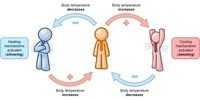
In this body temperature feedback loop, predict what would happen if cooling mechanisms were NOT activated?
The body would not warm up.
The body would not cool down.
Your body would get colder and colder.
Your body would release lots of heat.
Tags
NGSS.HS-LS1-3
4.
MULTIPLE CHOICE QUESTION
30 sec • 1 pt

According to the feedback loop, what does high blood sugar promote?
Insulin Release
Glucagon Release
Insulin Uptake
Glycogen Uptake
Tags
NGSS.HS-LS1-3
5.
MULTIPLE CHOICE QUESTION
30 sec • 1 pt

What happens if stretch receptors are activated in the uterus?
Oxytocin will cause uterine muscles to relax
Contractions will get weaker
The baby will be born later than normal
The brain will signal for the release of oxytocin
Tags
NGSS.HS-LS1-3
6.
MULTIPLE CHOICE QUESTION
30 sec • 1 pt

If the anterior pituitary does not release TSH, what will happen?
Thyroid follicles will not release T3 and T4
The hypothalamus will release TRH
Tags
NGSS.HS-LS1-3
7.
MULTIPLE SELECT QUESTION
30 sec • 1 pt

What is the difference between what will happen if their is too much Glucose or too little Glucose? SELECT ALL THAT APPLY
With too much Glucose, Insulin is released. With too little Glucose, Glucagon is released.
With too much Glucose, the pancreas produces insulin. With too little Glucose, the pancreas produces glucagon.
With too much Glucose, Glucagon is released. With too little Glucose, Insulin is released.
There is no difference.
Tags
NGSS.HS-LS1-3
Access all questions and much more by creating a free account
Create resources
Host any resource
Get auto-graded reports

Continue with Google

Continue with Email

Continue with Microsoft
or continue with

%20(1).png)
Apple

Others
By signing up, you agree to our Terms of Service & Privacy Policy
Already have an account?


