
AP Physics 1 Unit 1-4 Conceptual
Authored by Tara Wodzicki
Physics
11th - 12th Grade
NGSS covered
Used 242+ times


AI Actions
Add similar questions
Adjust reading levels
Convert to real-world scenario
Translate activity
More...
About
This quiz covers fundamental concepts in mechanics, specifically focusing on kinematics, dynamics, energy, and gravitation that form the foundation of AP Physics 1. The content is designed for grades 11-12 and represents the conceptual understanding expected in a calculus-based introductory physics course. Students must demonstrate mastery of Newton's laws of motion, including the ability to analyze equilibrium conditions, force diagrams, and the relationship between net force and acceleration. The energy concepts require students to apply conservation principles, distinguish between kinetic and potential energy, and understand work-energy relationships in various contexts including projectile motion and orbital mechanics. The gravitational physics problems demand understanding of universal gravitation, orbital dynamics, and how gravitational force varies with distance according to the inverse square law. Students need strong conceptual reasoning skills to analyze motion graphs, interpret force diagrams, and apply energy conservation without getting lost in mathematical manipulation. Created by Tara Wodzicki, a Physics teacher in the US who teaches grades 11 and 12. This comprehensive quiz serves as an excellent tool for formative assessment, allowing teachers to gauge student understanding of core mechanics concepts before moving to more advanced topics. The quiz works effectively as a review session before unit exams, as homework to reinforce classroom discussions, or as a warm-up activity to activate prior knowledge at the beginning of related lessons. Teachers can use individual questions to spark classroom discussions about common misconceptions, particularly regarding equilibrium conditions, energy conservation, and gravitational relationships. The format aligns with NGSS standards HS-PS2-1 (analyzing data to support claims about forces and motion), HS-PS2-4 (using mathematical representations of Newton's Law of Gravitation), and HS-PS3-2 (developing models to illustrate energy conservation and transformation), while supporting AP Physics 1 learning objectives for Units 1-4 covering kinematics, dynamics, circular motion, and energy.
Content View
Student View
10 questions
Show all answers
1.
MULTIPLE CHOICE QUESTION
3 mins • 1 pt
A ball is thrown straight up in the air. When the ball reaches its highest point, which of the following is true?
It is in equilibrium.
It has zero acceleration.
C It has maximum momentum.
It has maximum kinetic energy
None of the above
2.
MULTIPLE CHOICE QUESTION
3 mins • 1 pt
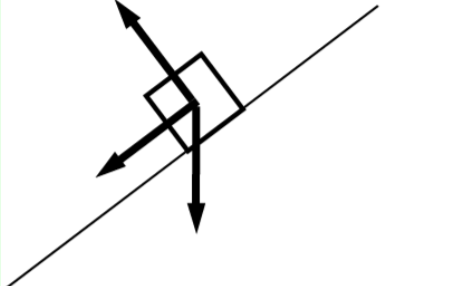
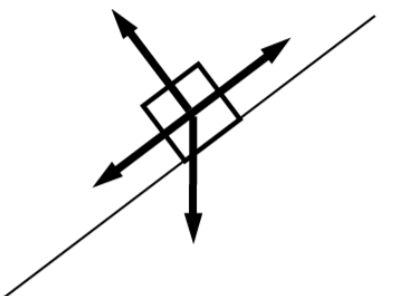
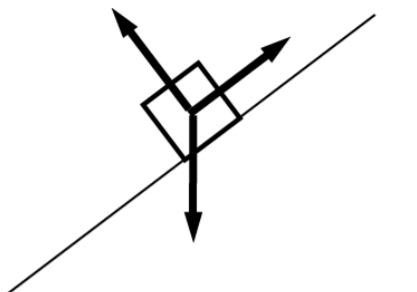
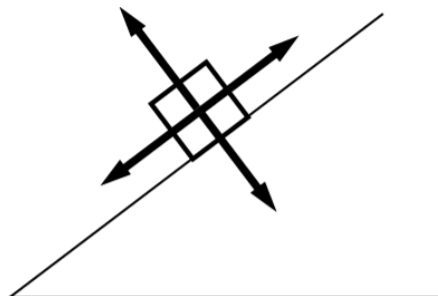
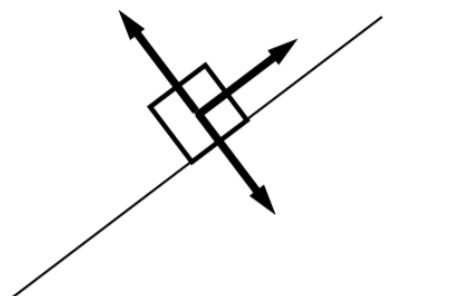
A box is given a sudden push up a ramp. Friction between the box and the ramp is not negligible. Which of the following diagrams best represents the directions of the actual forces acting on the box as it moves upward after the push?
Tags
NGSS.HS-PS2-1
3.
MULTIPLE CHOICE QUESTION
3 mins • 1 pt
A planet of mass m orbits a star of mass M, where m<<M. The orbit is circular, its radius is r, and
its period is T. True statements about the planet’s orbit include which of the following?
I. The orbital speed equals 2πr / T
II. The gravitational force equals GMm / r2
III. If the orbital radius r were greater, T would also be greater.
I only
II only
I and III only
II and III only
I, II, and III
Tags
NGSS.HS-PS2-4
NGSS.HS-ESS1-4
4.
MULTIPLE CHOICE QUESTION
3 mins • 1 pt
While traveling in its elliptical orbit around the Sun, Mars gains speed during the part of the orbit where it is getting closer to the Sun. Which of the following can be used to explain this gain in speed?
As Mars gets closer to the Sun, the Mars–Sun system loses potential energy and Mars gains kinetic energy.
A component of the gravitational force exerted on Mars is perpendicular to the direction of motion, causing an acceleration and hence a gain in speed along that direction.
The torque exerted on Mars by the Sun during this segment of the orbit increases the Mars–Sun system’s angular momentum.
The centripetal force exerted on Mars is greater than the gravitational force during this segment of the orbit, causing Mars to gain speed as it gets closer to the Sun.
Tags
NGSS.HS-PS2-4
NGSS.HS-PS3-2
5.
MULTIPLE CHOICE QUESTION
3 mins • 1 pt
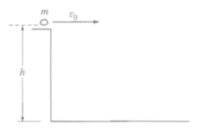
A rock of mass m is thrown horizontally off a building from a height h, as shown above. The speed of the rock as it leaves the thrower's hand at the edge of the building is v.
What is the kinetic energy of the rock just before it hits the ground?
mgh
Tags
NGSS.HS-PS3-1
6.
MULTIPLE CHOICE QUESTION
3 mins • 1 pt
What is the kinetic energy of a satellite of mass in that orbits the Earth, of mass M, in a circular orbit of radius R ?
zero
Tags
NGSS.HS-PS2-4
NGSS.HS-ESS1-4
7.
MULTIPLE CHOICE QUESTION
3 mins • 1 pt

An object is moving in the positive x-direction while a net force directed along the x-axis is exerted on the object. The figure above shows the force as a function of position. What is the net work done on the object over the distance shown?
Tags
NGSS.HS-PS2-1

Access all questions and much more by creating a free account
Create resources
Host any resource
Get auto-graded reports

Continue with Google

Continue with Email

Continue with Microsoft
or continue with

%20(1).png)
Apple

Others
By signing up, you agree to our Terms of Service & Privacy Policy
Already have an account?


