
Chi Square Test of Homogeneity
Authored by Kelly Palmisano
Mathematics
11th - 12th Grade
CCSS covered
Used 3+ times


AI Actions
Add similar questions
Adjust reading levels
Convert to real-world scenario
Translate activity
More...
Content View
Student View
5 questions
Show all answers
1.
MULTIPLE CHOICE QUESTION
45 sec • 1 pt
Is the distribution of music that Californians listen to the same as that of Nevadans? 900 Californians and 600 Nevadans were surveyed.
Tags
CCSS.HSS.ID.B.5
CCSS.HSS.IC.A.1
2.
MULTIPLE CHOICE QUESTION
2 mins • 1 pt

What are the expected counts of a female who likes Pepsi?
Tags
CCSS.HSS.MD.A.2
3.
MULTIPLE CHOICE QUESTION
45 sec • 1 pt
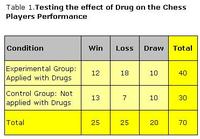
What are the degrees of freedom for the following χ² test?
Tags
CCSS.HSS.CP.A.4
4.
MULTIPLE CHOICE QUESTION
2 mins • 1 pt

In a Chi-Square test, what is the degree of freedom for the table above?
2
4
8
10
5.
MULTIPLE CHOICE QUESTION
3 mins • 1 pt

Recent revenue shortfalls in a midwestern state led to a reduction in the state budget for higher education. To offset the reduction, the largest state university proposed a 25% tuition increase. It was determined that such an increase was needed simply to compensate for the lost support from the state. Separate random samples of 50 freshmen, 50 sophomores, 50 juniors, and 50 seniors from the university were asked whether they were strongly opposed to the increase, given that it was the minimum increase necessary to maintain the university's budget at current levels. The results are in the table provided. Why hypotheses would be appropriate for performing a chi-square test?
Tags
CCSS.HSS.CP.A.4
CCSS.HSS.ID.B.5
CCSS.HSS.CP.A.3
Access all questions and much more by creating a free account
Create resources
Host any resource
Get auto-graded reports

Continue with Google

Continue with Email

Continue with Microsoft
or continue with

%20(1).png)
Apple

Others
By signing up, you agree to our Terms of Service & Privacy Policy
Already have an account?

