
Ecology 1
9th - 10th Grade
•37 Qs

Similar activities
Chemistry of Life
10th - 12th Grade
•41 Qs
Review for DMD Assessment
9th - 12th Grade
•33 Qs
Biology
9th - 10th Grade
•39 Qs
Cell Transport
10th - 12th Grade
•40 Qs
Cell Cycle & Mitosis - Academic
10th Grade
•38 Qs
Biology Chemistry of Life
10th Grade
•38 Qs
Unit 1: Intro to Marine Science
9th - 12th Grade
•39 Qs
Genetics/Heredity 7th Grade
7th - 10th Grade
•35 Qs

Ecology 1

Quiz
•
Biology
•
9th - 10th Grade
•
Medium
+9
Standards-aligned

Laura Rodriguez
Used 55+ times
FREE Resource

Enhance your content in a minute
37 questions
Show all answers
1.
MULTIPLE CHOICE QUESTION
1 min • 1 pt
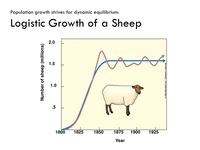
What is the carrying capacity for this sheep population?
Tags
NGSS.MS-LS2-1
NGSS.MS-LS2-4
2.
MULTIPLE CHOICE QUESTION
1 min • 1 pt

When a population grows past the ecosystem's carrying capacity, what happens to the population?
Tags
NGSS.MS-LS2-1
NGSS.MS-LS2-4
3.
MULTIPLE CHOICE QUESTION
1 min • 1 pt

which statement sounds accurate based on the graph data.
Tags
NGSS.MS-LS2-1
NGSS.MS-LS2-2
NGSS.MS-LS2-4
4.
MULTIPLE CHOICE QUESTION
1 min • 1 pt
Which of the following is NOT an example of a Density Dependent Factor?
Parasitism
Natural Disasters
Predation
Competition
Tags
NGSS.HS-LS2-1
5.
MULTIPLE CHOICE QUESTION
1 min • 1 pt
A density-dependent limiting factor only becomes limiting if:
A population begins to decrease in size.
Random events occur in nature.
There are predator-prey interactions.
A population reaches its carrying capacity.
Tags
NGSS.MS-LS2-1
NGSS.MS-LS2-4
6.
MULTIPLE CHOICE QUESTION
1 min • 1 pt
All of the meerkats that live in the same place at the same time make up a ____________.
Community
Ecosystem
Population
Biosphere
Tags
NGSS.HS-LS2-2
NGSS.HS-LS2-8
7.
MULTIPLE CHOICE QUESTION
1 min • 1 pt
______________ is all of the living and nonliving things in a given area.
a population
a community
an ecosystem
the biosphere
Tags
NGSS.MS-LS2-3

Access all questions and much more by creating a free account
Create resources
Host any resource
Get auto-graded reports

Continue with Google

Continue with Email

Continue with Classlink

Continue with Clever
or continue with

Microsoft
%20(1).png)
Apple

Others
Already have an account?
Similar Resources on Wayground
37 questions
Eye structure
Quiz
•
9th - 11th Grade
42 questions
Unit 6 Insta-Review AP Biology APBioPenguins
Quiz
•
10th Grade - University
40 questions
VCE Biology - U1- Transport Through the Membrane
Quiz
•
9th - 11th Grade
35 questions
Membrane Transport
Quiz
•
9th Grade
32 questions
Ecology Quiz
Quiz
•
10th Grade
33 questions
National End-of-Year Test
Quiz
•
10th Grade
34 questions
Cetacean Review
Quiz
•
9th - 12th Grade
41 questions
Forensic DNA/Protein Synthesis/DNA Mutations
Quiz
•
9th Grade
Popular Resources on Wayground
15 questions
Fractions on a Number Line
Quiz
•
3rd Grade
20 questions
Equivalent Fractions
Quiz
•
3rd Grade
25 questions
Multiplication Facts
Quiz
•
5th Grade
22 questions
fractions
Quiz
•
3rd Grade
20 questions
Main Idea and Details
Quiz
•
5th Grade
20 questions
Context Clues
Quiz
•
6th Grade
15 questions
Equivalent Fractions
Quiz
•
4th Grade
20 questions
Figurative Language Review
Quiz
•
6th Grade
Discover more resources for Biology
20 questions
Cell Organelles
Quiz
•
10th Grade
20 questions
Cell Organelles
Quiz
•
9th Grade
20 questions
DNA & Protein Synthesis
Quiz
•
9th Grade
7 questions
Amoeba Sisters Dihybrid Cross Punnett Square

Interactive video
•
9th - 12th Grade
25 questions
photosynthesis and cellular respiration
Quiz
•
9th Grade
20 questions
Human Body Systems
Quiz
•
9th Grade
19 questions
Natural Selection
Quiz
•
9th Grade
20 questions
Pedigree Practice
Quiz
•
9th Grade